. 1997 Jun 10;94(12):6148-52.
doi: 10.1073/pnas.94.12.6148.

Discovery of a second 15S-lipoxygenase in humans

Affiliations

Discovery of a second 15S-lipoxygenase in humans

A R Brash et al. Proc Natl Acad Sci U S A. .

Abstract

The lipoxygenase metabolism of arachidonic acid occurs in specific blood cell types and epithelial tissues and is activated in inflammation and tissue injury. In the course of studying lipoxygenase expression in human skin, we detected and characterized a previously unrecognized enzyme that at least partly accounts for the 15S-lipoxygenase metabolism of arachidonic acid in certain epithelial tissues. The cDNA was cloned from human hair roots, and expression of the mRNA was detected also in prostate, lung, and cornea; an additional 16 human tissues, including peripheral blood leukocytes, were negative for the mRNA. The cDNA encodes a protein of 676 amino acids with a calculated molecular mass of 76 kDa. The amino acid sequence has approximately 40% identity to the known human 5S-, 12S-, and 15S-lipoxygenases. When expressed in HEK 293 cells, the newly discovered enzyme converts arachidonic acid exclusively to 15S-hydroperoxyeicosatetraenoic acid, while linoleic acid is less well metabolized. These features contrast with the previously reported 15S-lipoxygenase, which oxygenates arachidonic acid mainly at C-15, but also partly at C-12, and for which linoleic acid is an excellent substrate. The different catalytic activities and tissue distribution suggest a distinct function for the new enzyme compared with the previously reported human 15S-lipoxygenase.


Figures
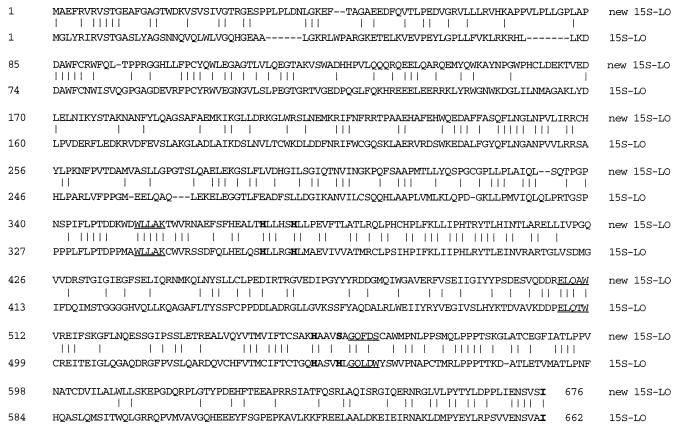
Figure 1
Figure 1
Sequence alignment of human 15S-lipoxygenases. The top line shows the amino acid sequence deduced from the new human lipoxygenase cDNA, in alignment with the sequence of the previously reported human 15S-lipoxygenase (7). The consensus sequences used in PCR cloning are underlined, and five putative iron ligands are in boldface. Two clones of the new cDNA were sequenced: there was a single nucleotide difference (position 1263 in the open reading frame, C or T) which did not change the deduced amino acid sequence. The new cDNA sequence is available in the GenBank/EMBL Data Bank with accession no. U78294U78294.
Figure 2
Figure 2
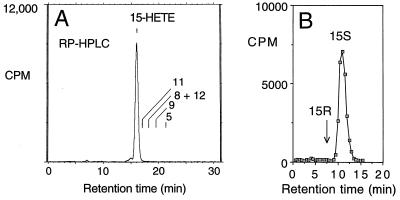
Expression in HEK 293 cells: Identification of the 15S-HETE product. Following transient expression of the cDNA, the HEK 293 cells were sonicated in 50 mM Tris⋅HCl (pH 7.5) containing 100 mM NaCl, then incubated with [14C]arachidonic acid (50 μM) for 30 min at 37°C, and the products were extracted as described (20). (A) Reversed-phase HPLC analysis of the products on a Beckman 5-μm ODS Ultrasphere column (25 × 0.46 cm) with a Bio-Rad 5S ODS guard column, a solvent system of methanol/water/glacial acetic acid (80:20:0.01, by volume) and a flow rate of 1.1 ml/min with on-line detection of radiolabeled products by a Packard Flo-One Radiomatic detector. Retention times of HETE standards are indicated on the chromatogram. The small peak on the front shoulder of the 15-HETE is 15-keto-eicosatetraenoic acid. (B) Chiral analysis of the methyl ester derivative of the 15-HETE product using a Chiralcel OB column with a solvent of hexane/isopropyl alcohol (100:2, vol/vol) and a flow rate of 1.1 ml/min.
Figure 3
Figure 3
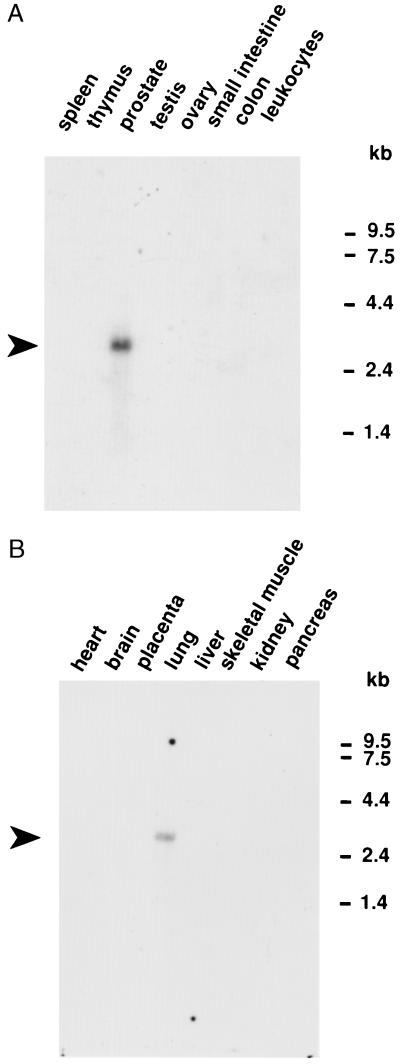
Multiple human tissue RNA blots. Two tissue blots of mRNA (CLONTECH) were probed with a 1,067-bp fragment of the new human lipoxygenase cDNA.
Figure 4
Figure 4
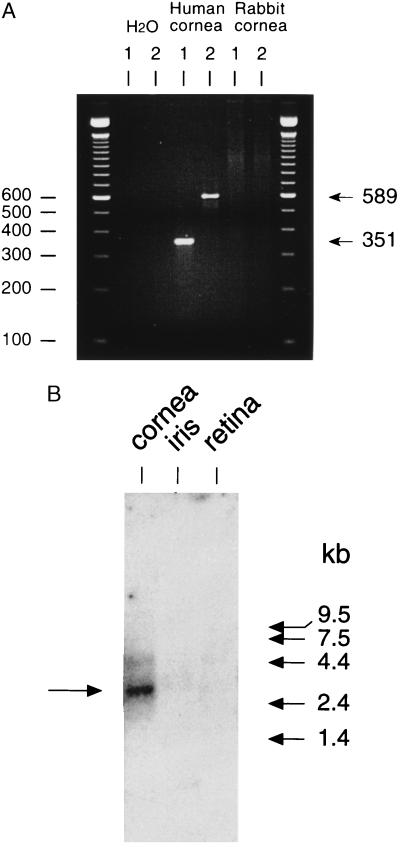
Detection of the new 15S-lipoxygenase transcript in human cornea. (A) RT-PCR. RNA samples were treated with DNase 1, then reverse transcribed to cDNA. PCRs were run using two primer sets (1 and 2) with human cornea cDNA as template, and also with rabbit cornea cDNA and buffer (H2O) alone as negative controls. Bands of the correct sizes, 351 bp and 589 bp, are detected in human cornea; the larger band was subcloned and sequenced, confirming the identity to the lipoxygenase cDNA cloned from skin. (B) Northern analysis of human eye tissues. The band in cornea mRNA at ≈2.5–3 kb corresponds to the new lipoxygenase transcript.

References

    1. Funk C D. Prog Nucleic Acid Res Mol Biol. 1993;45:67–98. - PubMed
    1. Matsumoto T, Funk C D, Radmark O, Hoog J-O, Jornvall H, Samuelsson B. Proc Natl Acad Sci USA. 1988;85:26–30. - PMC - PubMed
    1. Dixon R A F, Jones R E, Diehl R E, Bennet C D, Kargman S, Rouzer C A. Proc Natl Acad Sci USA. 1988;85:416–420. - PMC - PubMed
    1. Funk C D, Furci L, FitzGerald G A. Proc Natl Acad Sci USA. 1990;87:5638–5642. - PMC - PubMed
    1. Izumi T, Hoshiko S, Radmark O, Samuelsson B. Proc Natl Acad Sci USA. 1990;87:7477–7481. - PMC - PubMed

Publication types

MeSH terms

Associated data