. 1997 Jun 24;94(13):6837-41.
doi: 10.1073/pnas.94.13.6837.

Photocarcinogenesis and inhibition of intercellular adhesion molecule 1 expression in cells of DNA-repair-defective individuals

Affiliations

Photocarcinogenesis and inhibition of intercellular adhesion molecule 1 expression in cells of DNA-repair-defective individuals

C Ahrens et al. Proc Natl Acad Sci U S A. .

Abstract

Cells from patients with xeroderma pigmentosum complementation group D (XP-D) and most patients with trichothiodystrophy (TTD) are deficient in excision repair of ultraviolet (UV) radiation-induced DNA damage. Although in both syndromes this defect is based on mutations in the same gene, XPD, only XP-D, not TTD, individuals have an increased risk of skin cancer. Since the reduction in DNA repair capacity is similar in XP-D and TTD patients, it cannot account for the difference in skin cancer risk. The features of XP-D and TTD might therefore be attributable to differences in the immune response following UV-irradiation, a factor which is presumed to be important for photocarcinogenesis. We have measured the capacity of UVB radiation to inhibit expression of the immunological key molecule intercellular adhesion molecule 1 (ICAM-1) in cells from three healthy individuals in comparison to cells from three XP-D and three TTD patients. Cells from XP-D patients, but not from TTD patients, exhibited an increased susceptibility to UVB radiation-induced inhibition of ICAM-1 expression. Transfection of XP-D cells with the wild-type XPD cDNA, but not with XPC cDNA, corrected this abnormal phenotype. Thus, the skin cancer risk in DNA repair-defective individuals correlated with the susceptibility of their cells to UVB radiation-induced inhibition of ICAM-1 expression, rather than with their defect in DNA repair. The XPD protein has dual roles: in DNA repair and transcription. The transcriptional role might be important for the control of expression of immunologically relevant genes and thereby contribute to the skin cancer risk of a DNA-repair-deficient individual.


Figures
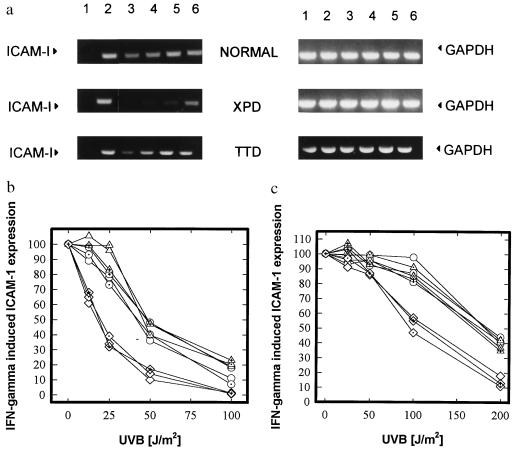
Figure 1
Figure 1
Effect of UVB radiation on the inhibition of IFN-γ-induced ICAM-1 mRNA and surface expression in DNA-repair-deficient versus normal cells. (a) RT-PCR on ICAM-1 (Left) and GAPDH (Right) mRNA expression in normal (N46), XP-D (XP16BR), and TTD (TTD1BEL) cells. Cells were left unstimulated (lane 1) or stimulated with rhIFN-γ (lanes 2–6). In lanes 1 and 2, cells were sham irradiated, in lanes 3–6, cells were exposed to decreasing doses of UVB radiation (lane 3, 100 J/m2; lane 4, 50 J/m2; lane 5, 25 J/m2; and lane 6, 12.5 J/m2). IFN-γ (500 units/ml) was added immediately after UVB radiation exposure and cells were harvested after a 4-h incubation period. Data are shown as fluorescence of ethidium bromide-stained gels and represent one of three essentially identical experiments. (b) Summary of RT-PCR results from three XPD (⋄), three normal (○), and three TTD (▵) cell strains. IFN-γ-induced ICAM-1 mRNA expression is given as percent of ICAM-1 mRNA expression in sham-irradiated, IFN-γ-stimulated cells and is plotted against UVB radiation (J/m2). Each curve represents mean values of three independent experiments. Standard deviation for each mean was less than ±15%. (c) Summary of FACS analysis results from three XPD (⋄), three normal (○), and three TTD (▵) cell strains. IFN-γ was added immediately after UVB radiation exposure and cells were harvested after a 24-h incubation period. IFN-γ-induced ICAM-1 surface expression is given as percent of ICAM-1 surface expression in sham-irradiated, IFN-γ-stimulated cells and plotted against UVB radiation (J/cm2). Each curve represents mean values of three independent experiments. Standard deviation for each mean was less than ±15%.
Figure 2
Figure 2
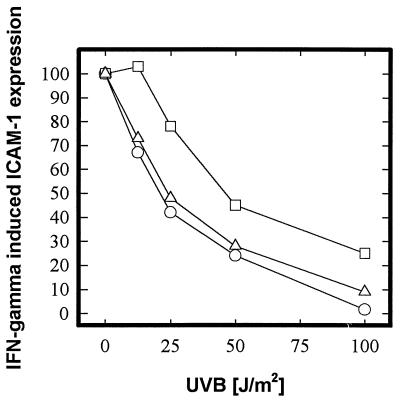
Effect of UVB radiation on inhibition of IFN-γ-induced ICAM-1 mRNA expression in genetically engineered XP-D cells. Summary of RT-PCR results from XP-D cells transfected with functional XPD cDNA (□), nontransfected XPD cells (○), and XP-D cells transfected with XPC cDNA (▵). Suppression of IFN-γ-induced mRNA expression is given as percent of ICAM-1 mRNA expression in sham-irradiated, IFN-γ-stimulated cells and is plotted against UVB radiation (J/m2). Each curve represents mean values (SD < 15%) of three independent experiments.

References

    1. Miller D L, Weinstock M A. J Am Acad Dermatol. 1994;27:774–778. - PubMed
    1. Ziegler A, Lefell D J, Kunala S, Sharma H W, Gailani M, Simon J A, Halperin A J, Baden H P, Shapiro P E, Bale A E, Brash D E. Proc Natl Acad Sci USA. 1993;90:4216–4220. - PMC - PubMed
    1. Kripke M L. Immunol Rev. 1984;80:87–102. - PubMed
    1. Kripke M L. J Natl Cancer Inst. 1974;53:1333–1336. - PubMed
    1. Greene M H, Young T I, Clark J W H. Lancet. 1974;i:1196–1198.

Publication types

MeSH terms

Substances