. 1997 Jul 8;94(14):7239-44.
doi: 10.1073/pnas.94.14.7239.

Requirement of STAT5b for sexual dimorphism of body growth rates and liver gene expression

Affiliations

Requirement of STAT5b for sexual dimorphism of body growth rates and liver gene expression

G B Udy et al. Proc Natl Acad Sci U S A. .

Abstract

The signal transducer and activator of transcription, STAT5b, has been implicated in signal transduction pathways for a number of cytokines and growth factors, including growth hormone (GH). Pulsatile but not continuous GH exposure activates liver STAT5b by tyrosine phosphorylation, leading to dimerization, nuclear translocation, and transcriptional activation of the STAT, which is proposed to play a key role in regulating the sexual dimorphism of liver gene expression induced by pulsatile plasma GH. We have evaluated the importance of STAT5b for the physiological effects of GH pulses using a mouse gene knockout model. STAT5b gene disruption led to a major loss of multiple, sexually differentiated responses associated with the sexually dimorphic pattern of pituitary GH secretion. Male-characteristic body growth rates and male-specific liver gene expression were decreased to wild-type female levels in STAT5b-/- males, while female-predominant liver gene products were increased to a level intermediate between wild-type male and female levels. Although these responses are similar to those observed in GH-deficient Little mice, STAT5b-/- mice are not GH-deficient, suggesting that they may be GH pulse-resistant. Indeed, the dwarfism, elevated plasma GH, low plasma insulin-like growth factor I, and development of obesity seen in STAT5b-/- mice are all characteristics of Laron-type dwarfism, a human GH-resistance disease generally associated with a defective GH receptor. The requirement of STAT5b to maintain sexual dimorphism of body growth rates and liver gene expression suggests that STAT5b may be the major, if not the sole, STAT protein that mediates the sexually dimorphic effects of GH pulses in liver and perhaps other target tissues. STAT5b thus has unique physiological functions for which, surprisingly, the highly homologous STAT5a is unable to substitute.


Figures
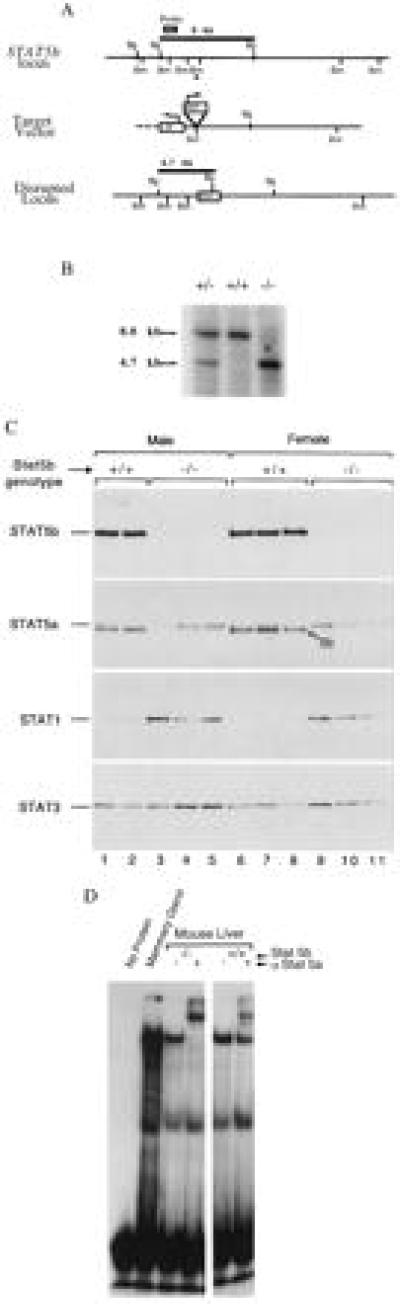
Figure 1
Figure 1
Targeted disruption of the murine STAT5b gene. (A) Targeting vector and recombination at STAT5b locus, with restriction sites for BamHI (Bm) and BglII (Bg). Two contiguous STAT5b gene BamHI fragments (0.9 kb, 12 kb) were used to construct the positive/negative selection vector. The neor cassette was inserted at a BamHI site (∗), and the HSV tk gene was used for negative selection. The probe used for Southern blot analyses (1-kb ApaI/EcoRV fragment) and the expected BglII restriction fragments are indicated. (B) Southern blot of wild-type (+/+), heterozygous (+/−), and STAT5b−/− (−/−) DNA using probe shown in A. (C) Western blot probed sequentially for the indicated STAT proteins in liver cytosols of STAT5b−/− and wild-type mice. Small arrow on second panel points to STAT5b, which apparently cross-reacts with anti-STAT5a at the extended exposure required to detect STAT5a in these liver samples. No cross-reactivity between STATs 1, 3, and 5 is detected using these antibodies (11). (D) Gel-shift analysis of liver nuclear STAT5 DNA-binding activity from wild-type and STAT5b−/− mice in the absence or presence of a supershifting anti-STAT5a antibody (α STAT5a). Lane 2, lactating goat mammary gland extract, a positive control for activated STAT5.
Figure 2
Figure 2
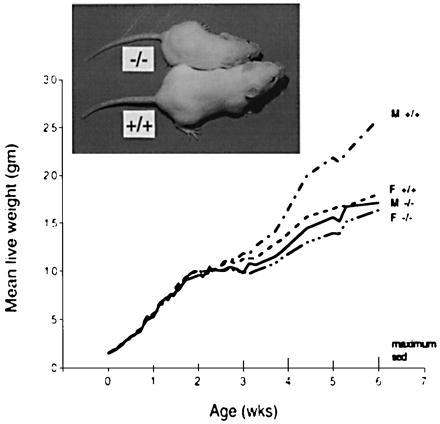
Growth curves of wild-type (+/+) and STAT5b−/− (−/−) mice, and 42-day-old wild-type and STAT5b−/− males from the same litter (Insert). Body weights of wild-type males were significantly different from STAT5b−/− males (M) and females (F) (P ≤ 0.001). No significant differences were seen between STAT5b−/− males, wild-type females, and STAT5b−/− females. Standard errors of differences (SED) are indicated on the x axis.
Figure 3
Figure 3
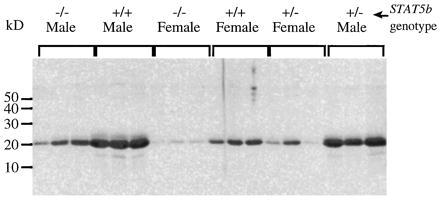
SDS gel analysis of MUP in urine of wild-type (+/+), STAT5b+/− (+/−), and STAT5b−/− (−/−) mice stained with Coomassie blue. Densitometric analysis revealed statistically significant differences between the wild type and knockout for both male genotypes (P < 0.005 for +/+ vs. +/− and +/+ vs. −/−) and female genotypes (P < 0.02 for +/+ vs. −/−). Other comparisons within each sex were not significant (P > 0.05; two-tailed Student’s t test).
Figure 4
Figure 4
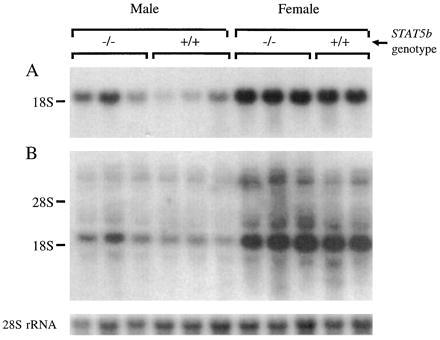
Northern blots showing relative levels of CYP15α/2A4 (A) and prolactin receptor mRNA (B), and 28S rRNA (Bottom). The mean ± SEM relative mRNA levels (normalized using 28S rRNA) for STAT5b−/− males, wild-type males, STAT5b−/− females, and wild-type females were, respectively, 1.04 ± 0.26, 0.30 ± 0.13, 2.13 ± 0.11, and 1.92 ± 0.15 for CYP15α, and 1.10 ± 0.20, 0.42 ± 0.10, 2.47 ± 0.17, and 2.36 ± 0.08 for the 2.5-kb short form of prolactin receptor.
Figure 5
Figure 5
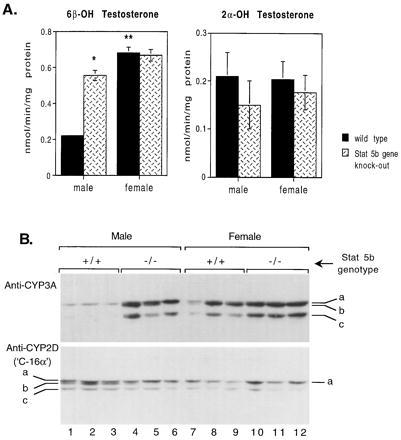
CYP-catalyzed testosterone hydroxylase enzyme activity (A) and CYP protein levels (B) in liver microsomes from STAT5b wild-type and knockout mice. (A) Specific activities are mean ± SEM values for n = 5–6 individual mice per group. ∗, significant difference from wild-type at P ≤ 0.05; ∗∗, significant difference from male at P ≤ 0.05 (two-tailed Student’s t test). Error bar is too small to be seen for the first sample in A. (B) Western blot of CYP3A and CYP2D proteins. Shown at Top are three CYP3A-immunoreactive proteins detected using anti-rat CYP3A antibody; bands marked b and c are both female-dominant and are increased in male STAT5b−/− mice. Shown at Bottom are three CYP2D-immunoreactive proteins detected using anti-mouse C-P45016α antibody; band b exhibits the male predominance reported for the C-P45016α (5) and is decreased to female levels in male STAT5b−/− mice.

References

    1. Isaksson O G, Eden S, Jansson J O. Annu Rev Physiol. 1985;47:483–499. - PubMed
    1. Carter-Su C, Schwartz J, Smit L S. Annu Rev Physiol. 1996;58:187–207. - PubMed
    1. Norstedt G, Palmiter R. Cell. 1984;36:805–812. - PubMed
    1. Kelly P A, Ali S, Rozakis M, Goujon L, Nagano M, et al. Recent Prog Horm Res. 1993;48:123–164. - PubMed
    1. Noshiro M, Negishi M. J Biol Chem. 1986;261:15923–15927. - PubMed

Publication types