. 1997 Jul 8;94(14):7251-6.
doi: 10.1073/pnas.94.14.7251.

Multiprotein bridging factor 1 (MBF1) is an evolutionarily conserved transcriptional coactivator that connects a regulatory factor and TATA element-binding protein

Affiliations

Multiprotein bridging factor 1 (MBF1) is an evolutionarily conserved transcriptional coactivator that connects a regulatory factor and TATA element-binding protein

K i Takemaru et al. Proc Natl Acad Sci U S A. .

Abstract

Multiprotein bridging factor 1 (MBF1) is a transcriptional cofactor that bridges between the TATA box-binding protein (TBP) and the Drosophila melanogaster nuclear hormone receptor FTZ-F1 or its silkworm counterpart BmFTZ-F1. A cDNA clone encoding MBF1 was isolated from the silkworm Bombyx mori whose sequence predicts a basic protein consisting of 146 amino acids. Bacterially expressed recombinant MBF1 is functional in interactions with TBP and a positive cofactor MBF2. The recombinant MBF1 also makes a direct contact with FTZ-F1 through the C-terminal region of the FTZ-F1 DNA-binding domain and stimulates the FTZ-F1 binding to its recognition site. The central region of MBF1 (residues 35-113) is essential for the binding of FTZ-F1, MBF2, and TBP. When the recombinant MBF1 was added to a HeLa cell nuclear extract in the presence of MBF2 and FTZ622 bearing the FTZ-F1 DNA-binding domain, it supported selective transcriptional activation of the fushi tarazu gene as natural MBF1 did. Mutations disrupting the binding of FTZ622 to DNA or MBF1, or a MBF2 mutation disrupting the binding to MBF1, all abolished the selective activation of transcription. These results suggest that tethering of the positive cofactor MBF2 to a FTZ-F1-binding site through FTZ-F1 and MBF1 is essential for the binding site-dependent activation of transcription. A homology search in the databases revealed that the deduced amino acid sequence of MBF1 is conserved across species from yeast to human.


Figures
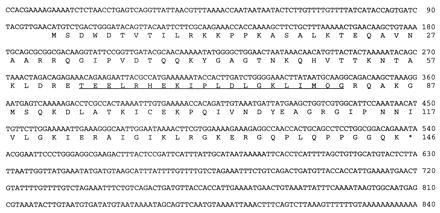
Figure 1
Figure 1
Sequence of MBF1 cDNA. Nucleotide sequence of the longest cDNA insert is shown. The predicted amino acid sequence of the factor is presented in single-letter code. The experimentally determined amino acid sequence is underlined. The asterisk represents the putative stop codon.
Figure 5
Figure 5
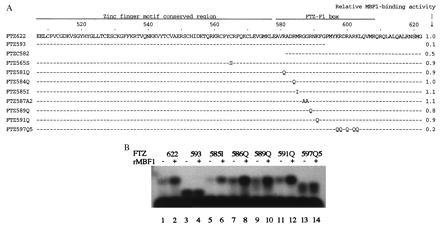
(A) MBF1-binding activities of FTZ622 mutants. Numbers on the top line represent amino acid positions within FTZ-F1 (16). Bars indicate sequences identical to those of FTZ-F1. Positions of amino acid substitutions are indicated by letters representing the substituted amino acids. Each peptide has a methionine at the N terminus (data not shown). GST assays for the binding of rMBF1 to FTZ622 or its mutants were carried out as described in Fig. 4B except that nonradioactive polypeptides were used in place of [32P]FTZ622. For each deletion mutant, the amount of input polypeptide was adjusted according to its molecular mass. Band intensities of bound FTZ622 or its derivatives were quantitated as described in Materials and Methods and divided by the corresponding input intensity. This value for each mutant in relation to that for FTZ622 is shown as relative MBF1-binding activity. (B) Interactions between MBF1 and FTZ622 mutants inferred from the MBF1-mediated increase of the DNA binding. The binding of FTZ622 or its mutants to the [32P]FTZ-F1-binding site probe was analyzed as described in Fig. 4A. Where indicated, the binding mixture contained 25 ng of his-tag MBF1.
Figure 2
Figure 2
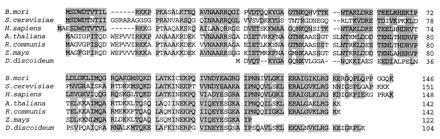
Evolutional conservation of the MBF1 sequence. The predicted amino acid sequence of MBF1 is compared with the homologous sequences in the databases. The amino acid sequences have been conceptually translated from the nucleotide sequences with accession numbers T38224 (Saccharomyces cerevisiae), T74845 (Homo sapiens), Z29020 (Arabidopsis thaliana), Z49698 (Ricinus communis), T14752 (Zea mays), and X15385 (Dictyostelium discoideum). Identical or similar amino acids are shadowed. Bars represent gaps.
Figure 3
Figure 3
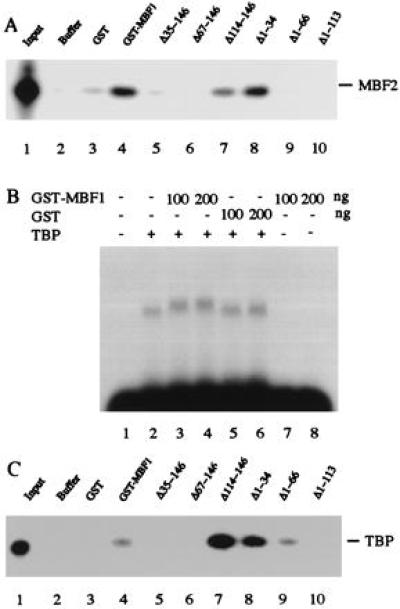
Protein–protein interactions through MBF1. (A) GST assay for the binding of rMBF1 to rMBF2. Approximately 20 ng of [32P]rMBF2 was incubated with buffer alone (lane 2), 200 ng of GST (lane 3), or each 200 ng of GST–MBF1 or its deletion derivative (lanes 4–10). The bound rMBF2 was collected using glutathione-Sepharose beads and analyzed by 12 % SDS/PAGE (Tricine buffer system). Lane 1, input [32P]rMBF2. (B) Electrophoresis mobility shift assay for the binding of rMBF1 to rTBP. 32P-labeled double-stranded oligonucleotide bearing the TATA element of the ftz gene was incubated with GST or GST–MBF1 fusion protein in the presence or absence of 6 ng of rhTBP. The specific protein⋅DNA complexes were resolved by electrophoresis on a 1% agarose gel containing 2 mM MgCl2. (C) GST assay for the binding of rMBF1 to rTBP. The assay was performed as in A except that [32P]rhTBP was used in place of [32P]rMBF2 and that electrophoresis was performed on an SDS/10% polyacrylamide gel. Lane 1, input [32P]rhTBP
Figure 4
Figure 4
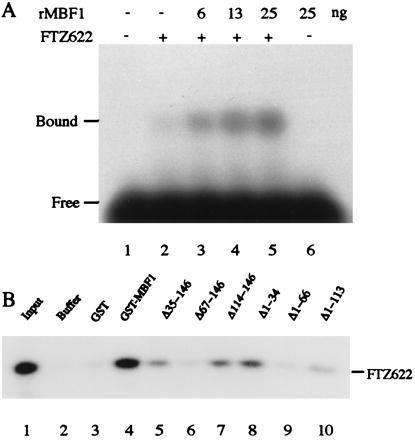
Interactions between MBF1 and FTZ-F1. (A) rMBF1 increases the DNA binding of FTZ622. The binding of FTZ622 to a 32P-labeled double-stranded oligonucleotide carrying the FTZ-F1 recognition site was analyzed by electrophoresis mobility shift assay. Each binding mixture containing 0.2 ng of FTZ622 and indicated amounts of his-tag MBF1 was incubated at 25°C for 30 min. The specific protein⋅DNA complexes were resolved by electrophoresis on a 1% agarose gel. (B) GST assay for the binding of rMBF1 to FTZ622. [32P]FTZ622 (20 ng) was incubated with buffer alone (lane 2), 200 ng of GST (lane 3), or each 200 ng of GST–MBF1 or its deletion derivative (lanes 4–10). The bound FTZ622 was collected and analyzed by 12% SDS/PAGE (Tricine buffer system). Lane 1, input [32P]FTZ622.
Figure 6
Figure 6
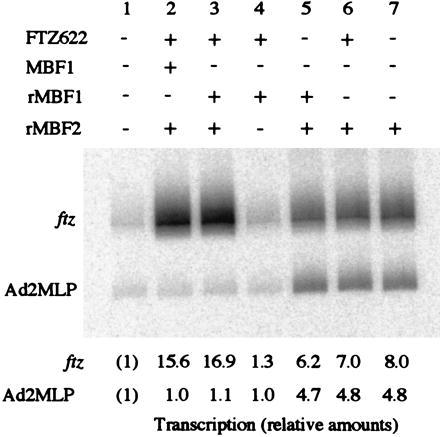
rMBF1 supports selective activation of ftz transcription. The ftz gene and Ad2MLP were transcribed in a HeLa cell nuclear extract. Where indicated, the reaction mixture contained 50 ng of either the natural MBF1 or his-tag MBF1. The relative levels of transcription are shown at the bottom.
Figure 7
Figure 7
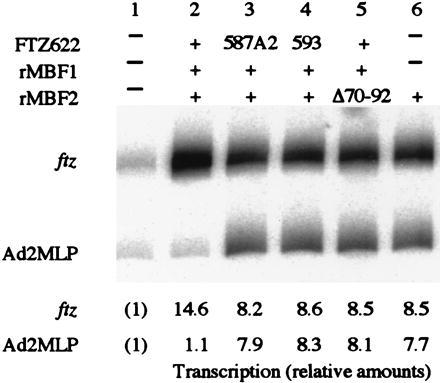
Selective activation of ftz transcription requires DNA–FTZ622, FTZ622–MBF1, and MBF1–MBF2 interactions. The ftz gene and Ad2MLP were transcribed in a HeLa cell nuclear extract. Where indicated, the transcription mixture contained 50 ng of the histidine-tagged recombinant factors.

References

    1. Johnson P, McKnight S. Annu Rev Biochem. 1989;58:799–839. - PubMed
    1. Mitchell P J, Tjian R. Science. 1989;245:371–378. - PubMed
    1. Lewin B. Cell. 1990;61:1161–1164. - PubMed
    1. Roeder R G. Trends Biochem Sci. 1991;16:402–408. - PubMed
    1. Kamei Y, Xu L, Heinzel T, Torchia J, Kurokawa R, Gloss B, Lim S-C, Heyman R A, Rose D W, Glass C K, Rosenfeld M G. Cell. 1996;85:403–414. - PubMed

Publication types

MeSH terms

Substances

Associated data

LinkOut - more resources