. 1997 Jul 22;94(15):7761-7.
doi: 10.1073/pnas.94.15.7761.

Incipient species formation in salamanders of the Ensatina complex

Affiliations

Incipient species formation in salamanders of the Ensatina complex

D B Wake. Proc Natl Acad Sci U S A. .

Abstract

The Ensatina eschscholtzii complex of plethodontid salamanders, a well-known "ring species," is thought to illustrate stages in the speciation process. Early research, based on morphology and coloration, has been extended by the incorporation of studies of protein variation and mitochondrial DNA sequences. The new data show that the complex includes a number of geographically and genetically distinct components that are at or near the species level. The complex is old and apparently has undergone instances of range contraction, isolation, differentiation, and then expansion and secondary contact. While the hypothesis that speciation is retarded by gene flow around the ring is not supported by molecular data, the general biogeographical hypothesis is supported. There is evidence of a north to south range expansion along two axes, with secondary contact and completion of the ring in southern California. Current research targets regions once thought to show primary intergradation, but which molecular markers reveal to be zones of secondary contact. Here emphasis is on the subspecies E. e. xanthoptica, which is involved in four distinct secondary contacts in central California. There is evidence of renewed genetic interactions upon recontact, with greater genetic differentiation within xanthoptica than between it and some of the interacting populations. The complex presents a full array of intermediate conditions between well-marked species and geographically variable populations. Geographically differentiated segments represent a diversity of depths of time of isolation and admixture, reflecting the complicated geomorphological history of California. Ensatina illustrates the continuing difficulty in making taxonomic assignments in complexes studied during species formation.


Figures
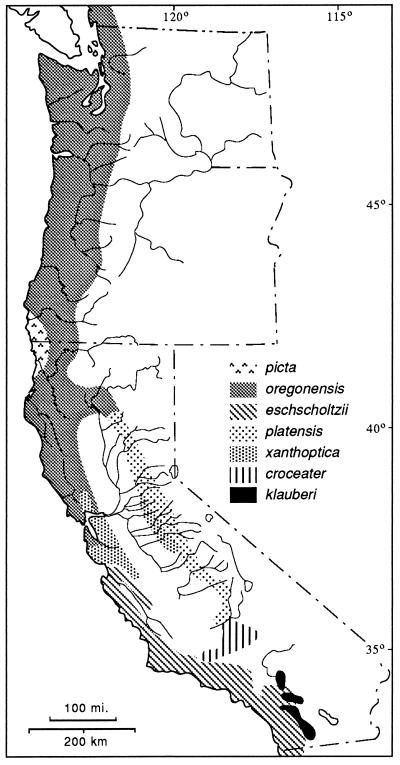
Figure 1
Figure 1
The Ensatina complex, showing distribution of taxa recognized by Stebbins (7), but with borders based on molecular markers rather than morphological traits.
Figure 2
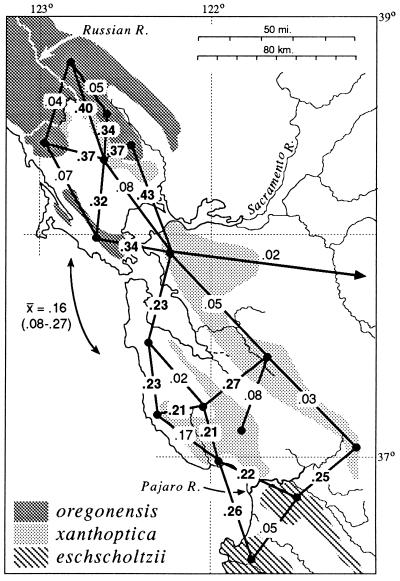
Figure 2
Distribution of taxa of Ensatina in the San Francisco Bay region, showing D (21) based on allozyme data between selected neighboring populations. Bold face type, D between taxa; normal type, D within taxa. The mean and range of D between North Bay and South Bay oregonensis is shown.
Figure 3
Figure 3
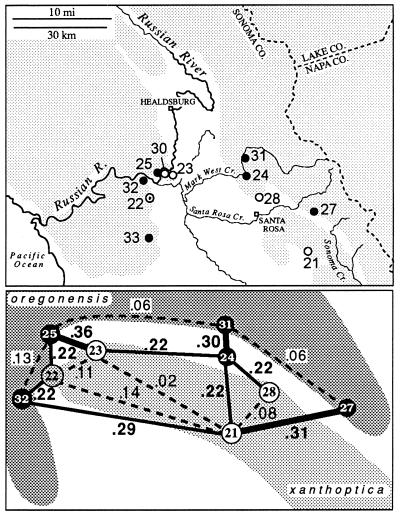
The xanthoptica–oregonensis contact zone north of San Francisco Bay in the Santa Rosa–Russian River area. Populations 22 and 24 are intermediate in nature. D values between selected populations are indicated. Shading in upper part of figure indicates wooded land.
Figure 4
Figure 4
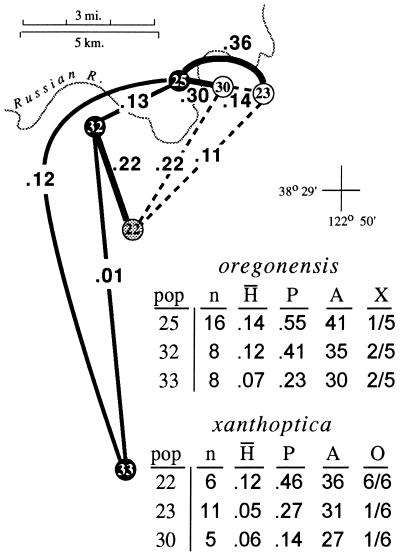
Expansion of Fig. 3, showing the Russian River contact zone. Populations are sorted by taxon, but population 22 is intermediate in most respects. pop, Population number in study three; n, sample size; H̄, mean heterozygosity (direct count); P, proportion of loci polymorphic; A, number of alleles in 22 allozymic loci; X, fraction of xanthoptica marker alleles present in populations assigned to oregonensis; O, fraction of oregonensis marker alleles in populations assigned to xanthoptica.
Figure 5
Figure 5
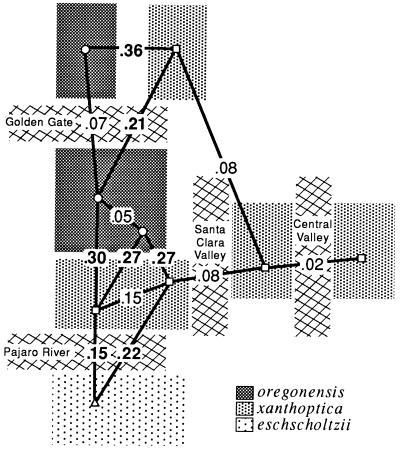
Modern barriers to dispersal in the San Francisco Bay area for taxa discussed in this paper. Genetic distances between selected populations indicated on lines connecting them. Bold D values are between taxa.
Figure 6
Figure 6
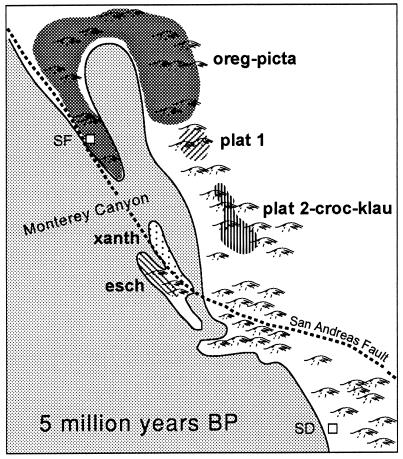
Hypothetical distribution of the Ensatina complex ≈5 million years before present. Based on reconstruction of California paleogeography by Yanev (27). Approximate location of precursors to genetically defined units within the Ensatina complex are indicated. oreg-picta, oregonensis and picta; plat 1, northern platensis (15, 17); plat 2-croc-klau, southern platensis plus croceater plus klauberi (15, 17); xanth, xanthoptica; esch, eschscholtzii; SF, approximate position of present day San Francisco; SD, approximate position of present-day San Diego. The approximate positions of the San Andreas Fault and Monterey Canyon (the latter at the outflow of the Pajaro and Salinas Rivers) are indicated.
Figure 7
Figure 7
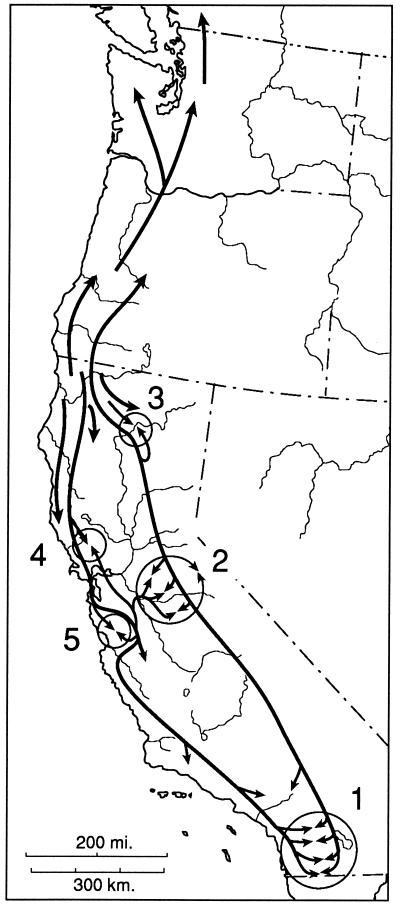
Historical biogeographic interpretation for the Ensatina complex. Five zones of secondary interaction are shown. 1, Interaction of klauberi and eschscholtzii. 2, Complex interaction between northern and southern platensis and of these interactors with xanthoptica in the central Sierra Nevada. 3, Interaction of oregonensis and northern platensis in the Lassen Peak area. 4, North Bay interaction of oregonensis and xanthoptica. 5, South Bay interaction of oregonensis and xanthoptica and of xanthoptica and eschscholtzii.

References

    1. Dobzhansky T. Genetics and the Origin of Species. New York: Columbia Univ. Press; 1937.
    1. Mayr E. Systematics and the Origin of Species. New York: Columbia Univ. Press; 1942.
    1. Ghiselin M. Syst Zool. 1974;23:536–544.
    1. Avise J C, Wollenberg K. Proc Natl Acad Sci USA. 1997;94:7748–7755. - PMC - PubMed
    1. deQueiroz K. In: Endless Forms: Species and Speciation. Berlocher S, Howard D, editors. Oxford: Oxford Univ. Press; 1997. , in press.

Publication types

LinkOut - more resources