. 1997 Jul 22;94(15):7982-6.
doi: 10.1073/pnas.94.15.7982.

An important developmental role for oligosaccharides during early embryogenesis of cyprinid fish

Affiliations

An important developmental role for oligosaccharides during early embryogenesis of cyprinid fish

J Bakkers et al. Proc Natl Acad Sci U S A. .

Abstract

Derivatives of chitin oligosaccharides have been shown to play a role in plant organogenesis at nanomolar concentrations. Here we present data which indicate that chitin oligosaccharides are important for embryogenesis in vertebrates. We characterize chitin oligosaccharides synthesized in vitro by zebrafish and carp embryos in the late gastrulation stage by incorporation of radiolabeled N-acetyl-D-[U14C]glucosamine and by HPLC in combination with enzymatic conversion using the Bradyrhizobium NodZ alpha-1, 6-fucosyltransferase and chitinases. A rapid and sensitive bioassay for chitin oligosaccharides was also used employing suspension-cultured plant cells of Catharanthus roseus. We show that chitin oligosaccharide synthase activity is apparent only during late gastrulation and can be inhibited by antiserum raised against the Xenopus DG42 protein. The DG42 protein, a glycosyltransferase, is transiently expressed between midblastula and neurulation in Xenopus and zebrafish embryogenesis. Microinjection of the DG42 antiserum or the Bradyrhizobium NodZ enzyme in fertilized eggs of zebrafish led to severe defects in trunk and tail development.


Figures
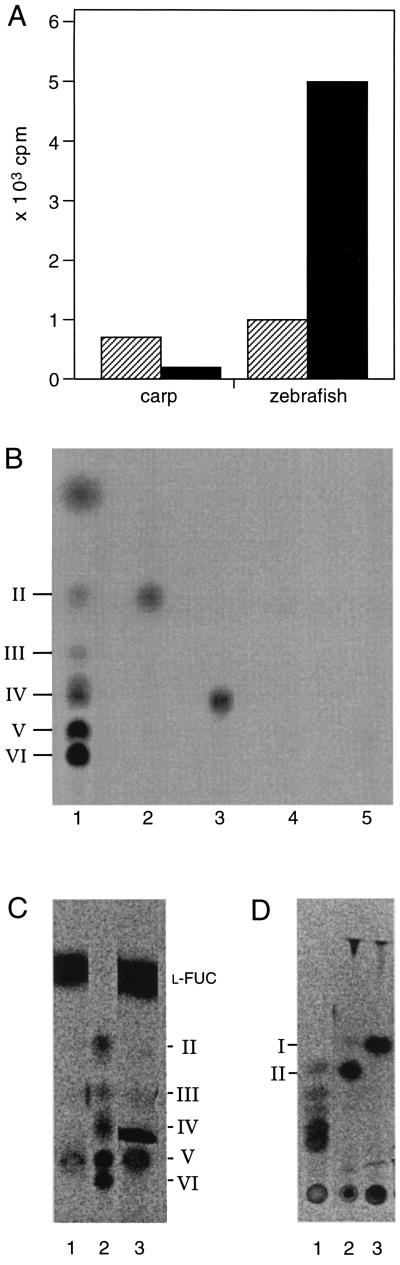
Figure 1
Figure 1
Radiolabeling of gastrulation-specific metabolites. Extracts of zebrafish or carp embryos from the gastrulation stage were incubated in the presence of radiolabeled or unlabeled UDP-GlcNAc (see Materials and Methods). (A) Incorporation of UDP-[U14C]GlcNAc into HPLC fractions with retention times similar to chitin tetraose (striped box) and chitin pentaose (filled box). In the incubations where unlabeled UDP-GlcNAc was used, the equivalent fractions were incubated with the NodZ protein in the presence of GDP-[U-14C]fucose. By using this assay it is possible to specifically detect chitin oligosaccharides at concentrations as low as 1 picomol (data not shown). The pooled fractions were used for chitinase and chitobiase treatments and separated on TLC (BD). (B) Radiolabeling of metabolites obtained from carp embryos and separated by HPLC, using the NodZ transfucosylation assay. Lanes: 1, fucosylated chitin oligosaccharide standards (as described in ref. 4); 2 and 3, HPLC fractions with retention times similar to chitin tetraose after transfucosylation, incubated with chitinase (lane 2) or without chitinase (lane 3); 4 and 5, HPLC fractions with retention times similar to chitin pentaose after transfucosylation, incubated with chitinase (lane 4) or without chitinase (lane 5). (C and D) Radiolabeling of metabolites obtained from zebrafish embryos using the NodZ transfucosylation assay. Fucosylated chitin oligosaccharide standards (C, lane 2; and D, lane 1); HPLC fractions with retention times similar to chitin pentaose after transfucosylation {C, lanes 1 and 3 (without removing free GDP-[U-14C]fucose)} incubated with chitinase (D, lane 2), or incubated with chitinase and chitobiase (from Streptomyces griseus, Sigma) (D, lane 3).
Figure 2
Figure 2
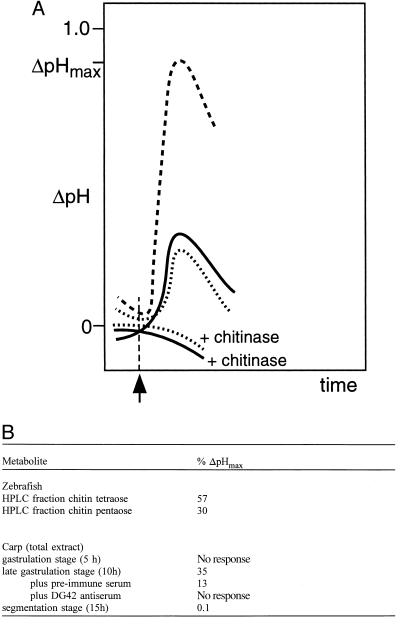
Induction of an alkalinization response of a C. roseus plant cell suspension by in vitro synthesized metabolites of zebrafish and carp embryos (see Material and Methods). (A) Typical response curve obtained with metabolites from gastrulation stage zebrafish embryos (arrow, the time point of addition; dotted line, fractions with retention times similar to chitin tetraose; solid line, fractions with retention times similar to chitin pentaose; dashed line, maximal pH shift obtained by adding 0.3 μg of chitin tetraose). (B) Alkalinization response of metabolites synthesized in vitro by embryo extracts at early gastrulation stage, late gastrulation stage, and segmentation stage, indicated as a percentage of the maximal pH shift (%ΔpHmax). Results shown are from experiments independent of those shown in A. This indicates a variation of approximately 20% in the alkalinization assay. Indicated also are the results obtained with extracts of late gastrulation stage embryos that were pre-incubated with DG42 antiserum or preimmune serum.
Figure 3
Figure 3
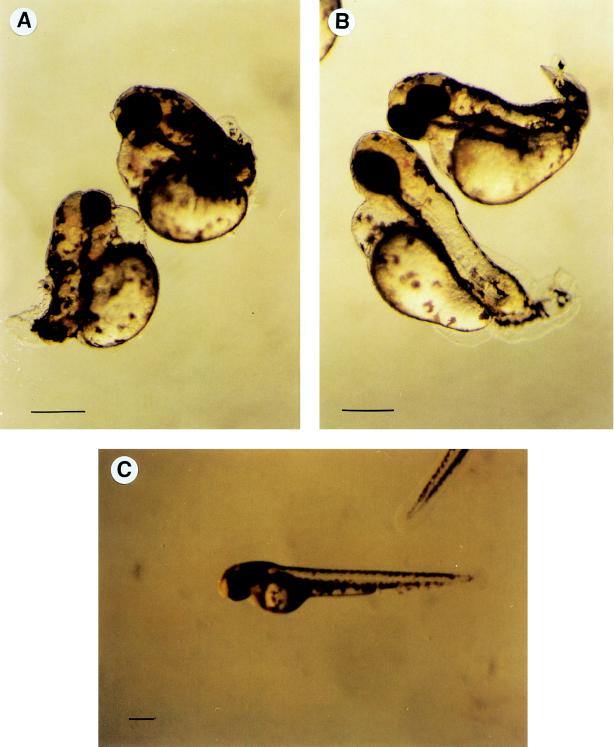
Results of microinjection experiments in zebrafish. All embryos shown are 48 h old and represent typical examples. (A) Embryos injected with DG42 antiserum. Sixty-one percent of the embryos (n = 288) were consistently and reproducibly affected in the formation of the trunk and tail. (B) Embryos injected with NodZ protein. Sixty-nine percent of the injected embryos (n = 106) show defects similar to those observed after injection of the DG42 antiserum. As a control, embryos were injected with an identical preparation of NodZ protein inactivated prior to injection by boiling for 5 min. Sixteen percent of these controls (n = 98) were affected, although the defects observed are nonspecific and do not resemble those seen when injecting the active protein (data not shown). (C) Control embryos injected with rabbit preimmune serum. Five percent of control embryos (n = 116) were affected by the injection procedure, but the observed defects were not specific. (Bars = 250 μm.)

References

    1. Lerouge P, Roche P, Faucher C, Maillet F, Truchet G, Promé J C, Dénarié J. Nature (London) 1990;344:781–784. - PubMed
    1. Spaink H P, Sheeley D M, van Brussel A A N, Glushka J, York W S, Tak T, Geiger O, Kennedy E P, Reinhold V N, Lugtenberg B J J. Nature (London) 1991;354:125–130. - PubMed
    1. van Brussel A A N, Bakhuizen R, van Spronsen P C, Spaink H P, Tak T, Lugtenberg B J J, Kijne J W. Science. 1992;257:70–72. - PubMed
    1. Quinto C, Wijfjes A H M, Bloemberg G V, Blok-Tip L, López-Lara I M, Lugtenberg B J J, Thomas-Oates J E, Spaink H P. Proc Natl Acad Sci USA. 1997;94:4336–4341. - PMC - PubMed
    1. Spaink H P. Annu Rev Phytopathol. 1995;33:345–368. - PubMed

Publication types