. 1997 Jul 22;94(15):8138-43.
doi: 10.1073/pnas.94.15.8138.

Mouse model of GM2 activator deficiency manifests cerebellar pathology and motor impairment

Affiliations

Mouse model of GM2 activator deficiency manifests cerebellar pathology and motor impairment

Y Liu et al. Proc Natl Acad Sci U S A. .

Abstract

The GM2 activator deficiency (also known as the AB variant), Tay-Sachs disease, and Sandhoff disease are the major forms of the GM2 gangliosidoses, disorders caused by defective degradation of GM2 ganglioside. Tay-Sachs and Sandhoff diseases are caused by mutations in the genes (HEXA and HEXB) encoding the subunits of beta-hexosaminidase A. The GM2 activator deficiency is caused by mutations in the GM2A gene encoding the GM2 activator protein. For degradation of GM2 ganglioside by beta-hexosamindase A, the GM2 activator protein must participate by forming a soluble complex with the ganglioside. In each of the disorders, GM2 ganglioside and related lipids accumulate to pathologic levels in neuronal lysosomes, resulting in clinically similar disorders with an onset in the first year of life, progressive neurodegeneration, and death by early childhood. We previously have described mouse models of Tay-Sachs (Hexa -/-) and Sandhoff (Hexb -/-) diseases with vastly different clinical phenotypes. The Hexa -/- mice were asymptomatic whereas the Hexb -/- mice were severely affected. Through gene disruption in embryonic stem cells we now have established a mouse model of the GM2 activator deficiency that manifests an intermediate phenotype. The Gm2a -/- mice demonstrated neuronal storage but only in restricted regions of the brain (piriform, entorhinal cortex, amygdala, and hypothalamic nuclei) reminiscent of the asymptomatic Tay-Sachs model mice. However, unlike the Tay-Sachs mice, the Gm2a -/- mice displayed significant storage in the cerebellum and defects in balance and coordination. The abnormal ganglioside storage in the Gm2a -/- mice consisted of GM2 with a low amount of GA2. The results demonstrate that the activator protein is required for GM2 degradation and also may indicate a role for the GM2 activator in GA2 degradation.


Figures
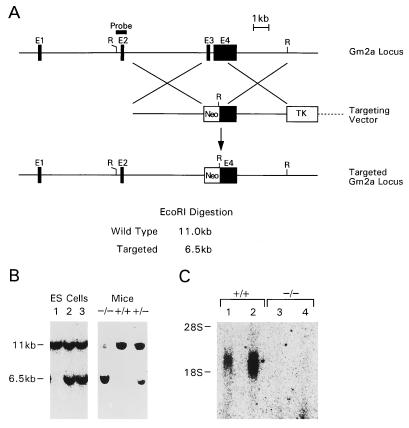
Figure 1
Figure 1
Targeted disruption of the Gm2a locus. (A) The mouse Gm2a locus is indicated on top, the structure of the mouse Gm2a targeting vector is in the middle, and the predicted structure of the homologously recombined locus is on the bottom. R, EcoRI site; TK, thymidine kinase gene, E, exon. (B) Southern analysis of ES clone and mouse tail DNA. Genomic DNA was isolated, digested with EcoRI endonuclease, electrophoresed on a 1% agarose gel, and transferred to GeneScreenPlus membranes. The hybridization probe is shown in A. (Left) Lane 1 shows a G418-resistant clone that had not undergone homologous recombination. Lanes 2 and 3 show correctly targeted clones. (Right) Tail DNA from Gm2a −/−, +/+, and +/− mice. (C) Northern analysis of testis and kidney from Gm2a +/+ and −/− mice. Twenty micrograms of total RNA from testis or kidney RNA was subjected to electrophoresis through a 1.2% formaldehyde/agarose gel, transferred to GeneScreenPlus membrane, and hybridized with Gm2a cDNA probe. Lanes 1 and 3, testis; lanes 2 and 4, kidney.
Figure 2
Figure 2
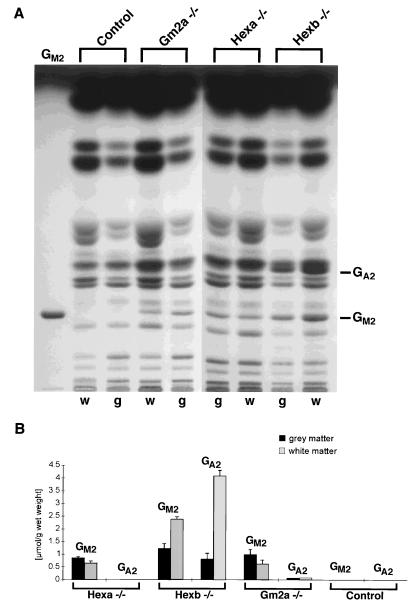
Glycolipid accumulation in the brains of 4-month-old Hexa −/−, Hexb −/−, and Gm2a −/− mice. (A) The sphingolipid fraction of brain tissues was separated by thin-layer chromatography. GM2 and GA2 standards are indicated. g, gray matter; w, white matter. (B) The sphingolipid fraction of gray and white matter was quantified, respectively (μmol/g wet weight).
Figure 3
Figure 3
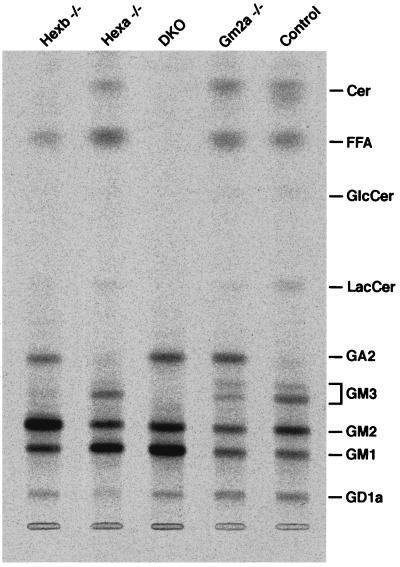
Ganglioside metabolism in gangliosidosis fibroblasts. [3H]GM1 ganglioside was added to fibroblast cultures for 120 hr. The glycolipids then were extracted, analyzed by thin-layer chromatography and visualized on a Raytest/Fuji BAS 1000 phosphoimager. (Left to right) Hexb −/−, Hexa −/−, DKO (double knockout, both Hexa −/− and Hexb −/−), Gm2a −/−, and control (wild-type) embryonic fibroblasts. Cer, ceramide; FFA, free fatty acid; GlcCer, glucosylceramide; LacCer, lactosylceramide.
Figure 4
Figure 4
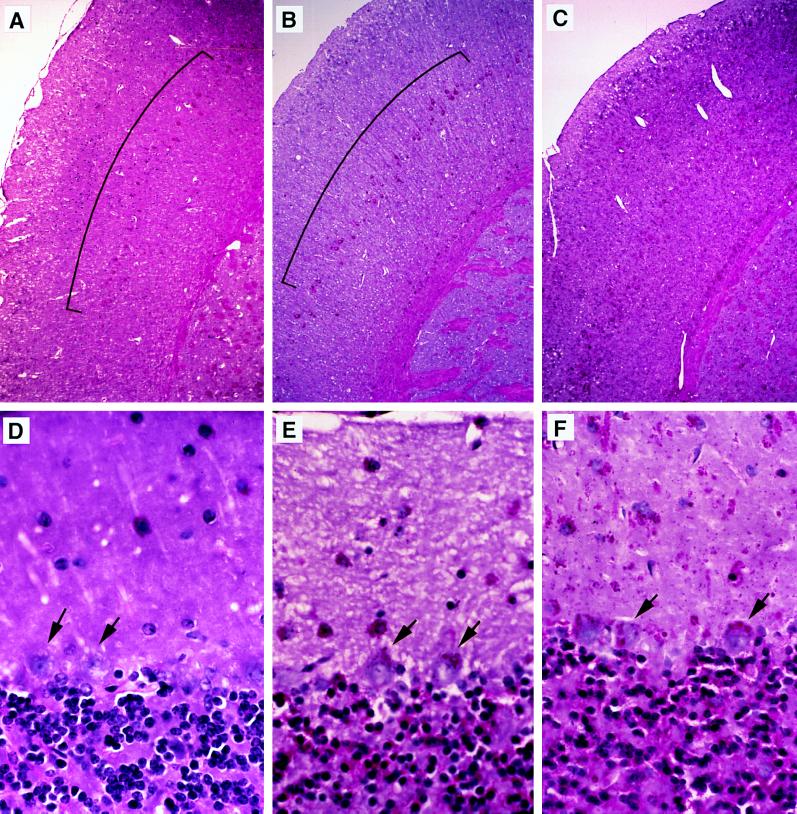
Gm2a −/− and Hexa −/− mice show restricted storage in the brain compared with Hexb −/− mice. All panels are photomicrographs of frozen sections stained by periodic acid-Schiff. B displays cerebral cortex from the Gm2a −/− mouse with storage predominant in large pyramidal neurons in the middle layer (bracketed) similar to the Hexa −/− mouse in A; while nearly all neurons contain storage in the Hexb −/− mouse (C). (×30.) (E) The cerebellum of the Gm2a −/− mouse shows storage in some Purkinje cells (arrows), glial cells in the molecular cell layer, and some granular cell neurons (may be also glial cells) in the granular cell layers. (D) In a similar section from a Hexa −/− mouse minimal storage is seen in a few glial cells in the molecular layer but not in Purkinje cells (arrows). (F) The Hexb −/− mouse shows more storage in Purkinje cells (arrows), granular cells, and molecular layer. (×300.)
Figure 5
Figure 5
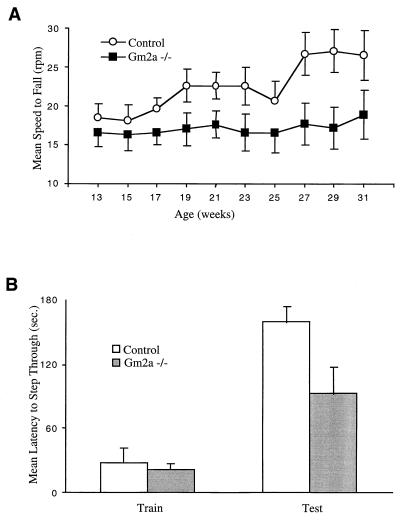
Gm2a −/− mice show difference in motor coordination and possible memory deficit when compared with control mice. (A) The ability to maintain balance on a rotating rotorod was measured every 2 weeks beginning at 13 weeks of age. Mean (±SEM) speed to fall from the rotorod for Gm2a −/− (n = 12) and controls (n = 12). Controls stayed on the rotorod significantly longer than Gm2a −/− mice overall. Controls exhibited improved rotorod performance over the 20-week testing period, while performance of the Gm2a −/− mice remained stable. (B) Mean (±SEM) latency to enter a dark chamber on the passive avoidance task for Gm2a −/− (n = 10) and controls (n = 12). Gm2a −/− mice were quicker to enter the dark chamber on the test trial, indicating poorer retention for the aversive experience of the previous day.
Figure 6
Figure 6
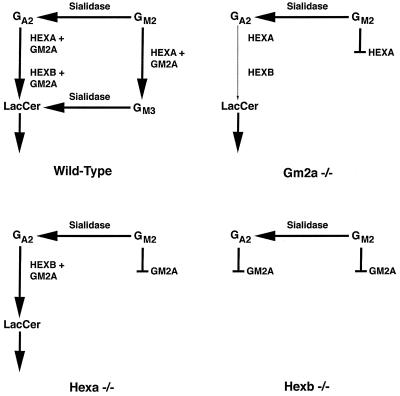
The ganglioside degradation pathways in gangliosidosis mice. The normal degradative pathway in mice has been described (5). Also shown are proposed degradative pathways in Hexa −/−, Hexb −/−, and Gm2a −/− mice. This scheme does not take into account the minor contribution of β-hexosaminidase S on GM2 hydrolysis. GM2, GM2 ganglioside; GM3, GM3 ganglioside; GA2, GA2 glycolipid; LacCer, lactosylceramide; HEXA, β-hexosaminidase A; HEXB, β-hexosaminidase B; GM2A, GM2 activator protein.

References

    1. Gravel R A, Clarke J T R, Kaback M M, Mahuran D, Sandhoff K, Suzuki K. In: The Metabolic and Molecular Basis of Inherited Disease. Scriver C R, Beaudet A L, Sly W S, Valle D, editors. New York: McGraw-Hill; 1995. pp. 2839–2879.
    1. Sandhoff K, Kolter T. Trends Cell Biol. 1996;6:98–103. - PubMed
    1. Yamanaka S, Johnson M D, Grinberg A, Westphal H, Crawley J N, Taniike M, Suzuki K, Proia R L. Proc Natl Acad Sci USA. 1994;91:9975–9979. - PMC - PubMed
    1. Taniike M, Yamanaka S, Proia R L, Langaman C, Bone-Turentine T, Suzuki K. Acta Neuropathol. 1995;89:296–304. - PubMed
    1. Sango K, Yamanaka S, Hoffmann A, Okuda Y, Grinberg A, Westphal H, McDonald M P, Crawley J N, Sandhoff K, Suzuki K, Proia R L. Nat Genet. 1995;11:170–176. - PubMed

Publication types