


Opioid receptors from a lower vertebrate (Catostomus commersoni): sequence, pharmacology, coupling to a G-protein-gated inward-rectifying potassium channel (GIRK1), and evolution
- PMID: 9223341
- PMCID: PMC21583
- DOI: 10.1073/pnas.94.15.8214
Opioid receptors from a lower vertebrate (Catostomus commersoni): sequence, pharmacology, coupling to a G-protein-gated inward-rectifying potassium channel (GIRK1), and evolution
Abstract
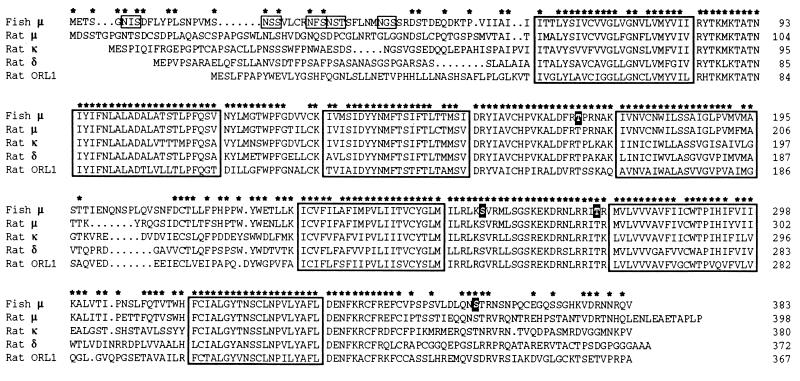
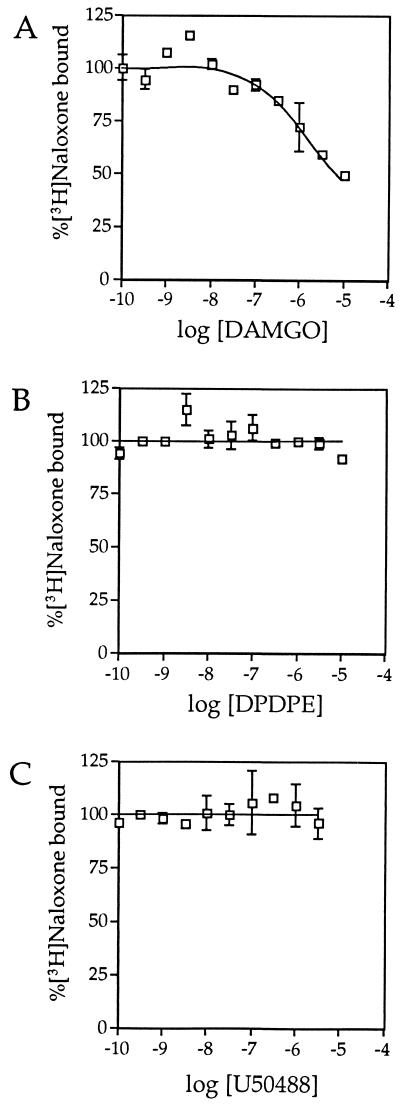
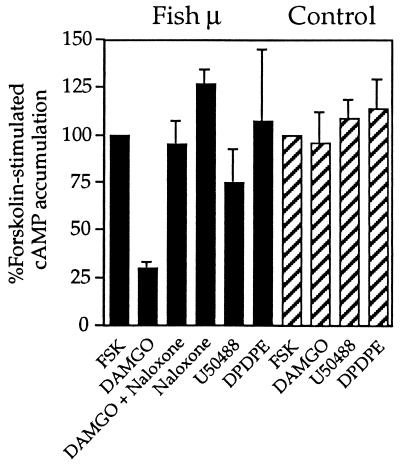
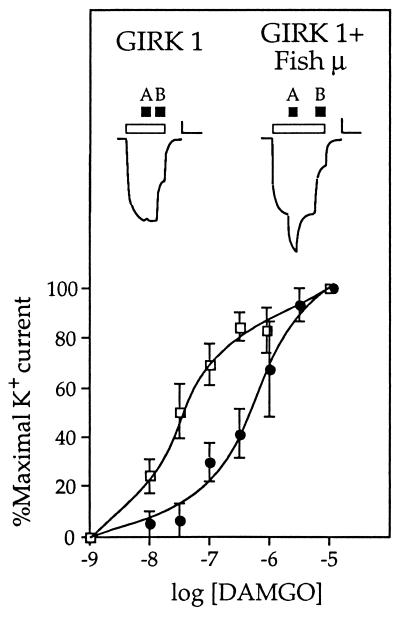
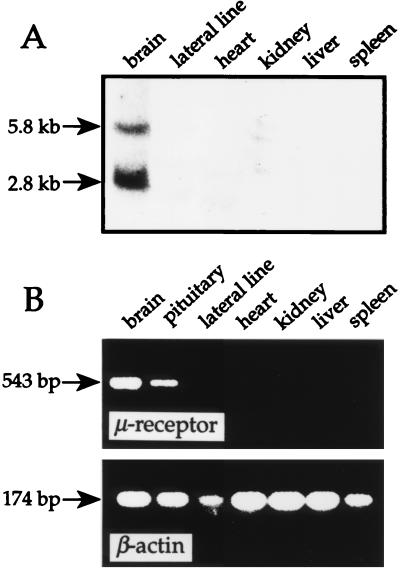
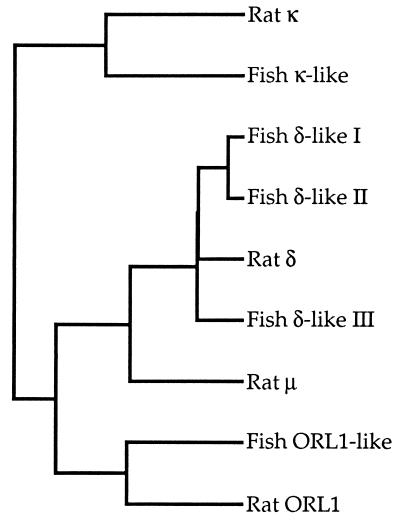
The molecular evolution of the opioid receptor family has been studied by isolating cDNAs that encode six distinct opioid receptor-like proteins from a lower vertebrate, the teleost fish Catostomus commersoni. One of these, which has been obtained in full-length form, encodes a 383-amino acid protein that exhibits greatest sequence similarity to mammalian mu-opioid receptors; the corresponding gene is expressed predominantly in brain and pituitary. Transfection of the teleost cDNA into HEK 293 cells resulted in the appearance of a receptor having high affinity for the mu-selective agonist [D-Ala2, MePhe4-Gly-ol5]enkephalin (DAMGO) (Kd = 0.63 +/- 0.15 nM) and for the nonselective antagonist naloxone (Kd = 3.1 +/- 1.3 nM). The receptor had negligible affinity for U50488 and [D-Pen2, D-Pen5]enkephalin (DPDPE), which are kappa- and delta-opioid receptor selective agonists, respectively. Stimulation of transfected cells with 1 microM DAMGO lowered forskolin-induced cAMP levels, an effect that could be reversed by naloxone. Experiments in Xenopus oocytes have demonstrated that the fish opioid receptor can, in an agonist-dependent fashion, activate a coexpressed mouse G-protein-gated inward-rectifying potassium channel (GIRK1). The identification of six distinct fish opioid receptor-like proteins suggests that additional mammalian opioid receptors remain to be identified at the molecular level. Furthermore, our data indicate that the mu-opioid receptor arose very early in evolution, perhaps before the appearance of vertebrates, and that the pharmacological and functional properties of this receptor have been conserved over a period of approximately 400 million years implying that it fulfills an important physiological role.
Figures

References
-
- Goldstein A. Trends Pharmacol Sci. 1987;8:456–459.
-
- Loh H H, Smith A P. Annu Rev Pharmacol Toxicol. 1990;30:123–147. - PubMed
-
- Barnard E A, Simon J. In: Neurotransmitter Receptors. Hucho F, editor. Amsterdam: Elsevier; 1993. pp. 297–323.
-
- Evans C J, Keith D E, Jr, Morrison H, Magendzo K, Edwards R H. Science. 1992;258:1952–1955. - PubMed
MeSH terms
Substances
Associated data
- Actions
LinkOut - more resources
Full Text Sources
Research Materials
Miscellaneous
