. 1997 Aug 5;94(16):8738-43.
doi: 10.1073/pnas.94.16.8738.

Transcripts from a single full-length cDNA clone of hepatitis C virus are infectious when directly transfected into the liver of a chimpanzee

Affiliations

Transcripts from a single full-length cDNA clone of hepatitis C virus are infectious when directly transfected into the liver of a chimpanzee

M Yanagi et al. Proc Natl Acad Sci U S A. .

Abstract

We have succeeded in constructing a stable full-length cDNA clone of strain H77 (genotype 1a) of hepatitis C virus (HCV). We devised a cassette vector with fixed 5' and 3' termini and constructed multiple full-length cDNA clones of H77 in a single step by cloning of the entire ORF, which was amplified by long reverse transcriptase-PCR, directly into this vector. The infectivity of two complete full-length cDNA clones was tested by the direct intrahepatic injection of a chimpanzee with RNA transcripts. However, we found no evidence for HCV replication. Sequence analysis of these and 16 additional full-length clones revealed that seven clones were defective for polyprotein synthesis, and the remaining nine clones had 6-28 amino acid mutations in the predicted polyprotein compared with the consensus sequence of H77. Next, we constructed a consensus chimera from four of the full-length cDNA clones with just two ligation steps. Injection of RNA transcripts from this consensus clone into the liver of a chimpanzee resulted in viral replication. The sequence of the virus recovered from the chimpanzee was identical to that of the injected RNA transcripts. This stable infectious molecular clone should be an important tool for developing a better understanding of the molecular biology and pathogenesis of HCV.


Figures
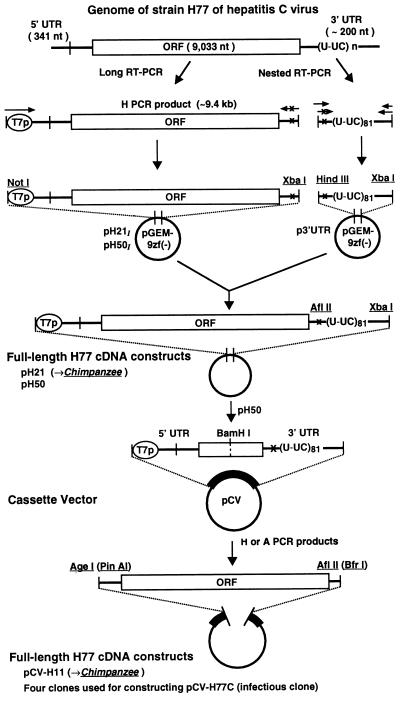
Figure 1
Figure 1
Strategy for the construction of full-length cDNA clones of HCV strain H77. The long PCR products amplified with H1 and H9417R primers were cloned directly into pGEM-9zf(−) after digestion with NotI and XbaI (pH21I and pH50I). Next, the 3′ UTR was cloned into both pH21I and pH50I after digestion with AflII and XbaI (pH21 and pH50). pH21 was tested for infectivity in a chimpanzee. To improve the efficiency of cloning, we constructed a cassette vector with consensus 5′ and 3′ termini of H77. This cassette vector (pCV) was obtained by cutting out the BamHI fragment (nucleotides 1,358–7,530 of the H77 genome) from pH50, followed by religation. Finally, the long PCR products of H77 amplified with primers H1 and H9417R (H product) or primers A1 and H9417R (A product) were cloned into pCV after digestion with AgeI and AflII or with PinAI and BfrI. The latter procedure yielded multiple complete cDNA clones of strain H77 of HCV.
Figure 2
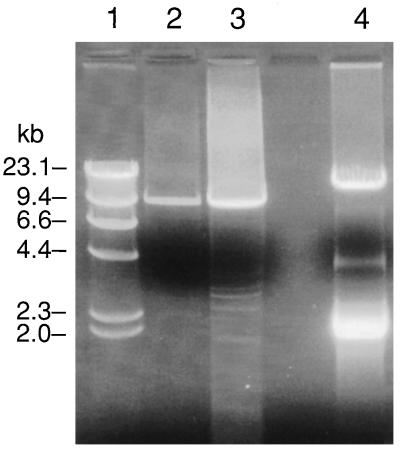
Figure 2
Gel electrophoresis of long RT-PCR amplicons of the entire ORF of H77 and the transcription mixture of the infectious clone of H77. The complete ORF was amplified by long RT-PCR with the primers H1 or A1 and H9417R from 105 GE of H77. A total of 10 μg of the consensus chimeric clone (pCV-H77C) linearized with XbaI was transcribed in a 100-μl reaction with T7 RNA polymerase. Five microliters of the transcription mixture was analyzed by gel electrophoresis and the remainder of the mixture was injected into a chimpanzee. Lane 1, molecular weight marker; lane 2, products amplified with primers H1 and H9417R; lane 3, products amplified with primers A1 and H9417R; lane 4, transcription mixture containing the RNA transcripts and linearized clone pCV-H77C (12.5 kb).
Figure 3
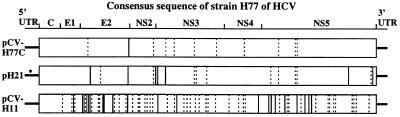
Figure 3
Diagram of the genome organization of HCV strain H77 and the genetic heterogeneity of individual full-length clones compared with the consensus sequence of H77. Solid lines represent amino acid changes. Dashed lines represent silent mutations. A ∗ in pH21 represents a point mutation at nucleotide 58 in the 5′ UTR. In the ORF, the consensus chimeric clone pCV-H77C had 11 nucleotide differences [at positions 1,625 (C → T), 2,709 (T → C), 3,380 (A → G), 3,710 (C → T), 3,914 (G → A), 4,463 (T → C), 5,058 (C → T), 5,834 (C → T), 6,734 (T → C), 7,154 (C → T), and 7,202 (T → C)] and one amino acid change (F → L at amino acid 790) compared with the consensus sequence of H77. This clone was infectious. Clone pH21 and pCV-H11 had 19 nucleotide (7 amino acid) and 64 nucleotide (21 amino acid) differences, respectively, compared with the consensus sequence of H77. These two clones were not infectious. A single point mutation in the 3′ UTR at nucleotide 9,406 (G → A) introduced to create an AflII cleavage site is not shown.

References

    1. Alter H J, Seeff L B. In: Viral Hepatitis: Scientific Basis and Clinical Management. Zuckerman A J, Thomas H C, editors. Edinburgh: Churchill Livingstone; 1993. pp. 467–498.
    1. Alter M J. Semin Liver Dis. 1995;15:5–14. - PubMed
    1. Fried M W, Hoofnagle J H. Semin Liver Dis. 1995;15:82–91. - PubMed
    1. Houghton M. In: Fields Virology. 3rd Ed. Fields B N, Knipe D M, Howley P M, editors. Philadelphia: Lippincott-Raven; 1996. pp. 1035–1058.
    1. Tanaka T, Kato N, Cho M-J, Shimotohno K. Biochem Biophys Res Commun. 1995;215:744–749. - PubMed

Publication types

Associated data