. 1997 Aug 19;94(17):8994-9.
doi: 10.1073/pnas.94.17.8994.

A protein encoded by a group I intron in Aspergillus nidulans directly assists RNA splicing and is a DNA endonuclease

Affiliations

A protein encoded by a group I intron in Aspergillus nidulans directly assists RNA splicing and is a DNA endonuclease

Y Ho et al. Proc Natl Acad Sci U S A. .

Erratum in

  • Proc Natl Acad Sci U S A 1997 Dec 23;94(26):14976

Abstract

Some group I introns self-splice in vitro, but almost all are thought to be assisted by proteins in vivo. Mutational analysis has shown that the splicing of certain group I introns depends upon a maturase protein encoded by the intron itself. However the effect of a protein on splicing can be indirect. We now provide evidence that a mitochondrial intron-encoded protein from Aspergillus nidulans directly facilitates splicing in vitro. This demonstrates that a maturase is an RNA splicing protein. The protein-assisted reaction is as fast as that of any other known group I intron. Interestingly the protein is also a DNA endonuclease, an activity required for intron mobilization. Mobile elements frequently encode proteins that promote their propagation. Intron-encoded proteins that also assist RNA splicing would facilitate both the transposition and horizontal transmission of introns.


Figures
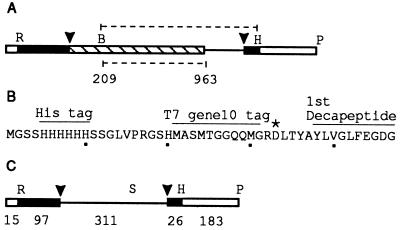
Figure 1
Figure 1
Plasmid constructs. (A) Map of a region of pSPAnCOB. □, vector sequence; ▪, A. nidulans cobA gene exon; ▧, intron ORF; —, intron sequence. R = EcoRI, H = HindIII, P = PvuII, B = BglII Arrowheads, splice-sites. The upper dotted line denotes the region cloned into the expression vector pET28b. The lower dotted line denotes the region replaced by a SalI site to yield pCOBsal. (B) Amino-terminal amino acid sequence of the 32-kDa maturase protein expressed from pET28b. ∗, start of the Aspergillus sequence. (C) Map of a region of pCOBsal. The region shown corresponds precisely to the precursor used for all splicing assays. The number of bases in each segment are shown (the intron ORF remaining from pSPAnCOB is not shown as ▧). S = SalI.
Figure 3
Figure 3
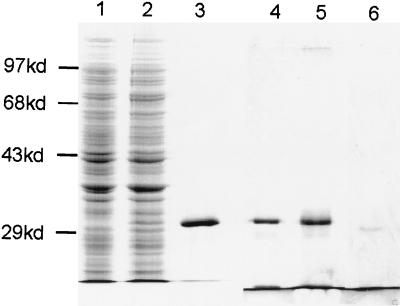
Purification of the AnCOB maturase. 10% SDS/PAGE, stained with Coomassie blue (lanes 1–3). Lanes 1 and 2: lysate of induced BL21DE3 with pET28b (the expression vector) or pEC (pET28b + the AnCOB intron), respectively. Lane 3: Ni++ chromatography purification of AnCOB protein (2.4 μg). A second gel was silver stained (lanes 4–6). Lane 4: Ni++ purification of AnCOB (1.2 μg). Lane 5: immunoaffinity chromatography purification of material from lane 4 (0.66 μg). Lane 6: carbonic anhydrase control (0.02 μg). It was not possible to load more than 0.66 μg of the immunoaffinity column purified material.
Figure 2
Figure 2
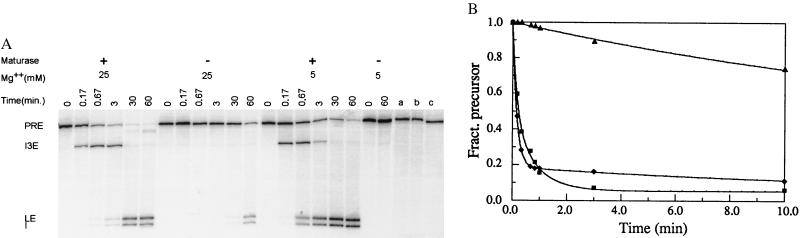
The AnCOB intron encodes a maturase that directly assists RNA splicing. (A) Group I introns react by two sequential transesterification reactions: First, a guanosine attacks the 5′ splice site and is transferred to the first base of the intron. The exposed 3′OH end of the upstream exon (5′ exon) then attacks the 3′ splice site, releasing the intron and leaving the exons ligated (58). PRE, precursor; I3E, intron + 3′ exon splicing intermediate; I, excised intron; LE, ligated exons. The 5′ exon is short and is not shown. Its presence exactly mirrors that of the I3E molecule, being generated during 5′splice-site cleavage and disappearing as RNA molecules complete the second step. (Lane a) Prior to mixing with RNA, the protein extract was treated with 2 μg/μl of proteinase K for 30 min at 37°C. (lanes b and c) The pre-RNA was incubated as above (5 mM MgCl2) with extracts purified by Ni++ affinity chromatography (as for the AnCOB protein) from BL21DE3 either containing just the pET28b vector (lane b) or expressing the endonuclease encoded by a different intron, AnOX2 (37) (lane c). (B) The rate of the first splicing step was determined as described in Materials and Methods. ▴, 25 mM Mg2+, no maturase; ⧫, 5 mM Mg2+ + maturase; ▪, 25 mM Mg2+ + maturase.
Figure 5
Figure 5
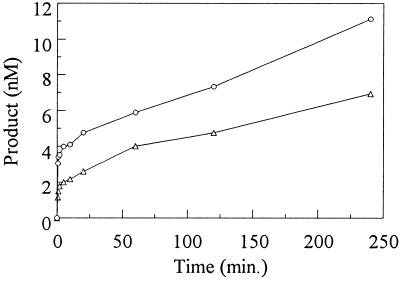
The AnCOB maturase shows a stoichiometric burst under multiple turnover conditions. ▵, 2 nM maturase; ○, 4 nM maturase. Product was determined as follows: ([IVS] + [I3E])/([IVS] + [I3E] + [PRE]) where IVS, intron; I3E, intron attached to 3′ exon; PRE, precursor (Fig. 2).
Figure 6
Figure 6
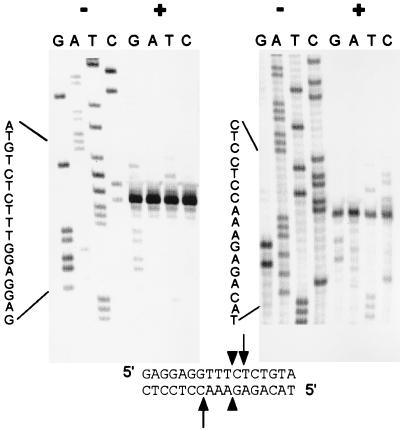
The AnCOB intron-encoded protein is also a DNA endonuclease. Two DNA chain termination sequencing reactions were performed, one on either strand of a cDNA clone that spans the intron insertion site (Materials and Methods). Half of each reaction remained uncut (−) and the other half was digested (+) with the AnCOB protein preparation. Newly synthesized DNA molecules that terminate before reaching or completing the recognition site will remain uncut (including those that extend beyond the cleavage site but fail to complete the entire recognition site; see ref. 30). Strands that extend beyond the recognition site will all be cleaved and give the same-sized, primer-proximal, labeled fragment and a distal unlabeled fragment that will vary in size (the radioactive label is primarily incorporated very close to the primer; see Materials and Methods). Arrows indicate the cleavage sites and the arrowheads the site at which the intron would be inserted.
Figure 4
Figure 4
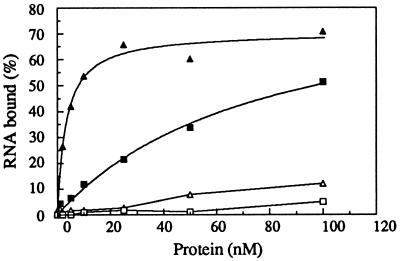
Specific binding of the AnCOB and AnOX2 intron-encoded proteins. ▴ and ▵: AnCOB protein with AnCOB and AnOX2 pre-RNA, respectively. ▪ and □: AnOX2 protein with AnOX2 and AnCOB pre-RNA, respectively.

References

    1. Noller H F, Hoffarth V, Zimniak L. Science. 1992;256:1416–1419. - PubMed
    1. Madhani H D, Guthrie C. Annu Rev Genet. 1994;28:1–26. - PubMed
    1. Brown J W, Nolan J M, Haas E S, Rubio M A T, Major F, Pace N R. Proc Natl Acad Sci USA. 1996;93:3001–3006. - PMC - PubMed
    1. Lambowitz A M, Perlman P S. Trends Biochem Sci. 1990;15:440–444. - PubMed
    1. Lazowska J, Jacq C, Slonimski P P. Cell. 1980;22:333–348. - PubMed

Publication types