. 1997 Aug 19;94(17):9046-51.
doi: 10.1073/pnas.94.17.9046.

Translation initiation factor eIF4G mediates in vitro poly(A) tail-dependent translation

Affiliations

Translation initiation factor eIF4G mediates in vitro poly(A) tail-dependent translation

S Z Tarun Jr et al. Proc Natl Acad Sci U S A. .

Abstract

The yeast translation factor eIF4G associates with both the cap-binding protein eIF4E and the poly(A)-binding protein Pab1p. Here we report that the two yeast eIF4G homologs, Tif4631p and Tif4632p, share a conserved Pab1p-binding site. This site is required for Pab1p and poly(A) tails to stimulate the in vitro translation of uncapped polyadenylylated mRNA, and the region encompassing it is required for the cap and the poly(A) tail to synergistically stimulate translation. This region on Tif4631p becomes essential for cell growth when the eIF4E binding site on Tif4631p is mutated. Pab1p mutations also show synthetic lethal interactions with eIF4E mutations. These data suggest that eIF4G mediates poly(A) tail stimulated translation in vitro, and that Pab1p and the domain encompassing the Pab1p-binding site on eIF4G can compensate for partial loss of eIF4E function in vivo.


Figures
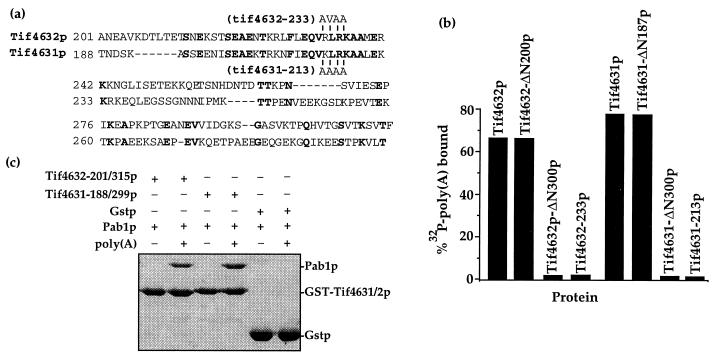
Figure 1
Figure 1
Identification and mutagenesis of a Pab1p binding site on eIF4G. (a) Alignment of the Pab1p-binding domain of Tif4632p (6) and the homologous region of Tif4631p. Identical residues are highlighted, the positions and type of substitutions in Tif4632–233p and Tif4631–213p are indicated above or below the sequences, and the positions of the residues in the full-length proteins are shown. (b) Mutations within the Tif4631p and Tif4632p Pab1p binding domains destroy Pab1p binding. Each eIF4G protein containing the indicated mutation was fused to glutathione S-transferase, immobilized on glutathione resin, and assayed for its ability to bind to a [32P]poly(A)/Pab1p complex, as previously described (6). [32P]poly(A) retention reflects the amount of Pab1p binding to the eIF4G proteins. (c) The Pab1p-binding domain of Tif4631p resides between amino acids 188 and 299. The Tif4631p and Tif4632p fragments diagrammed in a were fused to glutathione S-transferase, immobilized on glutathione resin, and assayed for their ability to bind Pab1p in the presence or absence of poly(A), as previously described (6). Bound proteins were resolved in a 10% SDS/PAGE gel and visualized by Coomasie blue staining. The position of each recombinant protein is indicated.
Figure 2
Figure 2
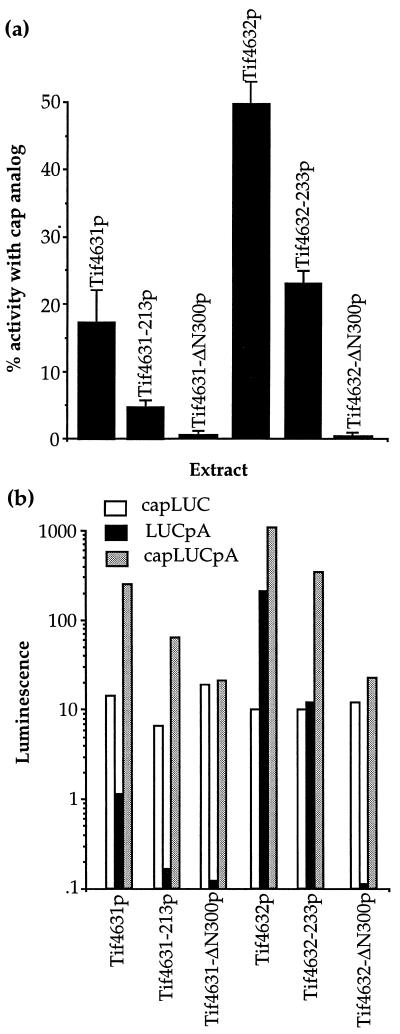
Mutations within the Pab1p-binding domain of Tif4631p and Tif4632p inhibit poly(A)-dependent translation. (a) Equal amounts of nuclease-treated translation extracts were programmed with [35S]methionine and yeast mRNA with or without the cap analog 7mGpppG. The percent of translational activity remaining in each extracts in the presence of the analog versus its absence is shown. This value represents poly(A)-dependent translation (4). Translational rates of incorporation in the absence of the analog, relative to the wild-type extracts were: Tif4631-213p (88%), Tif4631-ΔN300p (115%), Tif4632-233 (70%)p, and Tif4632-ΔN300p (72%). (b) Equal amounts of translation extracts prepared from yeast strains harboring the indicated TIF4631 or TIF4632 genes were analyzed for their ability to translate luciferase (LUC) mRNA containing either a cap (capLUC), a poly(A) tail (LUCpA), or both (capLUCpA) as previously described (4, 5). Luciferase enzyme production was monitored by a luminescence assay. The data shown are representative of at least three independent assays. LUC mRNA lacking a cap and a poly(A) tail was not detectably translated in these extracts (data not shown).
Figure 3
Figure 3
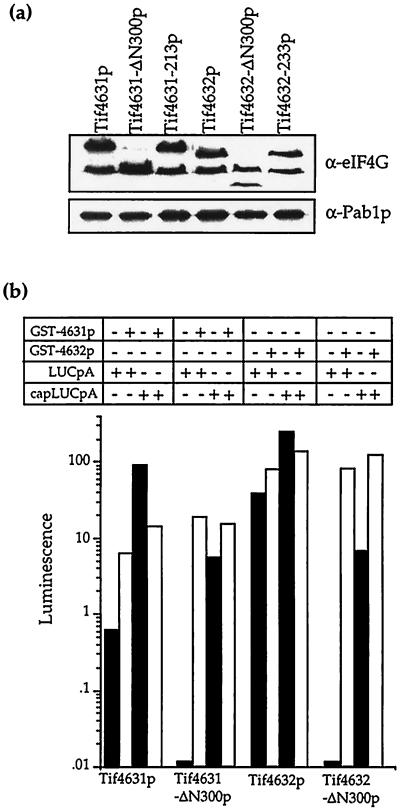
Reconstitution of poly(A)-dependent translation in extracts containing mutant eIF4G. (a) Western analysis for Pab1p and the various forms of Tif4631p and Tif4632p in each of the extracts. Rat polyclonal antibodies against the C-terminus of Tif4631p and mouse mAbs to Pab1p were used to probe equal total amounts of protein from each extract that had been resolved by SDS/PAGE. The upper band in each of the samples probed for eIF4G represents the intact protein, while the lower band presumably represents a proteolytic fragment. (b) Recombinant eIF4G rescues the translational deficiency of the mutant extracts. The expression levels of LUCpA or capLUCpA mRNA in the indicated extracts containing or lacking recombinant Tif4631p or Tif4632p are shown.

References

    1. Sachs A B, Sarnow P, Hentze M W. Cell. 1997;89:831–838. - PubMed
    1. Hershey J W B, Mathews M B, Sonenberg N, editors. Translational Control. Vol. 30. Plainview, NY: Cold Spring Harbor Lab. Press; 1996.
    1. Sachs A B, Davis R W. Cell. 1989;58:857–867. - PubMed
    1. Tarun S, Sachs A B. Genes Dev. 1995;9:2997–3007. - PubMed
    1. Iizuka N, Najita L, Franzusoff A, Sarnow P. Mol Cell Biol. 1994;14:7322–7330. - PMC - PubMed

Publication types

MeSH terms

Substances