. 1997 Aug 19;94(17):9244-8.
doi: 10.1073/pnas.94.17.9244.

Evidence of evolutionary up-regulation of the single active X chromosome in mammals based on Clc4 expression levels in Mus spretus and Mus musculus

Affiliations

Evidence of evolutionary up-regulation of the single active X chromosome in mammals based on Clc4 expression levels in Mus spretus and Mus musculus

D A Adler et al. Proc Natl Acad Sci U S A. .

Abstract

Previous studies have shown that the chloride channel gene Clc4 is X-linked and subject to X inactivation in Mus spretus, but that the same gene is autosomal in laboratory strains of mice. This exception to the conservation of linkage of the X chromosome in one of two interfertile mouse species was exploited to compare expression of Clc4 from the X chromosome to that from the autosome. Clc4 was found to be highly expressed in brain tissues of both mouse species. Quantitative analyses of species-specific expression of Clc4 in brain tissues from mice resulting from M. spretus x laboratory strain crosses, demonstrate that each autosomal locus has half the level of Clc4 expression as compared with the single active X-linked locus. In contrast expression of another chloride channel gene, Clc3, which is autosomal in both mouse species is equal between alleles in F1 animals. There is no evidence of imprinting of the Clc4 autosomal locus. These results are consistent with Ohno's hypothesis of an evolutionary requirement for a higher expression of genes on the single active X chromosome to maintain balance with autosomal gene expression [Ohno, S. (1967) Sex Chromosomes and Sex-Linked Genes (Springer, Berlin)].


Figures
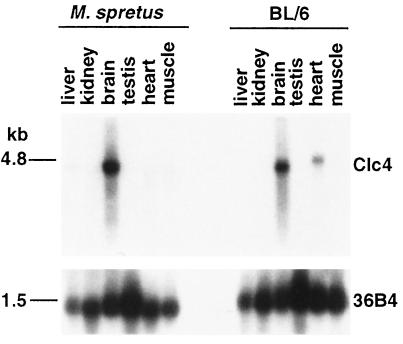
Figure 1
Figure 1
Northern blot analysis of tissue-specific expression of Clc4 in M. spretus and C57BL/6Ros mice. Two micrograms of poly(A)+ RNA from tissues of each species were run on a denaturing agarose gel as indicated above the lanes. The resulting blot was hybridized to a 32P-labeled Clc4 MR9 cDNA probe, resulting in a 4.5- to 5-kb band. The blot was rehybridized to a control ribosomal phosphoprotein cDNA probe, 36B4 (12), producing a 1.5-kb band.
Figure 2
Figure 2
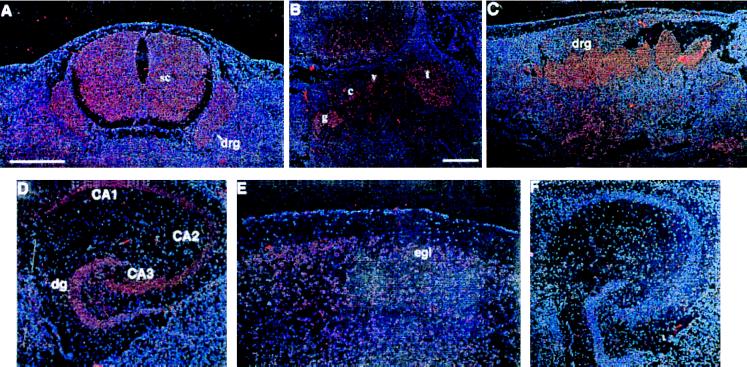
In situ hybridization of 35S-labeled Clc4 riboprobes to embryos and adult brains form a laboratory strain. (A) A transverse section of a 13.5-day embryo shows expression in the spinal cord (SC) and the dorsal root ganglia (drg). (B and C) Sagittal sections of a 14.5-day embryo show expression in the glossopharyngeal nerve ganglion (g), the cochlear ganglion (c), the vestibular ganglion (v), the trigerminal ganglion (t), and the dorsal root ganglia (drg). (D and E) Horizontal sections of adult brain show expression in the dentate gyrus (dg), the pyramidal cell layers of the CA1, CA2, and CA3 fields of Ammons horn, and in the external granular layer on layer II (eg1). (F) Negative control hybridization using a sense probe. Magnifications are identical for all panels (bar shown in A, 500 μm), except for B (bar, 200 μm).
Figure 3
Figure 3
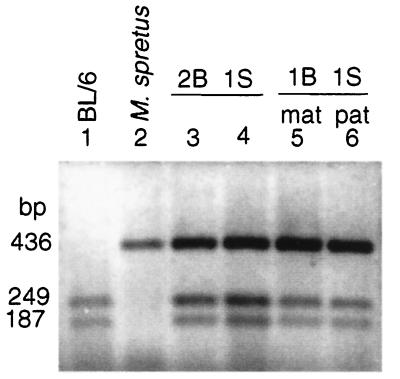
EagI digests of Clc4 RT-PCR products amplified from brain tissues of parental mouse species BL/6 and M. spretus and of backcross progeny with different copy numbers of Clc4. Lanes 1 and 2 contain products from parental male controls. Lanes 3 and 4 contain products from two different male mice with one X chromosome locus of M. spretus origin (1S) and two chromosome 7 loci of BL/6 origin (2B). Lane 5 is from a male mouse with one X chromosome locus of M. spretus origin (1S) and one paternally inherited chromosome 7 locus of BL/6 origin (1Bmat). Lane 6 is from a mouse with one X chromosome locus of M. spretus origin (1S) and one maternally inherited chromosome 7 locus of BL/6 origin (1Bpat). Levels of allele-specific transcripts were quantified as described (Table 1).
Figure 4
Figure 4
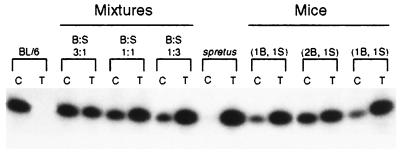
Examples of SNuPE analyses of Clc4 from brain RNA. (Left) Parental species BL/6 (B) and M. spretus (S) flanking artificial mixtures of the two species cDNAs with B/S ratios of 3:1, 1:1, and 1:3, respectively. (Right) Two backcross mice with one Clc4 locus of BL/6 origin (1B) and one Clc4 locus of M. spretus origin (1S) flanking one mouse with two Clc4 loci of BL/6 origin (2B) and one Clc4 locus of M. spretus origin (1S). For each sample, C indicates the lane with primer extension products obtained in the presence of 32P-labeled dCTP and T in the presence of 32P-labeled dTTP. Amounts of incorporation were quantified as described (Table 1).

References

    1. Rugarli E I, Adler D A, Borsani G, Tsuchiya K, Franco B, Hauge X, Disteche C, Chapman V, Ballabio A. Nat Genet. 1995;10:466–471. - PubMed
    1. Palmer S, Perry J, Ashworth A. Nat Genet. 1995;10:472–476. - PubMed
    1. Ohno S. Sex Chromosomes and Sex-Linked Genes. Berlin: Springer; 1967. pp. 1–140.
    1. Ellis N A. Nat Genet. 1995;10:373–375. - PubMed
    1. Jentsch T J, Gunther W, Pusch M, Schwappach B. J Physiol Lond. 1995;482:S19–S25. - PMC - PubMed

Publication types

Substances

LinkOut - more resources