. 1997 Aug 19;94(17):9428-33.
doi: 10.1073/pnas.94.17.9428.

Immediate and simultaneous sensory reorganization at cortical and subcortical levels of the somatosensory system

Affiliations

Immediate and simultaneous sensory reorganization at cortical and subcortical levels of the somatosensory system

B M Faggin et al. Proc Natl Acad Sci U S A. .

Abstract

The occurrence of cortical plasticity during adulthood has been demonstrated using many experimental paradigms. Whether this phenomenon is generated exclusively by changes in intrinsic cortical circuitry, or whether it involves concomitant cortical and subcortical reorganization, remains controversial. Here, we addressed this issue by simultaneously recording the extracellular activity of up to 135 neurons in the primary somatosensory cortex, ventral posterior medial nucleus of the thalamus, and trigeminal brainstem complex of adult rats, before and after a reversible sensory deactivation was produced by subcutaneous injections of lidocaine. Following the onset of the deactivation, immediate and simultaneous sensory reorganization was observed at all levels of the somatosensory system. No statistical difference was observed when the overall spatial extent of the cortical (9.1 +/- 1.2 whiskers, mean +/- SE) and the thalamic (6.1 +/- 1.6 whiskers) reorganization was compared. Likewise, no significant difference was found in the percentage of cortical (71.1 +/- 5.2%) and thalamic (66. 4 +/- 10.7%) neurons exhibiting unmasked sensory responses. Although unmasked cortical responses occurred at significantly higher latencies (19.6 +/- 0.3 ms, mean +/- SE) than thalamic responses (13. 1 +/- 0.6 ms), variations in neuronal latency induced by the sensory deafferentation occurred as often in the thalamus as in the cortex. These data clearly demonstrate that peripheral sensory deafferentation triggers a system-wide reorganization, and strongly suggest that the spatiotemporal attributes of cortical plasticity are paralleled by subcortical reorganization.


Figures
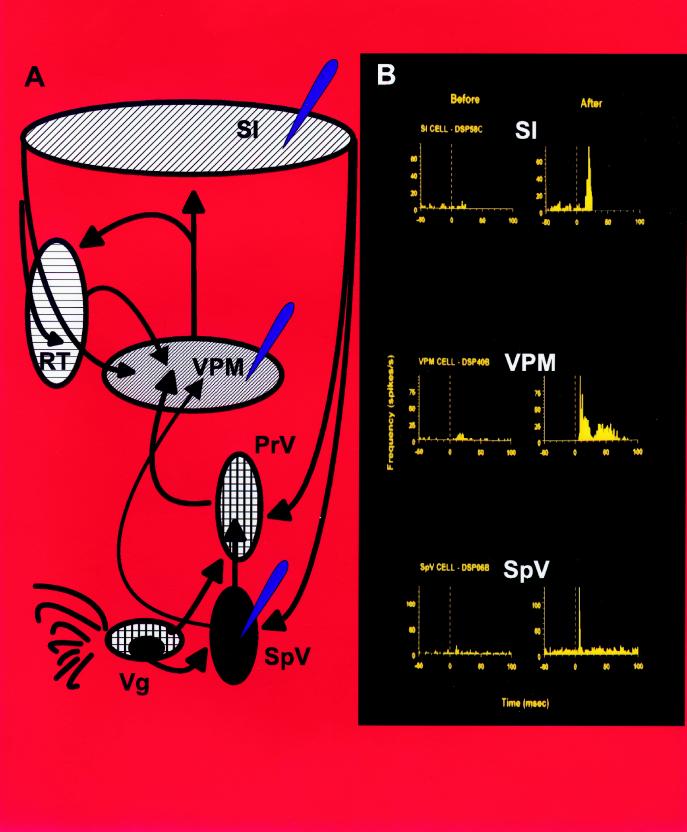
Figure 1
Figure 1
Simultaneous, multi-level sensory reorganization in the rat trigeminal somatosensory system. (A) Schematic organization of the processing levels and connectivity of the rat trigeminal somatosensory system. Notice the existence of parallel projections from the brainstem (PrV and SpV) to the VPM thalamus. The reticular (RT) nucleus provides the only source of GABAergic projections to VPM neurons. Dense corticothalamic and corticobulbar feedback projections are also depicted in this scheme. Blue arrows depict the main cortical and subcortical structures from which simultaneous neural ensemble recordings were obtained. (B) PSTHs were used to quantify the simultaneous unmasking of novel responses in the SpV nucleus, VPM nucleus, and SI cortex following a subcutaneous injection of lidocaine. Notice than before the injection these three simultaneously recorded neurons did not exhibit a significant response to the stimulation of whisker C3. Minutes after the induction of the lidocaine block, the same neurons responded vigorously to stimulation of that same whisker. Stimulus onset is at 0 ms. Stimulus duration is 100 ms. Response magnitude is depicted in spikes/s (Hz). Vg, trigeminal ganglion; PrV, principal nucleus of the trigeminal brainstem complex.
Figure 2
Figure 2
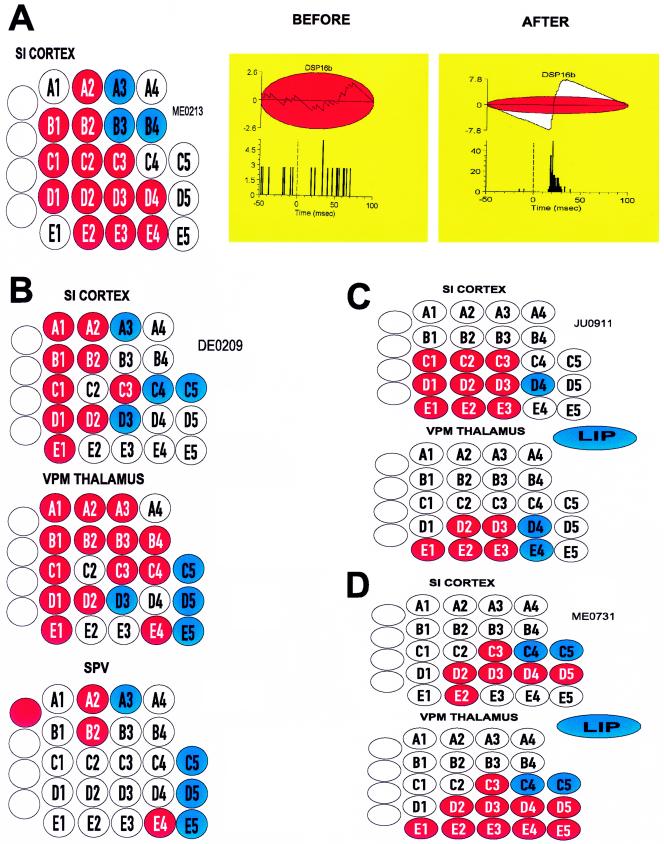
The spatial extent of the sensory reorganization process was measured by quantifying the number of stimulated whiskers (red circles) that induced unmasked (new) sensory responses at each level of the trigeminal pathway after the peripheral lidocaine block. In these plots, blue circles indicate the whiskers anesthetized by the lidocaine injection. These whisker, when stimulated produced no neural response. (A) The spatial extent of the cortical reorganization in one adult rat is illustrated. A total of 13 facial whiskers were found to induce novel responses in the SI cortex of this animal after an injection of lidocaine in the A3 whisker. An example of the criterion used to defined the occurrence of an unmasked sensory response is illustrated by the pairwise comparison of PSTHs and CFHs, obtained by stimulating whisker C3 and recording the sensory response of neuron DSP16b before (no significant response) and after (highly significant response) the peripheral lidocaine injection. (B) Similar analysis carried out for multi-level recordings revealed a high degree of spatial overlap for the simultaneous sensory reorganization process observed in the SI cortex, VPM thalamus, and SpV brainstem nucleus. In this animal lidocaine was injected in the gum. (C and D) Reorganization in the SI cortex reflected similar changes observed in the VPM thalamus. However, in some instances cortical reorganization involved a larger territory (C). Conversely, not all whiskers (see E1 and E3–E5 in D) that defined the unmasked zone in the VPM thalamus belonged to the corresponding cortical unmasked region. Lidocaine injection in C and D was in the animals’ upper lip.
Figure 3
Figure 3
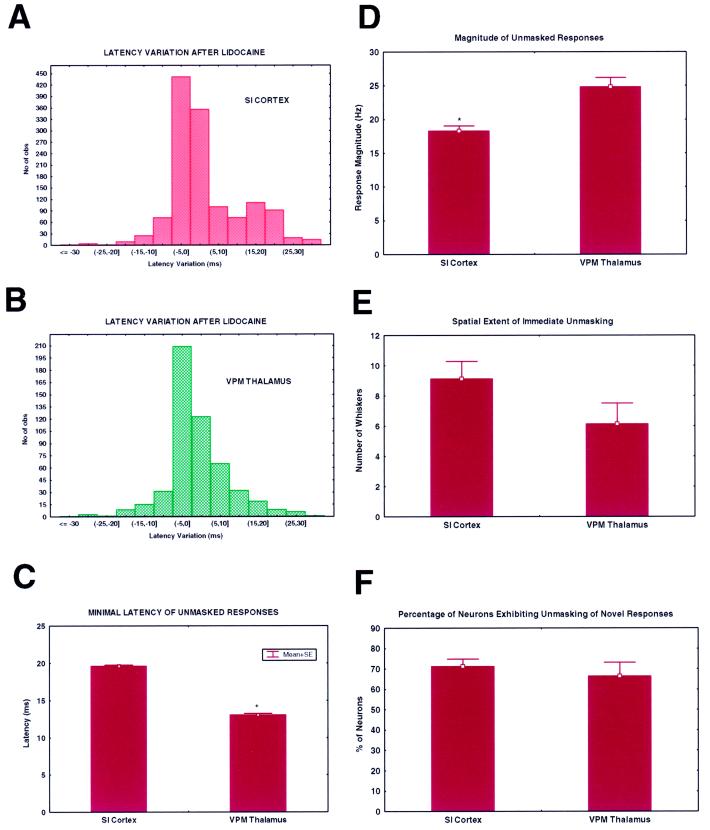
Comparison of the spatial and temporal attributes of the simultaneous reorganization observed in the SI cortex and VPM nucleus of the thalamus. (A and B) Quantitative analysis of the distributions of neuronal latency variation after the peripheral lidocaine injection revealed similar effects in the SI cortex (A) and the VPM nucleus of the thalamus (B). The only exception was the larger component of longer latencies (15–25 ms) observed for novel cortical responses. Further analysis (C) revealed that this could explained by the fact that unmasked cortical responses had significantly longer latencies than their thalamic counterparts. (D) The magnitude of these unmasked responses, on the other hand, was higher in the VPM nucleus than the SI cortex. No statistical difference was observed between the thalamic and the cortical reorganization processes when the spatial extent of the reorganization at the neuronal population level was measured (in number of whiskers, E) and when the percentage of neurons exhibiting unmasked sensory responses after the lidocaine injection (F) was calculated.

References

    1. Merzenich M M, Kaas J H, Wall J T, Nelson R J, Sur M, Felleman D J. Neuroscience. 1983;8:33–55. - PubMed
    1. Merzenich M M, Kaas J H, Wall J T, Nelson R J, Sur M, Felleman D J. Neuroscience. 1983;10:639–665. - PubMed
    1. Kaas J H, Merzenich M M, Killackey H P. Annu Rev Neurosci. 1983;6:325–356. - PubMed
    1. Kaas J H. Annu Rev Neurosci. 1991;14:137–168. - PubMed
    1. Sanes J N, Suner S, Lando J F, Donoghue J P. Proc Natl Acad Sci Usa. 1988;85:2003–2007. - PMC - PubMed

Publication types

LinkOut - more resources