. 1997 Aug 1;11(15):2012-21.
doi: 10.1101/gad.11.15.2012.

The response to extracytoplasmic stress in Escherichia coli is controlled by partially overlapping pathways

Affiliations

The response to extracytoplasmic stress in Escherichia coli is controlled by partially overlapping pathways

L Connolly et al. Genes Dev. .

Abstract

The activity of the alternate sigma-factor sigmaE of Escherichia coli is induced by several stressors that lead to the extracytoplasmic accumulation of misfolded or unfolded protein. The sigmaE regulon contains several genes, including that encoding the periplasmic protease DegP, whose products are thought to be required for maintaining the integrity of the cell envelope because cells lacking sigmaE are sensitive to elevated temperature and hydrophobic agents. Selection of multicopy suppressors of the temperature-sensitive phenotype of cells lacking sigmaE revealed that overexpression of the lipoprotein NlpE restored high temperature growth to these cells. Overexpression of NlpE has been shown previously to induce DegP synthesis by activating the Cpx two-component signal transduction pathway, and suppression of the temperature-sensitive phenotype by NlpE was found to be dependent on the Cpx proteins. In addition, a constitutively active form of the CpxA sensor/kinase also fully suppressed the temperature-sensitive defect of cells lacking sigmaE. DegP was found to be necessary, but not sufficient, for suppression. Activation of the Cpx pathway has also been shown to alleviate the toxicity of several LamB mutant proteins. Together, these results reveal the existence of two partially overlapping regulatory systems involved in the response to extracytoplasmic stress in E. coli.


Figures
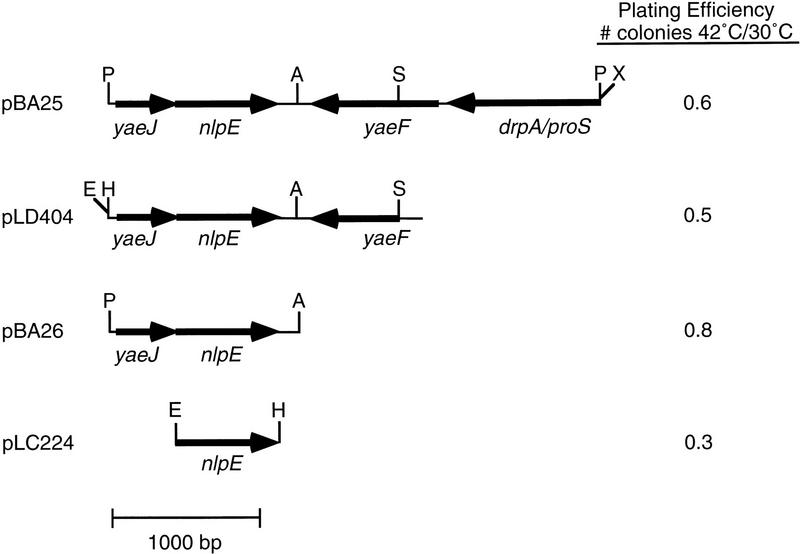
Figure 1
Figure 1
Maps and suppressor activity of plasmid subclones. pBA25 is the original suppressor plasmid, pBA26 was created by the removal of the represented sequences and religating, pLD404 has been described previously (Snyder et al. 1995), and pLC224 was generated by PCR amplification and subcloning of a fragment containing nlpE alone from pBA25. Restriction enzyme site abbreviations: (P) PstI; (A) AflII; (X) XbaI; (E) EcoRI; (H) HindIII; (S) StyI. Note that the plating efficiency of cells containing vector alone was 4.2 × 10−5 (pUC18 for pBA25 and pBA26), 4.0 × 10−6 (pBR322 for pLD404), and 7.1 × 10−7 (pLC222 for pLC224).
Figure 2
Figure 2
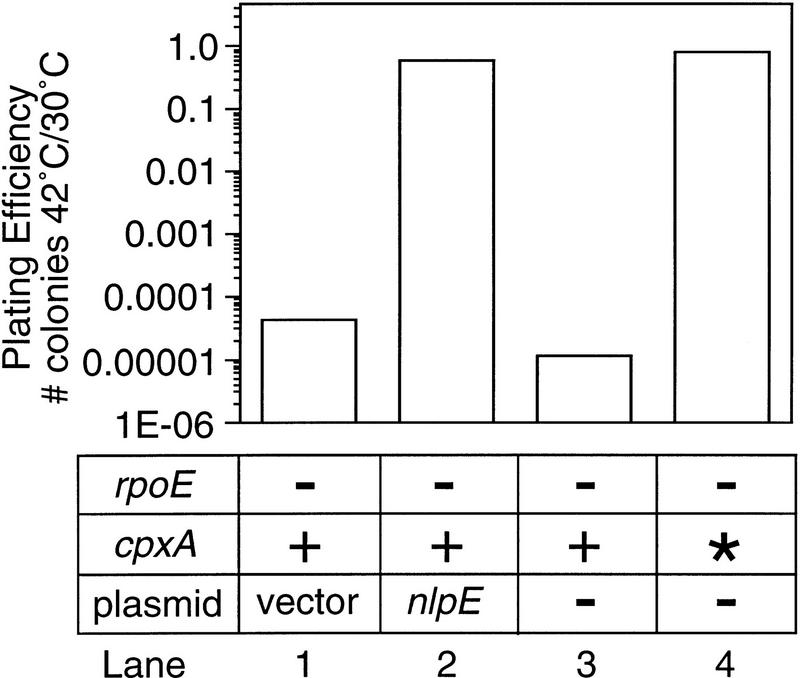
Plating efficiency of rpoE::ΩCm cells activated for the Cpx pathway. The efficiency of plating of rpoE::ΩCm cells containing vector alone (lane 1) or pBA25 (lane 2), or no plasmid and a wild-type (lane 3) or constitutively activated (lane 4) cpxA allele was determined as described in Materials and Methods. The numerical values of the plating efficiency of each strain were vector alone, 4.2 × 10−5; pBA25, 0.6; cpxA+, 1.1 × 10−5; cpxA*, 0.8.
Figure 3
Figure 3
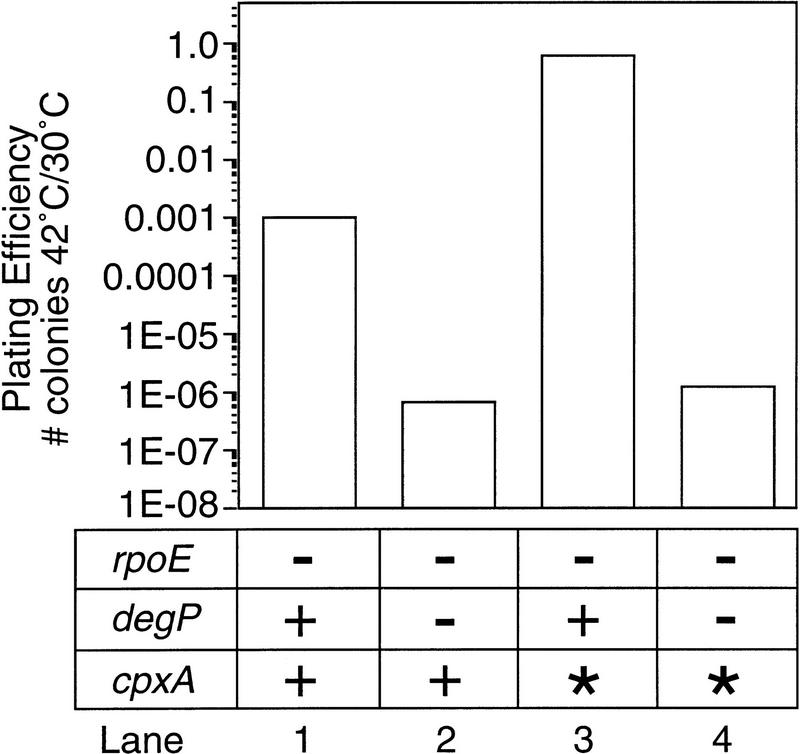
Plating efficiency of rpoE::ΩCm cells lacking degP. The plating efficiency of rpoE::ΩCm cpxA+ (lane 1), rpoE::ΩCm cpxA+ degP::Km (lane 2), rpoE::ΩCm cpxA* (lane 3), and rpoE::ΩCm cpxA* degP::Km (lane 4) strains was determined as described in Materials and Methods. The numerical values of each plating efficiency were rpoE::ΩCm cpxA+, 1.0 × 10−3; rpoE::ΩCm cpxA+ degP::Km, 6.7 × 10−7; rpoE::ΩCm cpxA*, 0.6; and rpoE::ΩCm cpxA* degP::Km, 1.2 × 10−6. Note that all strains used in this experiment were recA+.
Figure 4
Figure 4
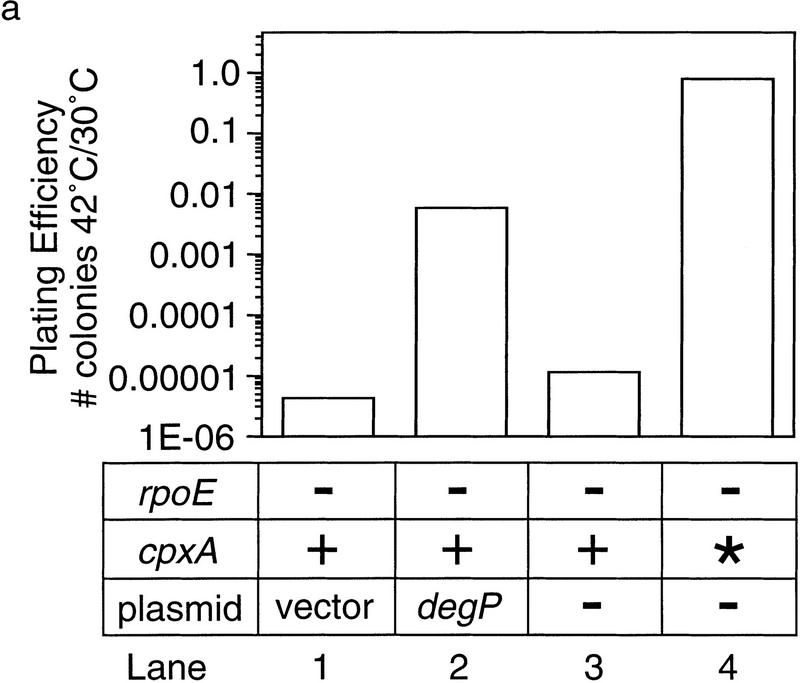
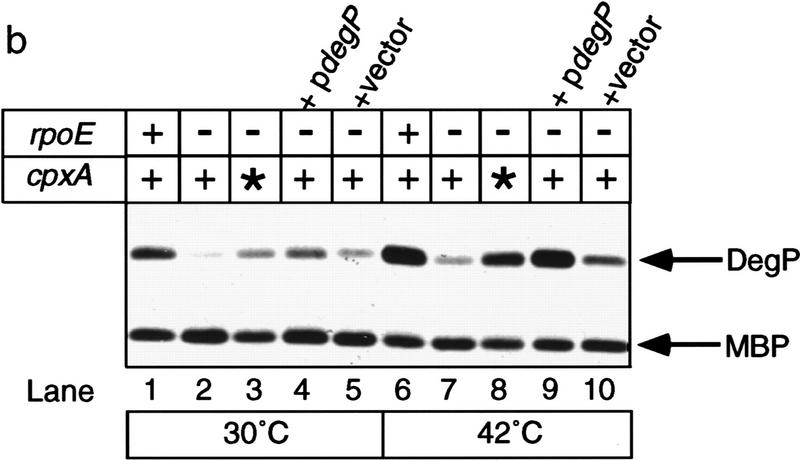
Phenotype of rpoE::ΩCm cells overexpressing DegP. (a) Plating efficiency. The efficiency of plating at 42°C of rpoE::ΩCm cells containing vector alone (lane 1) or a plasmid overexpressing degP (lane 2) was determined. For comparison, the plating efficiencies of rpoE cells containing a wild-type (lane 3) or fully activated (lane 4) cpxA allele are also shown. The numerical values of each plating efficiency were vector alone, 4.1 × 10−6; pdegP, 6.0 × 10−3; cpxA+, 1.1 × 10−5; and cpxA*, 0.8. (b) Western blot analysis of DegP expression. Wild-type cells (lanes 1,6), rpoE::ΩCm cells containing wild-type (cpxA+, lanes 2,7) or activated (cpxA*, lanes 3,8) cpxA alleles, or rpoE::ΩCm cells containing either a plasmid overexpressing degP (pdegP, lanes 4,9) or vector alone (lanes 5,10) were grown at 30°C to mid-log phase and then shifted to 42°C and grown for 20 min. The steady-state level of DegP expression in cells grown before and after heat shock was then determined by Western blot analysis as described in Materials and Methods. As a loading control, the blot was also probed with antibodies against maltose-binding protein (MBP).
Figure 4
Figure 4
Phenotype of rpoE::ΩCm cells overexpressing DegP. (a) Plating efficiency. The efficiency of plating at 42°C of rpoE::ΩCm cells containing vector alone (lane 1) or a plasmid overexpressing degP (lane 2) was determined. For comparison, the plating efficiencies of rpoE cells containing a wild-type (lane 3) or fully activated (lane 4) cpxA allele are also shown. The numerical values of each plating efficiency were vector alone, 4.1 × 10−6; pdegP, 6.0 × 10−3; cpxA+, 1.1 × 10−5; and cpxA*, 0.8. (b) Western blot analysis of DegP expression. Wild-type cells (lanes 1,6), rpoE::ΩCm cells containing wild-type (cpxA+, lanes 2,7) or activated (cpxA*, lanes 3,8) cpxA alleles, or rpoE::ΩCm cells containing either a plasmid overexpressing degP (pdegP, lanes 4,9) or vector alone (lanes 5,10) were grown at 30°C to mid-log phase and then shifted to 42°C and grown for 20 min. The steady-state level of DegP expression in cells grown before and after heat shock was then determined by Western blot analysis as described in Materials and Methods. As a loading control, the blot was also probed with antibodies against maltose-binding protein (MBP).
Figure 5
Figure 5
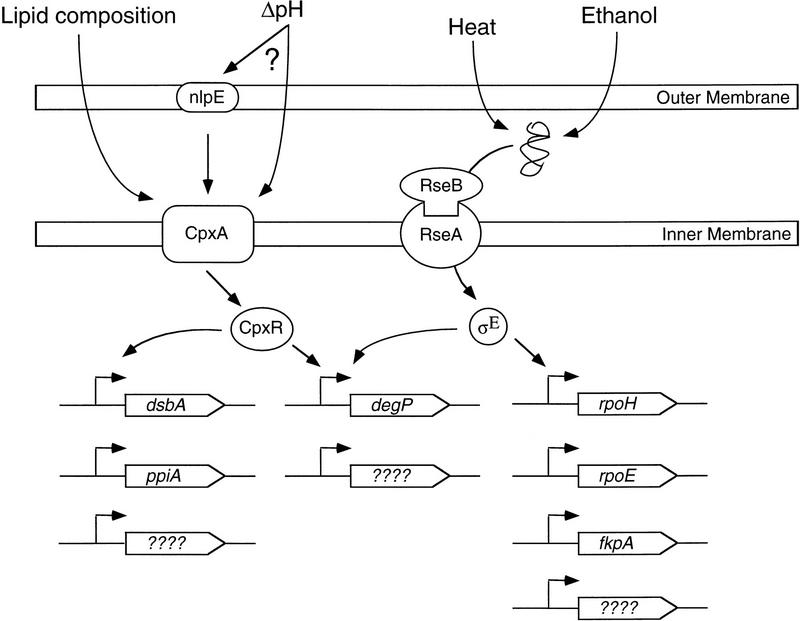
The extracytoplasmic stress response is controlled by partially overlapping pathways. The Cpx pathway controls the expression of several resident periplasmic folding proteins (DegP, PpiA, and DsbA) in response to overproduction of the outer membrane lipoprotein NlpE, and perhaps structural or physical alterations in the envelope induced by changes in pH or lipid composition. The alternate σ-factor σE controls the expression of degP, rpoH, rpoE, fkpA, and several other unidentified genes in response to the accumulation of misfolded OMP precursors in the periplasmic space. (See Discussion for further details).

References

    1. Altschul SF, Gish W, Miller W, Myers EW, Lipman DJ. Basic local alignment search tool. J Mol Biol. 1990;215:403–410. - PubMed
    1. Bartolomé B, Jubete Y, Martinez E, de la Cruz F. Construction and properties of a family of pACYC184-derived cloning vectors compatible with pBR322 and its derivatives. Gene. 1991;102:75–78. - PubMed
    1. Becker J, Craig EA. Heat-shock proteins as molecular chaperones. Eur J Biochem. 1994;219:11–23. - PubMed
    1. Bolivar F, Rodriguez RL, Greene PJ, Betlach MC, Heyneker HL, Boyer HW. Construction and characterization of new cloning vehicles. II. A multipurpose cloning system. Gene. 1977;2:95–113. - PubMed
    1. Bukau B. Regulation of the Escherichia coli heat-shock response. Mol Microbiol. 1993;9:671–680. - PubMed

Publication types

MeSH terms

LinkOut - more resources