


Is language a barrier to the use of preventive services?
- PMID: 9276652
- PMCID: PMC1497155
- DOI: 10.1046/j.1525-1497.1997.00085.x
Is language a barrier to the use of preventive services?
Abstract
Objective: To isolate the effect of spoken language from financial barriers to care, we examined the relation of language to use of preventive services in a system with universal access.
Design: Cross-sectional survey.
Setting: Household population of women living in Ontario, Canada, in 1990.
Participants: Subjects were 22,448 women completing the 1990 Ontario Health Survey, a population-based random sample of households.
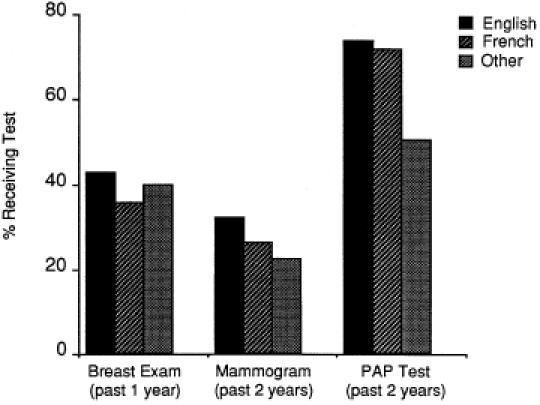
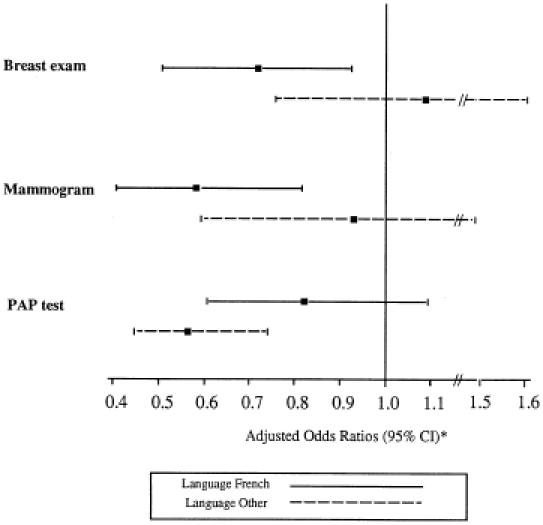
Measurements and main results: We defined language as the language spoken in the home and assessed self-reported receipt of breast examination, mammogram and Pap testing. We used logistic regression to calculate odds ratios for each service adjusting for potential sources of confounding: socio-economic characteristics, contact with the health care system, and measures reflecting culture. Ten percent of the women spoke a non-English language at home (4% French, 6% other). After adjustment, compared with English speakers, French-speaking women were significantly less likely to receive breast exams or mammography, and other language speakers were less likely to receive Pap testing.
Conclusions: Women whose main spoken language was not English were less likely to receive important preventive services. Improving communication with patients with limited English may enhance participation in screening programs.
Figures
References
Publication types
MeSH terms
LinkOut - more resources
Full Text Sources
Research Materials