. 1997 Sep 16;94(19):10189-94.
doi: 10.1073/pnas.94.19.10189.

The alpha chain of laminin-1 is independently secreted and drives secretion of its beta- and gamma-chain partners

Affiliations

The alpha chain of laminin-1 is independently secreted and drives secretion of its beta- and gamma-chain partners

P D Yurchenco et al. Proc Natl Acad Sci U S A. .

Erratum in

  • Proc Natl Acad Sci U S A 1998 Feb 17;95(4):1968

Abstract

A mammalian recombinant strategy was established to dissect rules of basement membrane laminin assembly and secretion. The alpha-, beta-, and gamma-chain subunits of laminin-1 were expressed in all combinations, transiently and/or stably, in a near-null background. In the absence of its normal partners, the alpha chain was secreted as intact protein and protein that had been cleaved in the coiled-coil domain. In contrast, the beta and gamma chains, expressed separately or together, remained intracellular with formation of betabeta or betagamma, but not gammagamma, disulfide-linked dimers. Secretion of the beta and gamma chains required simultaneous expression of all three chains and their assembly into alphabetagamma heterotrimers. Epitope-tagged recombinant alpha subunit and recombinant laminin were affinity-purified from the conditioned medium of alphagamma and alphabetagamma clones. Rotary-shadow electron microscopy revealed that the free alpha subunit is a linear structure containing N-terminal and included globules with a foreshortened long arm, while the trimeric species has the typical four-arm morphology of native laminin. We conclude that the alpha chain can be delivered to the extracellular environment as a single subunit, whereas the beta and gamma chains cannot, and that the alpha chain drives the secretion of the trimeric molecule. Such an alpha-chain-dependent mechanism could allow for the regulation of laminin export into a nascent basement membrane, and might serve an important role in controlling basement membrane formation.


Figures
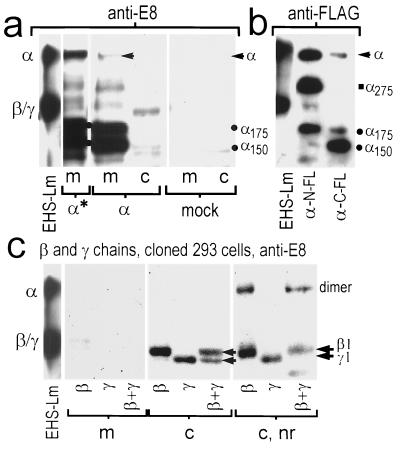
Figure 1
Figure 1
Expression of laminin solitary α chain and β and γ chains in 293 cells. Human 293 cells were transfected with DNAs encoding mouse laminin β, γ, β + γ, or with carrier DNA (mock). Conditioned culture medium (secreted fraction, m) and soluble cell lysate (c) were collected and analyzed in immunoblots under reducing or nonreducing (lanes indicated with nr) conditions using anti-E8 or anti-FLAG antibodies. (a) Wild-type 293 cells were stably (α*) and transiently (α) transfected with α cDNA. Medium from cloned transfected cells revealed a mixture of intact (arrow), and 175-kDa/150-kDa (dots) laminin-α-reacting species. Intact α chain, most secreted, was detected after transient transfection; however, most of the transiently expressed protein was noted to migrate at 175 and 150 kDa, suggesting proteolytic processing. No laminin bands were detected after mock transfections. EHS-laminin standard is shown in the left lane (note that the β and γ chains of EHS laminin are not resolved due to carbohydrate micro-heterogeneity). (b) Laminin α-pCIS, modified to contain the FLAG sequence at the N or C terminus, was transiently expressed. The differential intensities of FLAG (FL) epitope reactivity (all bands reacted with anti-laminin, not shown) indicated that the 275-kDa, 175-kDa, and 150-kDa bands were degradation products containing either the N or C terminus, and with cleavage in the coiled-coil domain. (c) Cellular expression, but not secretion, of prominent β and γ chains, and low amounts of smaller (degraded) species, was observed. When analyzed under nonreducing conditions, β and βγ dimers, but not γγ dimers, were detected.
Figure 2
Figure 2
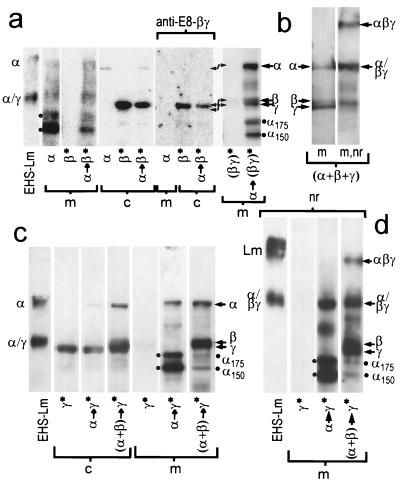
Expression of the α chain with β and γ chains. (a) 293 cells, wild type and stably expressing β (β*), or both β and γ [(βγ)*], were transiently transfected with α-pCIS (arrow points to transfection target cell) and evaluated for recombinant protein production with anti-E8 (or, where indicated, the βγ-specific reagent). With α/β coexpression, the α chain was detected in the medium while all of the β chain was confined to the cell fraction. In contrast, α transfection of βγ-expressing cells resulted in secretion of all three chains and in an increase in the fraction of intact α-chain. (b) Wild-type 293 cells were simultaneously transiently transfected with the α, β, and γ cDNAs. Expression and secretion of all three chains, with little degraded product, was detected with anti-E8 antibody, and a fraction of the secreted protein migrated in the expected position of disulfide-linked trimeric laminin. (c and d) Laminin γ cells (γ*) were transiently transfected with α DNA or were cotransfected with α and β DNA. Under reducing conditions the γ chain remained intracellular when expressed alone or coexpressed with only α (α→γ*). However, when α was coexpressed with the β and γ chains [(α+β)→γ*)], a broad βγ complex (double arrows) was detected in medium along with intact α chain (single arrow). Again, the α chain was secreted regardless of whether the β and γ were expressed; however, the chain was largely intact (≈380 kDa) when all three chains were expressed, but considerably cleaved (two dots) when expressed only with the γ chain. Under nonreducing conditions (nr, d), a fraction of the α chain migrated similar to that trimeric native EHS-laminin only when all three chains were expressed, indicating some recombinant chain was disulfide-linked to its partners.
Figure 3
Figure 3
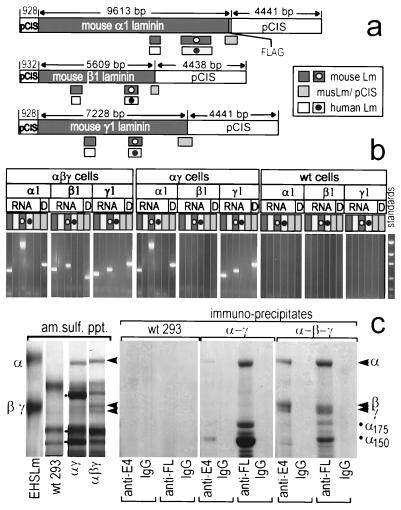
mRNA and protein characterization of cells expressing αγ and αβγ chains. (a) RT-PCR amplification products from the ORF (dark gray bars) of mouse α1, β1, and γ1 cDNAs, from pCIS extending into the ORFs (light gray bars), and from corresponding human α1, β1, and γ1 chains (white bars) were prepared from αβγ, αβ, and wild-type (wt) cells, using either total RNA (DNase-treated) or genomic DNA (D) as template. The human primers amplified the expected products from human placental RNA but not from midterm mouse embryo RNA. Conversely, the mouse primers amplified the expected products from mouse RNA but not from human RNA (data not shown). (b) The 293 cell products were electrophoresed on agarose gels to analyze recombinant and endogenous chain-specific mRNA expression (coded bars matched to map; standards were 2.0, 1.2, 0.8, 0.4, and 0.2 kb). The pCIS-specific products revealed that recombinant DNAs are present and that the RNA was not contaminated with these DNAs. As expected, recombinant mouse chains were expressed in the αγ and αβγ clones and not in wild-type cells. (c) Coomassie blue-stained polyacrylamide gel, reducing conditions, showing corresponding immunoblots with anti-E8 from media of wild-type cells and cells stably expressing mouse laminin αγ chains and αβγ chains. Secreted proteins from the media were precipitated with ammonium sulfate or immunoprecipitated with anti-E4 (β1-specific) antibody, rabbit IgG control, anti-FLAG (FL) antibody, or mouse IgG control. EHS laminin 1 (5 μg) was used as standard.
Figure 4
Figure 4
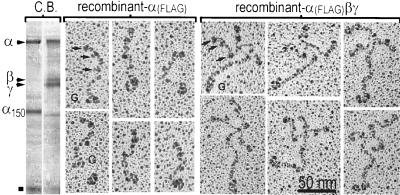
Rotary-shadowed electron micrographs of recombinant laminin α subunit and heterotrimeric laminin 1. Secreted FLAG-tagged recombinant α chain and laminin were affinity purified, rotary shadowed, analyzed in Coomassie blue (C.B.)-stained gels (Left), and examined by electron microscopy (Center and Right). The free α chain (Center) was a linear structure with a normal short arm (arrows indicate globules) and shortened long arm terminating in G domain. The fully recombinant αβγ chain complex (Right) had the typical appearance of laminin.
Figure 5
Figure 5
Working hypothesis of laminin subunit assembly and secretion. Expression by 293 cells of laminin β or γ chain alone results in intracellular retention of non-disulfide-linked chain with dimerization of the β chain, but not γ chain. β and γ coexpression results in intracellular retention of heterodimers. Expression of α chain results in secretion of monomeric chain with partial proteolytic cleavage: assembly with β without γ, or γ without β, does not occur. Coexpression of all three chains results in secretion of intact trimeric laminin. The α chain, the only chain which can be secreted free, drives secretion of paired βγ chains.

References

    1. Yurchenco P D. In: Extracellular Matrix Assembly and Structure. Yurchenco D P, Birk D, Mecham R, editors. New York: Academic; 1994. pp. 351–388.
    1. Timpl R, Brown J C. BioEssays. 1996;18:123–132. - PubMed
    1. Engvall E, Wewer U M. J Cell Biochem. 1996;61:493–501. - PubMed
    1. Burgeson R E, Chiquet M, Deutzmann R, Ekblom P, Engel J, Kleinman H, Martin G R, Meneguzzi G, Paulsson M, Sanes J, Timpl R, Tryggvason K, Yamada Y, Yurchenco P D. Matrix Biol. 1994;14:209–211. - PubMed
    1. Beck K, Hunter I, Engel J. FASEB J. 1990;4:148–160. - PubMed

Publication types

LinkOut - more resources