. 1997 Sep 16;94(19):10455-60.
doi: 10.1073/pnas.94.19.10455.

Synergistic interaction between leptin and cholecystokinin to reduce short-term food intake in lean mice

Affiliations

Synergistic interaction between leptin and cholecystokinin to reduce short-term food intake in lean mice

M D Barrachina et al. Proc Natl Acad Sci U S A. .

Abstract

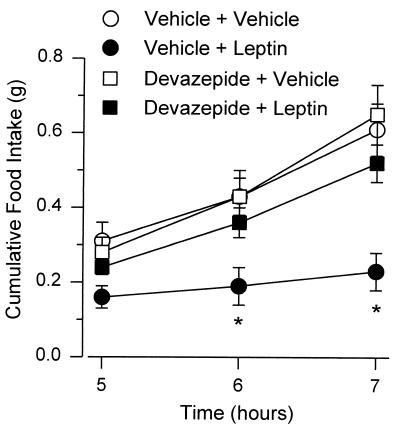
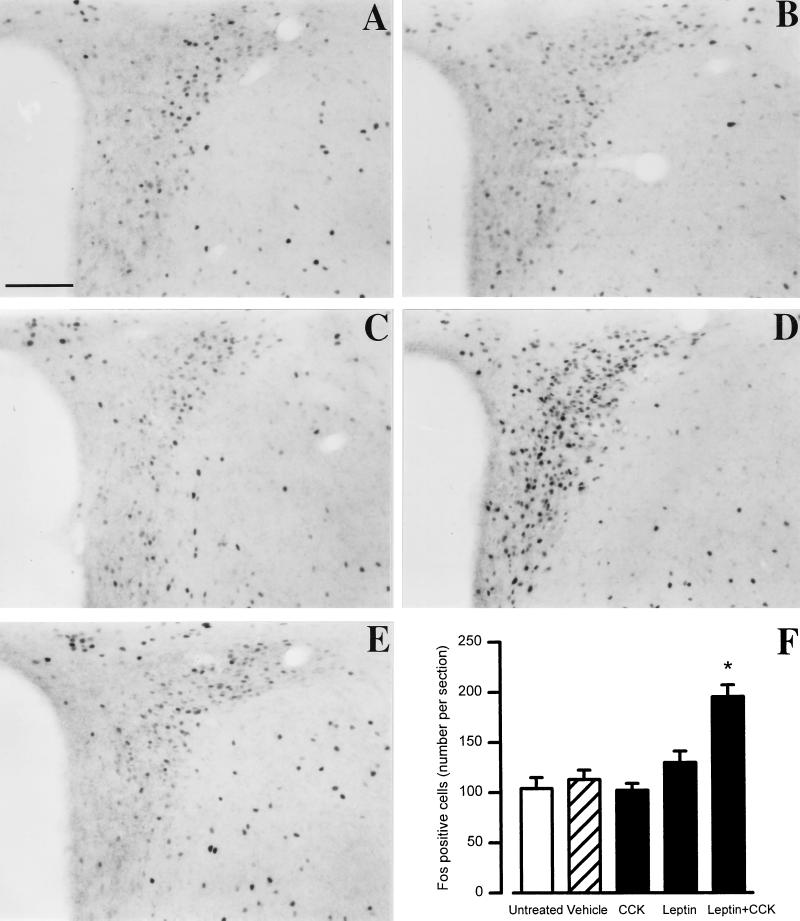
Leptin is a circulating protein involved in the long-term regulation of food intake and body weight. Cholecystokinin (CCK) is released postprandially and elicits satiety signals. We investigated the interaction between leptin and CCK-8 in the short-term regulation of food intake induced by 24-hr fasting in lean mice. Leptin, injected intraperitoneally (i.p.) at low doses (4-120 microg/kg), which did not influence feeding behavior for the first 3 hr postinjection, decreased food intake dose dependently by 47-83% during the first hour when coinjected with a subthreshold dose of CCK. Such an interaction was not observed between leptin and bombesin. The food-reducing effect of leptin injected with CCK was not associated with alterations in gastric emptying or locomotor behavior. Leptin-CCK action was blocked by systemic capsaicin at a dose inducing functional ablation of sensory afferent fibers and by devazepide, a CCK-A receptor antagonist but not by the CCK-B receptor antagonist, L-365,260. The decrease in food intake which occurs 5 hr after i.p. injection of leptin alone was also blunted by devazepide. Coinjection of leptin and CCK enhanced the number of Fos-positive cells in the hypothalamic paraventricular nucleus by 60%, whereas leptin or CCK alone did not modify Fos expression. These results indicate the existence of a functional synergistic interaction between leptin and CCK leading to early suppression of food intake which involves CCK-A receptors and capsaicin-sensitive afferent fibers.


Figures
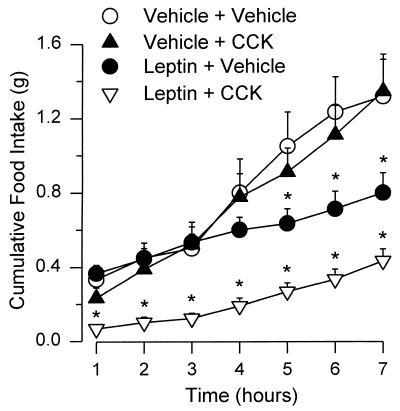
Figure 1
Figure 1
Early inhibition of cumulative food intake induced by i.p. injection of leptin plus CCK in fasted lean mice (+/+). Animals were exposed to food immediately after a single i.p. injection of control vehicles (10 ml/kg, ○; n = 6), vehicle plus leptin (120 μg/kg, •, n = 8), vehicle plus CCK (3.5 μg/kg, ▴, n = 7) or leptin plus CCK (▵, n = 8). Data are expressed as mean ± SEM. ∗, P < 0.05 vs. the group treated with combined vehicles [ANOVA, F(27,203) = 10.899].
Figure 2
Figure 2
Dose-related inhibition of the 2-hr cumulative food intake induced by leptin in presence of CCK in lean mice (+/+) fasted for 24 hr. Leptin was coinjected i.p. with either vehicle, CCK (3.5 μg/kg), or bombesin (5 μg/kg), and mice were immediately exposed to food for 2 hr. Data are expressed as mean ± SEM of 6–12 animals per group. ∗, P < 0.05 vs. the respective leptin alone-treated group or vs. the group receiving CCK alone [ANOVA, F(11,94) = 9.047].
Figure 3
Figure 3
Blockade of leptin–CCK interaction by the CCK-A receptor antagonist devazepide or by systemic capsaicin in lean mice (+/+). After 10-min pretreatment with L-365,260 (1 mg/kg, i.p.), 10-min pretreatment with devazepide (1 mg/kg, i.p.), 7-day pretreatment with capsaicin (50 mg/kg, s.c.), or pooled vehicles, 24-hr fasted mice received a single i.p. injection of either vehicle plus vehicle or leptin (120 μg/kg) plus CCK (3.5 μg/kg) and were exposed to food for 2 hr. Data are mean ± SEM of 6–11 mice per group. ∗, P < 0.05 vs. all other groups [ANOVA, F(7,65) = 24.694].
Figure 4
Figure 4
Blockade of leptin-induced inhibition of food intake by devazepide. Mice fasted for 20 hr were injected i.p. with either saline (5 ml/kg) or leptin (120 μg/kg) and 4 hr later were exposed to food for 3 hr. Vehicle (5 ml/kg) or devazepide (1 mg/kg) was injected i.p. 10 min before food exposure. ∗, P < 0.05 vs. other experimental groups at the same time period [ANOVA, F(11,102) = 9.876].
Figure 5
Figure 5
Fos immunoreactivity in the PVN after leptin + CCK coinjected in lean mice (+/+). Representative microphotographs show Fos protein immunoreactivity in the PVN 2 hr after a single i.p. injection of (A) combined vehicles (10 ml/kg), (B) CCK (3.5 μg/kg), (C) leptin (120 μg/kg), or (D) leptin plus CCK, and (E) in fasted untreated animals. Marked increase in Fos immunoreactivity, resulting in dark and well-shaped nuclei, was observed in the parvo- and magnocellular divisions of the PVN after leptin plus CCK treatment, whereas other groups exhibited only scattered and lightly labeled cells. (Bar = 100 μm.) (F) The number of cells per section (unilateral). Data are mean ± SEM of four animals per group. ∗, P < 0.05 vs. all other groups (Kruskal–Wallis ANOVA, KW = −1308.4).

References

    1. Pelleymounter M A, Cullen M J, Baker M B, Hecht R, Winters D, Boone T, Collins F. Science. 1995;269:540–543. - PubMed
    1. Halaas J L, Gajiwala K S, Maffei M, Cohen S L, Chait B T, Rabinowitz D, Lallone R L, Burley S K, Friedman J M. Science. 1995;269:543–546. - PubMed
    1. Campfield L A, Smith F J, Guisez Y, Devos R, Burn P. Science. 1995;269:546–549. - PubMed
    1. Muzzin P, Eisensmith R C, Copeland K C, Woo S L C. Proc Natl Acad Sci USA. 1996;93:14804–14808. - PMC - PubMed
    1. Levin N, Nelson C, Gurney A, Vandlen R, De Sauvage F. Proc Natl Acad Sci USA. 1996;93:1726–1730. - PMC - PubMed

Publication types

LinkOut - more resources