Ranitidine bismuth citrate with clarithromycin for the treatment of duodenal ulcer
- PMID: 9301496
- PMCID: PMC1891448
- DOI: 10.1136/gut.41.2.181
Ranitidine bismuth citrate with clarithromycin for the treatment of duodenal ulcer
Abstract
Background/aims: To investigate the effect of the new Helicobacter pylori eradication regimen, ranitidine bismuth citrate (RBC) and clarithromycin (CLAR) dual therapy, on duodenal ulcer healing and absence of ulcer recurrence during 24 weeks follow up (overall success).
Methods: Two hundred and thirty two H pylori positive patients with active duodenal ulcer received four weeks treatment with RBC 400 mg twice daily alone (RBC400) (n = 82), or RBC 400 or 800 mg twice daily co-prescribed with clarithromycin 250 mg four times daily for 14 days, followed by 14 days of RBC 400 mg twice daily alone (RBC400+CLAR and RBC 800+CLAR, respectively, n = 75 for each).
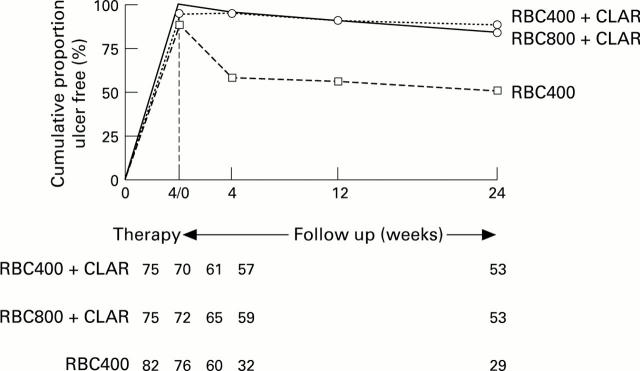
Results: The co-prescription regimens gave high H pylori eradication rates determined using two tests (CLOtest and 13C-urea breath test) for the presence of the organism. These rates were 92% and 81% for RBC400+CLAR (n = 62) and RBC800+CLAR (n = 63) respectively, compared with 2% for RBC400 (n = 66) (p < 0.001). With respect to overall success as estimated by life table analysis, RBC400+CLAR (89%) and RBC800+CLAR (87%) were significantly more effective than RBC400 alone (51%) (p < 0.001). All regimens were safe and well tolerated. Trough plasma bismuth concentrations at week 4 were low (treatment medians less than 6.6 ng bismuth/ml).
Conclusions: Ranitidine bismuth citrate is a well tolerated and efficacious ulcer healing drug which, when co-prescribed with clarithromycin, affords effective H pylori eradication therapy and prevents ulcer relapse in most patients with duodenal ulcer.
Figures
References
Publication types
MeSH terms
Substances
LinkOut - more resources
Full Text Sources
Medical