


Alcohol self-administration: further examination of the role of dopamine receptors in the nucleus accumbens
- PMID: 9309321
- PMCID: PMC11584055
- DOI: 10.1111/j.1530-0277.1997.tb04257.x
Alcohol self-administration: further examination of the role of dopamine receptors in the nucleus accumbens
Abstract
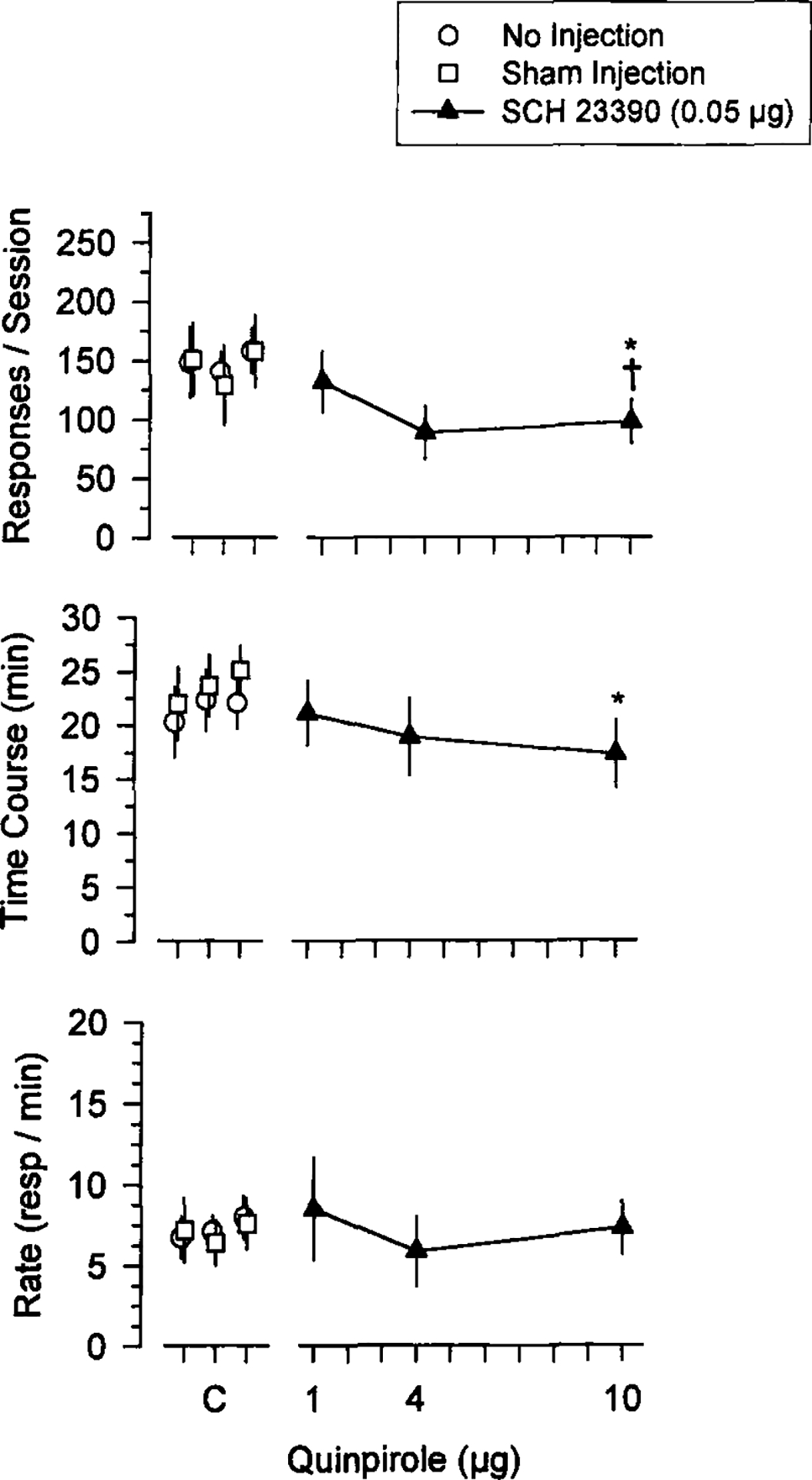
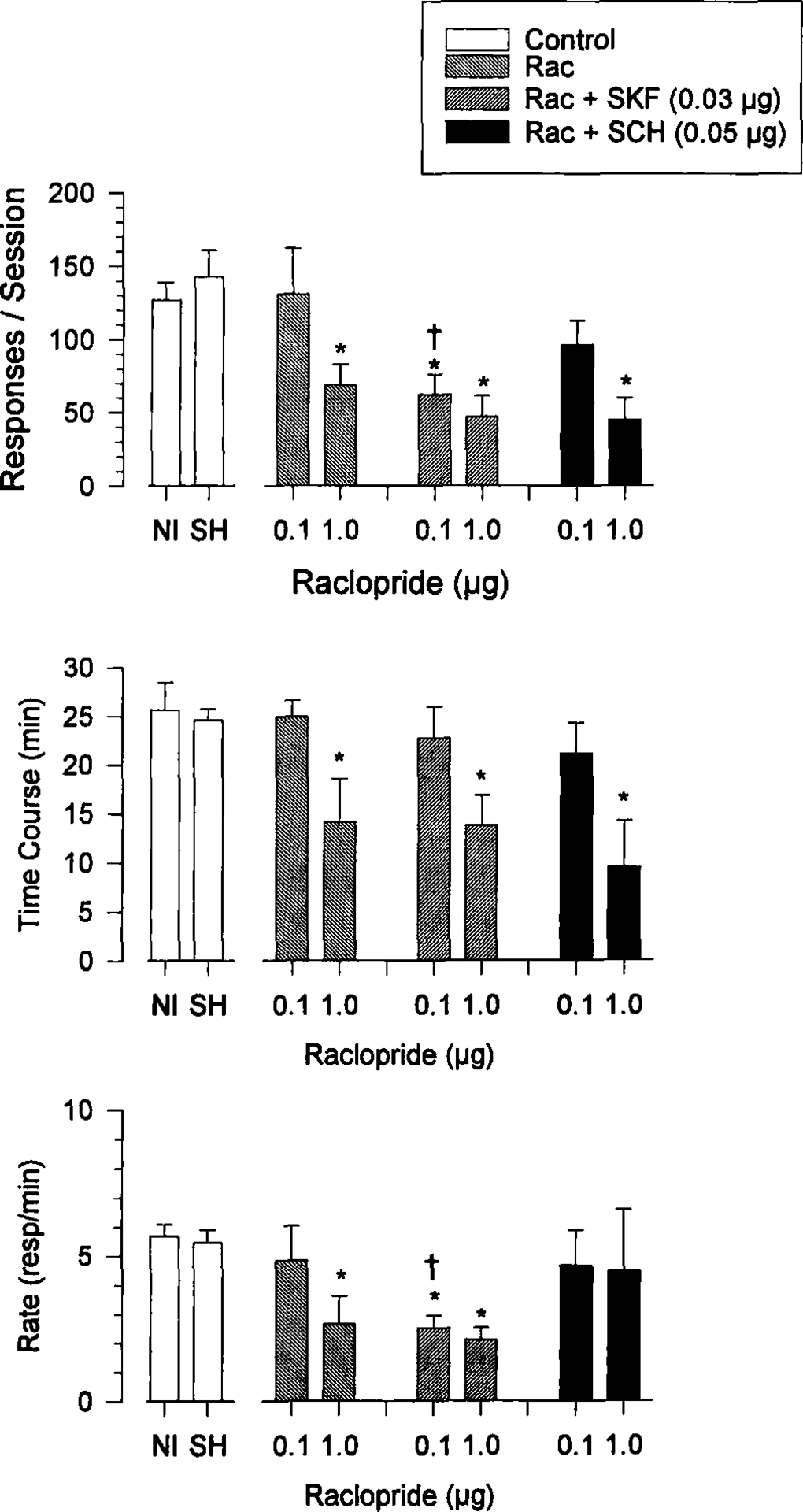
One of the functions of the mesolimbic dopamine (DA) system is to regulate the process of reinforcement, a process that is thought to influence drug self-administration. This study tested the effects of centrally administered DA receptor ligands on ethanol self-administration behavior. Long-Evans rats were trained to lever press on a fixed-ratio 4 schedule of ethanol (10% v/v) reinforcement. DA agonists and antagonists were then bilaterally microinjected (0.5 microliter/side) into the nucleus accumbens (N Acc) 10-min before sessions to test for effects on the onset, maintenance, and termination of ethanol self-administration. Infusions of the D1-like agonist SKF 38393 (0.03 to 3.0 micrograms) produced no effect on ethanol self-administration. The D1-like antagonist SCH 23390 (0.5 to 2.0 micrograms) reduced total responding by decreasing the time course of self-administration without altering response rate. The D2-like agonist quinpirole produced a biphasic effect on self-administration. Quinpirole (1.0 microgram) increased total responses and response rate, whereas higher doses (4.0 to 10.0 micrograms) decreased total responding as a result of early termination. The D2-like antagonist raclopride (0.1 to 1.0 microgram) reduced total responding by decreasing time course and response rate. Co-administration of either SKF 38393 or SCH 23390 with quinpirole prevented the behavioral effects observed with the low doses of quinpirole. Thus, in the N Acc either increased activation of D1-like receptors or their blockade can affect the expression of the behavioral effects of the D2-like agonist. This suggests that some intermediate level of D1 activation is required to observe the D2 effect. The decreases in total responding produced by raclopride were enhanced by co-administration of SKF 38393, but not altered by SCH 23390, thus suggesting that D1-like and D2-like receptors in the N Acc interact in the regulation of ethanol self-administration in a manner similar to their interactive regulation of other behaviors.
Figures


References
-
- Colle L, Wise RA: Concurrent facilitory and inhibitory effects of amphetamine on stimulation-induced eating. Brain Res 459:356–360, 1988 - PubMed
-
- Evans KR, Vaccarino FJ: Intra-nucleus accumbens amphetamine: Dose dependent effects on food intake. Pharmacol Biochem Behav 27: 1149–1151, 1986 - PubMed
-
- Dreher JK, Jackson DM: Role of D1 and D2 dopamine receptors in mediating locomotor activity elicited from the nucleus accumbens of rats. Brain Res 487:267–277, 1989 - PubMed
-
- Salamone JD: The involvement of nucleus accumbens dopamine in appetitive and aversive motivation. Behav Brain Res 61:117–133, 1994 - PubMed
-
- Koob GF: Drugs of abuse: Anatomy, pharmacology and function of reward pathways. Trends Pharmacol Sci 13:177–184, 1992 - PubMed
Publication types
MeSH terms
Substances
Grants and funding
LinkOut - more resources
Full Text Sources
Medical
Miscellaneous
