. 1997 Oct 6;186(7):1165-70.
doi: 10.1084/jem.186.7.1165.

Cloning and characterization of TRAIL-R3, a novel member of the emerging TRAIL receptor family

Affiliations

Cloning and characterization of TRAIL-R3, a novel member of the emerging TRAIL receptor family

M A Degli-Esposti et al. J Exp Med. .

Abstract

TRAIL-R3, a new member of the TRAIL receptor family, has been cloned and characterized. TRAIL-R3 encodes a 299 amino acid protein with 58 and 54% overall identity to TRAIL-R1 and -R2, respectively. Transient expression and quantitative binding studies show TRAIL-R3 to be a plasma membrane-bound protein capable of high affinity interaction with the TRAIL ligand. The TRAIL-R3 gene maps to human chromosome 8p22-21, clustered with the genes encoding two other TRAIL receptors. In contrast to TRAIL-R1 and -R2, this receptor shows restricted expression, with transcripts detectable only in peripheral blood lymphocytes and spleen. The structure of TRAIL-R3 is unique when compared to the other TRAIL receptors in that it lacks a cytoplasmic domain and appears to be glycosyl-phosphatidylinositol-linked. Moreover, unlike TRAIL-R1 and -R2, in a transient overexpression system TRAIL-R3 does not induce apoptosis.


Figures
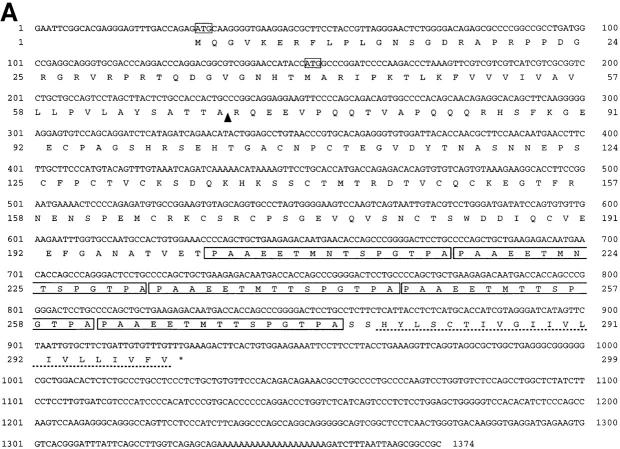
Figure 1
Figure 1
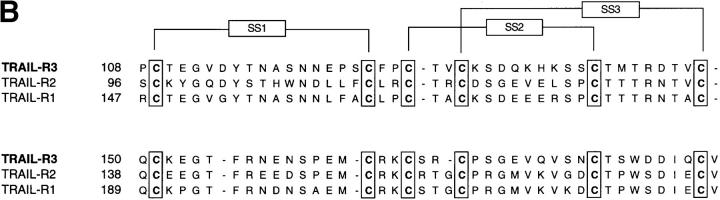
TRAIL-R3 is a novel member of the TRAIL receptor family. (A) The nucleotide and aa sequence of TRAIL-R3 is shown. The aa sequence is started at the first Met; the two potential initiator codons are boxed. The predicted NH2-terminal leader cleavage site is indicated by the triangle. The COOH-terminal hydrophobic domain is marked by a dashed line. Five pseudo-repeats in the linker region, separating the extracellular domain from the hydrophobic COOH terminus, are shown in boxes. (B) Alignment of the extracellular domains of TRAIL-R3, -R2, and -R1 shows conservation of two of the cysteine-rich pseudo-repeats characteristic of the TNF receptor family. Conserved cysteine residues are boxed. Predicted disulfide bonds are shown. These sequence data are available from EMBL/GenBank/DDBJ under accession number AF014794.
Figure 1
Figure 1
TRAIL-R3 is a novel member of the TRAIL receptor family. (A) The nucleotide and aa sequence of TRAIL-R3 is shown. The aa sequence is started at the first Met; the two potential initiator codons are boxed. The predicted NH2-terminal leader cleavage site is indicated by the triangle. The COOH-terminal hydrophobic domain is marked by a dashed line. Five pseudo-repeats in the linker region, separating the extracellular domain from the hydrophobic COOH terminus, are shown in boxes. (B) Alignment of the extracellular domains of TRAIL-R3, -R2, and -R1 shows conservation of two of the cysteine-rich pseudo-repeats characteristic of the TNF receptor family. Conserved cysteine residues are boxed. Predicted disulfide bonds are shown. These sequence data are available from EMBL/GenBank/DDBJ under accession number AF014794.
Figure 2
Figure 2
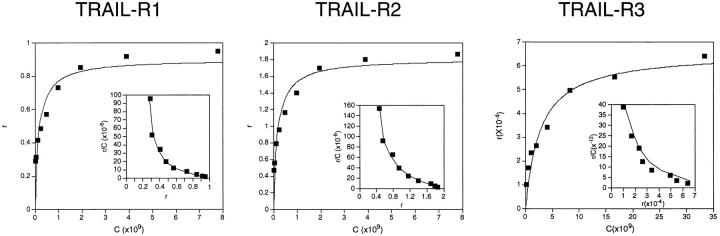
Equilibrium binding isotherms of TRAIL-R3, -R2, and -R1. Full length TRAIL-R3 transiently expressed on CVI/EBNA cells and purified TRAIL-R1 and -R2 Fc proteins were used in equilibrium binding assays with LZ-TRAIL + 125I-labeled M15 anti-LZ antibody, as described above (see Materials and Methods). The binding data plotted in the Scatchard coordinate system is shown. The membrane-bound TRAIL-R3 protein binds TRAIL with similar affinity as TRAIL-R1 and -R2 soluble Fc proteins.
Figure 3
Figure 3
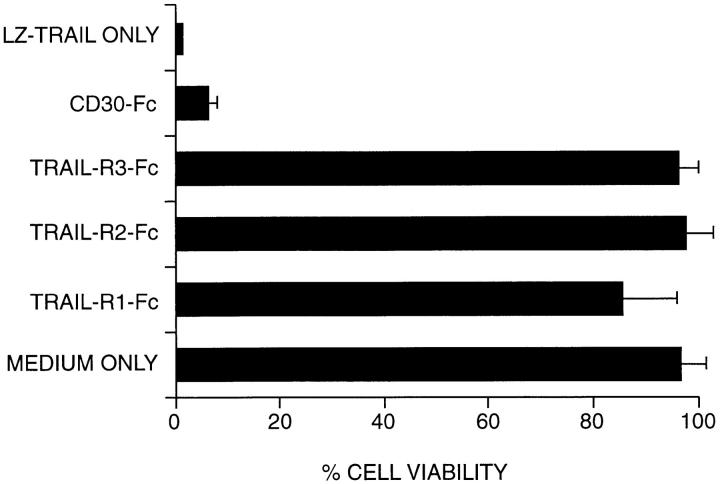
TRAIL-R3–Fc inhibits TRAIL-mediated killing. Jurkat cells treated with LZ-TRAIL (150 ng/ml) were cultured for 16 h with concentrated supernatants containing soluble TRAIL-R3–Fc, -R2–Fc, -R1– Fc or CD30-Fc proteins. All three TRAIL-R–Fc proteins block TRAIL-mediated apoptosis of Jurkat cells as measured by MTT conversion (12). The maximum viability value corresponds to the MTT reading in the absence of LZ-TRAIL (MEDIUM ONLY). The minimum viability value corresponds to the MTT reading in the presence of LZ-TRAIL (LZ-TRAIL ONLY).
Figure 4
Figure 4
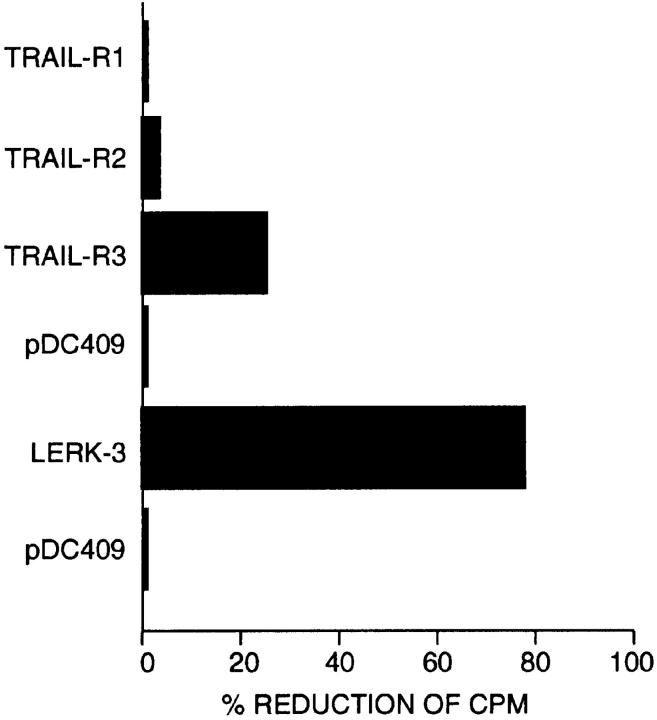
TRAIL-R3 can be partially displaced from the cell membrane by phospholipase C. The effect of PI-PLC treatment of CVI/EBNA cells transiently transfected with TRAIL-R1, -R2, -R3, LERK-3, or empty pDC409 vector is shown. After treatment or no treatment with PI-PLC, the cells were incubated with either LZ-TRAIL followed by 125I-labeled M15 anti-LZ antibody or Hek-Fc followed by 125I-labeled goat anti–human–Fc. The radioactivity in the free and bound probes, separated by microfuging through a pthalate oil mixture, was counted and the results plotted. PI-PLC treatment resulting in lowered bound probe counts (cpm) indicates displacement of cell surface proteins that bind the labeled probe.
Figure 5
Figure 5
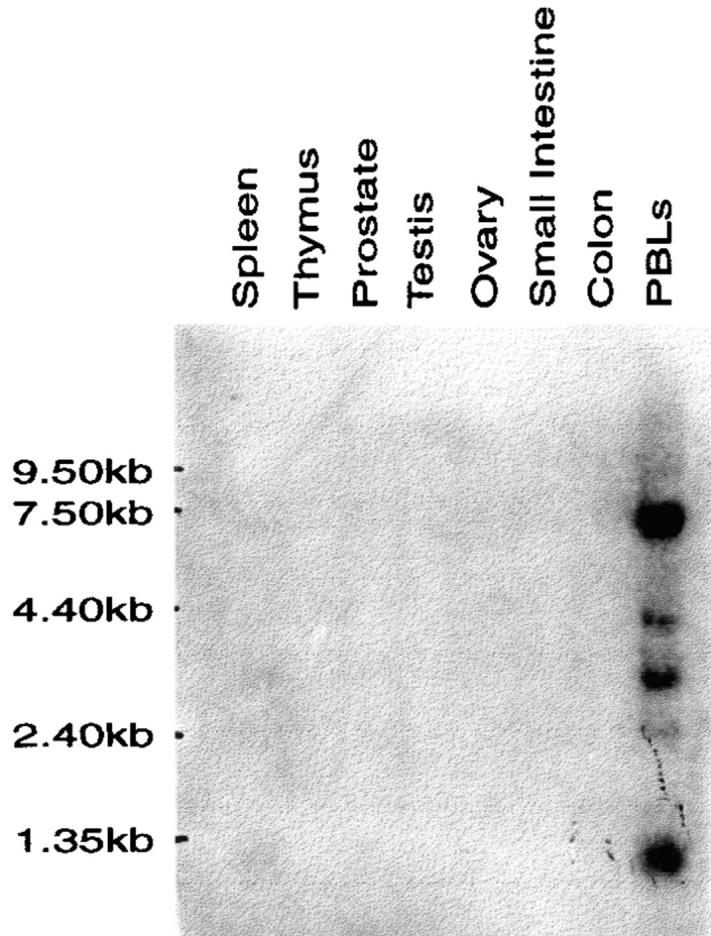
TRAIL-R3 shows restricted tissue expression. Northern analysis showing the distribution of TRAIL-R3 mRNA in whole human tissues. The source of the mRNA is shown above each lane. The position of RNA size markers is shown on the left. Multiple transcripts are detected in PBLs.

References

    1. Cosman D. A family of ligands for the TNF receptor superfamily. Stem Cells. 1994;12:440–455. - PubMed
    1. Smith CA, Farrah T, Goodwin RG. The TNF receptor superfamily of cellular and viral proteins: activation, costimulation, and death. Cell. 1994;76:959–962. - PubMed
    1. Wiley SR, Schooley K, Smolak PJ, Din WS, Huang C-P, Nicholl JK, Sutherland GR, Davis-Smith T, Rauch C, Smith CA, Goodwin RG. Identification and characterization of a new member of the TNF family that induces apoptosis. Immunity. 1995;3:673–682. - PubMed
    1. Suda T, Okazaki T, Naito Y, Yokota T, Arai N, Ozaki S, Nakao K, Nagata S. Expression of the Fas ligand in cells of T cell lineage. J Immunol. 1995;154:3806–3813. - PubMed
    1. Griffith TS, Brunner T, Fletcher S, Green DR, Ferguson TA. Fas ligand–induced apoptosis as a mechanism of immune privilege. Science (Wash DC) 1995;270:1189–1192. - PubMed

MeSH terms

Substances

Associated data