. 1997 Oct 14;94(21):11238-43.
doi: 10.1073/pnas.94.21.11238.

Sequence-specific recognition of a subgenomic RNA promoter by a viral RNA polymerase

Affiliations

Sequence-specific recognition of a subgenomic RNA promoter by a viral RNA polymerase

R W Siegel et al. Proc Natl Acad Sci U S A. .

Abstract

RNA templates of 33 nucleotides containing the brome mosaic virus (BMV) core subgenomic promoter were used to determine the promoter elements recognized by the BMV RNA-dependent RNA polymerase (RdRp) to initiate RNA synthesis. Nucleotides at positions -17, -14, -13, and -11 relative to the subgenomic initiation site must be maintained for interaction with the RdRp. Changes to every other nucleotide at these four positions allow predictions for the base-specific functional groups required for RdRp recognition. RdRp contact of the nucleotide at position -17 was suggested with a template competition assay. Comparison of the BMV subgenomic promoter to those from other plant and animal alphaviruses shows a remarkable degree of conservation of the nucleotides required for BMV subgenomic RNA synthesis. We show that the RdRp of the plant-infecting BMV is capable of accurately, albeit inefficiently, initiating RNA synthesis from the subgenomic promoter of the animal-infecting Semliki Forest virus. The sequence-specific recognition of RNA by the BMV RdRp is analogous to the recognition of DNA promoters by DNA-dependent RNA polymerases.


Figures
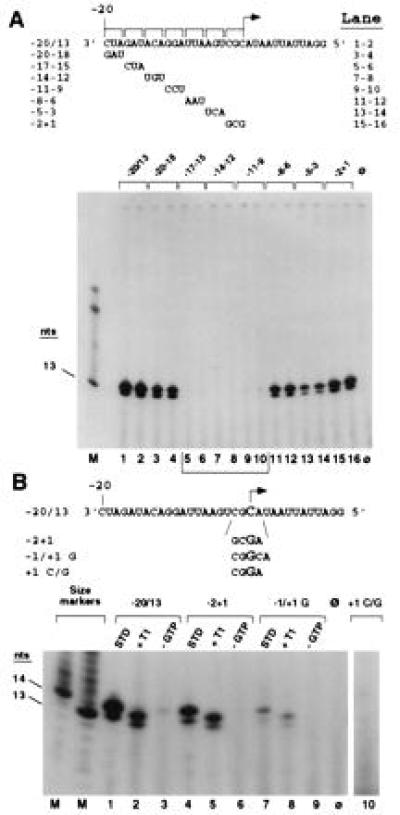
Figure 1
Figure 1
Regions in the BMV subgenomic promoter required for accurate and efficient initiation of RNA synthesis. (A) Triple transversion mutants. The sequence shown is proscript −20/13 containing the WT BMV core promoter directing synthesis of a 13-nt product. Nucleotide changes, in groups of three, in proscripts are shown with brackets and the mutant nucleotides are displayed below the WT sequence. Identity of input templates, in duplicate reactions, is indicated at the top of the gel. Reaction products were separated by denaturing PAGE (lanes 1–16) and visualized by autoradiography. The predominant RdRp product was 14 nt as judged by comparison to a 13-nt size marker (lane M) due to the nontemplated addition of one nucleotide, possibly by RdRp. Lane φ represents the products of a control reaction with no added template. Region of the subgenomic promoter required for activity is bracketed below the gel. (B) Sequence requirements for accurate initiation of RNA synthesis. The WT promoter sequence is shown on top. RNAs with altered initiation sequences are shown below. The initiating nucleotide (WT or mutant) is denoted with an arrow and larger size font. STD indicates products of a standard RdRp reaction (lanes 1, 4, and 7) and reactions lacking GTP are indicated by −GTP (lanes 3, 6, and 9). RNase T1 digestion of the RdRp products is indicated with +T1 (lanes 2, 5, and 8). Size markers (lane M) indicate size of the RdRp products; products from reactions with no added template are shown (lane φ).
Figure 2
Figure 2
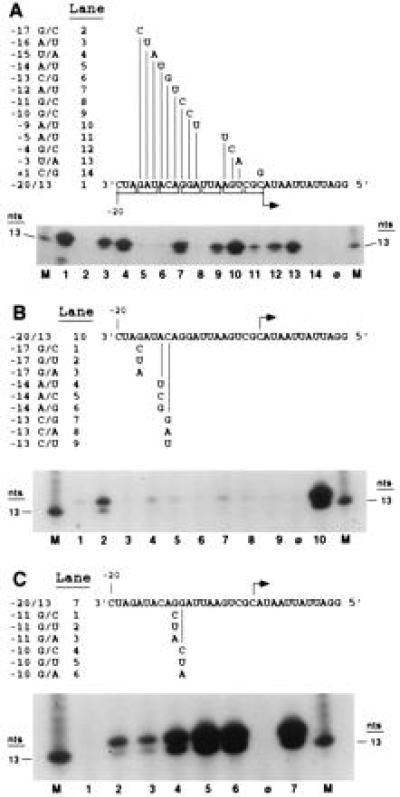
Mutational analysis of the BMV subgenomic core promoter. The lanes containing the RdRp reaction products from input proscripts are indicated adjacent to proscript names in each schematic. All products were separated on 20% denaturing polyacrylamide gels. Because these autoradiographs do not contain bands other than the RdRp products of the expected sizes, only the portions of the autoradiograph containing the RdRp products are shown. Lane φ indicates products made from reactions lacking input template whereas lane M contains a 13-nt size marker, generated by T7 RNA polymerase, of the identical sequence as the expected RdRp product. Products from proscripts supporting synthesis were accurately initiated as judged by comparison to size markers and the WT construct. (A) Single nucleotide transversion mutations in nucleotides −17 to −9, −5 to −3, and +1. Nucleotide sequences of the WT template (−20/13) and corresponding changes are shown with the original three nucleotide transversions bracketed. (B) All possible nucleotide replacements at positions −17, −14, and −13. Sequence of WT proscript (−20/13) is shown with appropriate changes indicated below. (C) All possible nucleotide replacements at positions −11 and −10. Schematic of WT proscript is shown and the identity of subsequent mutants is indicated below.
Figure 3
Figure 3
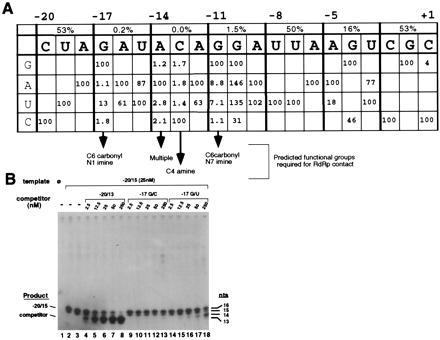
(A) Summary of the mutational analysis of the BMV subgenomic promoter. The WT sequence is in bold letters displayed horizontally with relative nucleotides positions marked above. Percentages in rectangles above the promoter sequence represent relative activity of the original triple transversion mutants. Key to nucleotide changes is at the left side. Values listed below the WT sequence represent the percent activity of the single nucleotide mutants compared with the WT proscript. The predicted functional groups required for the nucleotides at positions −17, −14, −13, and −11 are indicated below the arrows. (B) Potential binding contacts within the subgenomic core promoter. Competition between a WT promoter directing synthesis of a 15-nt product (−20/15) and one of three competitor templates encoding 13-nt products: −20/13, containing the WT BMV subgenomic promoter sequence; −17 G/C, a nonfunctional mutant template; −17 G/U, a partially functional template. The reaction in lane 1 was performed without any input templates whereas reactions in lanes 2–18 each contain 25 nM of the −20/15 template with the identity and quantity of competitor template indicated above the autoradiograph. The identities of the RdRp products and their sizes are denoted on each side of the autoradiograph.
Figure 4
Figure 4
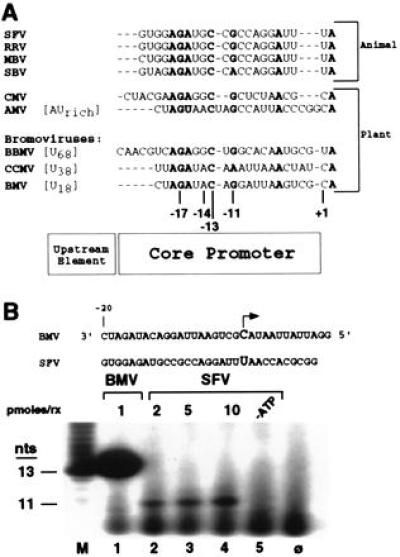
Conservation of subgenomic core promoters in the alphavirus-like superfamily. (A) Alignment of subgenomic promoters from both animal and plant viruses. Conserved nucleotides in the core promoter are shown in bold. Sequences were obtained from the GenBank database. Homopolymeric upstream elements, where present, are indicated with brackets. SFV, Semliki Forest virus; RRV, Ross River virus; MBV, Middelburg virus; SBV, Sindbis virus; CMV, cucumber mosaic virus; AMV, alfalfa mosaic virus; BBMV, broad bean mottle virus; CCMV, cowpea chlorotic mottle virus; BMV, brome mosaic virus. The alignment was generated using the clustalw software program. Positions −17, −14, −13, and −11 are noted below the BMV sequence; +1 denotes the initiation nucleotide. (B) BMV RdRp recognizes the SFV subgenomic promoter. A schematic for proscripts containing the WT subgenomic promoter for either BMV or SFV is shown with the initiating nucleotide indicated by the arrow. The 13-nt product from the BMV proscript −20/13 is shown in lane 1. The SFV proscript encodes an 11-nt product which requires an adenylate for correct initiation (lanes 2–5). Amounts of template (in pmol) used in an RdRp reaction are shown at the top of the gel; −ATP indicates absence of ATP in reaction. M denotes a 13-nt size marker produced by T7 RNA polymerase, and φ denotes a reaction with no added template.
Figure 5
Figure 5
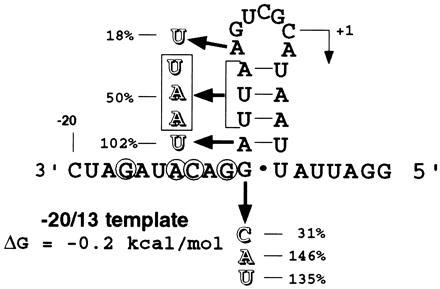
Correlation between the structure of proscript −20/13 and the ability of mutant BMV proscripts to direct RNA synthesis. Computer-predicted structure of the WT template (−20/13) is shown and positions −17, −14, −13, and −11 determined to be critical for RNA synthesis are circled. Mutations generated in this study which should affect the predicted secondary structure are indicated along with the relative activity of that mutant proscript. The initiation nucleotide (+1) is indicated with an arrow.

References

    1. Buck K W. Adv Virus Res. 1996;47:159–251. - PMC - PubMed
    1. Ishihama A, Barbier P. Arch Virol. 1994;134:235–258. - PMC - PubMed
    1. Goldbach R, LeGall O, Welink J. Semin Virol. 1991;2:19–25.
    1. Hardy S F, German T L, Loesch-Fries L S, Hall T C. Proc Natl Acad Sci USA. 1979;76:4956–4960. - PMC - PubMed
    1. Miller W A, Dreher T W, Hall T C. Nature (London) 1985;313:68–70. - PubMed

Publication types