. 1997 Oct 14;94(21):11577-82.
doi: 10.1073/pnas.94.21.11577.

Random locomotion and chemotaxis of human blood polymorphonuclear leukocytes (PMN) in the presence of EDTA: PMN in close quarters require neither leukocyte integrins nor external divalent cations

Affiliations

Random locomotion and chemotaxis of human blood polymorphonuclear leukocytes (PMN) in the presence of EDTA: PMN in close quarters require neither leukocyte integrins nor external divalent cations

S E Malawista et al. Proc Natl Acad Sci U S A. .

Abstract

Divalent cations are thought essential for motile function of leukocytes in general, and for the function of critical adhesion molecules in particular. In the current study, under direct microscopic observation with concomitant time-lapse video recording, we examined the effects of 10 mM EDTA on locomotion of human blood polymorphonuclear leukocytes (PMN). In very thin slide preparations, EDTA did not impair either random locomotion or chemotaxis; motile behavior appeared to benefit from the close approximation of slide and coverslip ("chimneying"). In preparations twice as thick, PMN in EDTA first exhibited active deformability with little or no displacement, then rounded up and became motionless. However, on creation of a chemotactic gradient, the same cells were able to orient and make their way to the target, often, however, losing momentarily their purchase on the substrate. In either of these preparations without EDTA, specific antibodies to beta2 integrins did not prevent random locomotion or chemotaxis, even when we added antibodies to beta1 and alphavbeta3 integrins and to integrin-associated protein, and none of these antibodies added anything to the effects of EDTA. In the more turbulent environment of even more media, effects of anti-beta2 integrins became evident: PMN still could locomote but adhered to substrate largely by their uropods and by uropod-associated filaments. We relate these findings to the reported independence from integrins of PMN in certain experimental and disease states. Moreover, we suggest that PMN locomotion in close quarters is not only integrin-independent, but independent of external divalent cations as well.


Figures
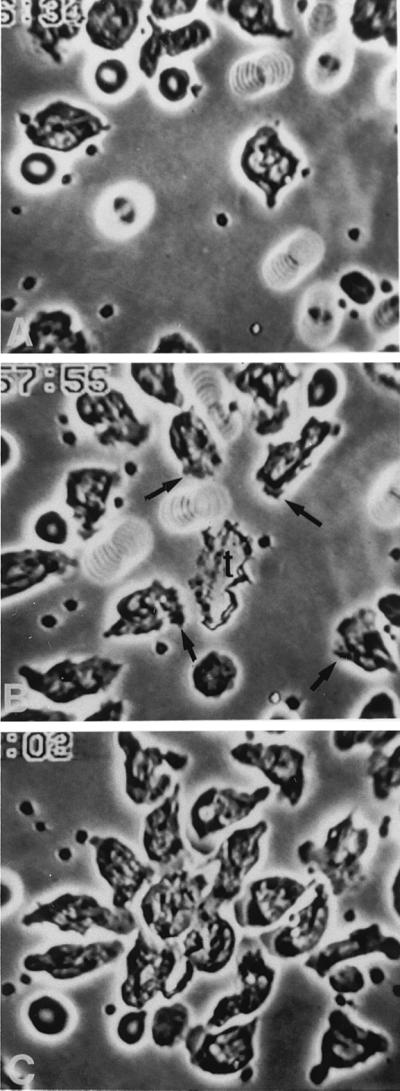
Figure 1
Figure 1
EDTA (10 mM) in standard (thin) preparations does not inhibit either random locomotion or chemotaxis of PMN. Slides were prepared as described in Methods. (A) PMN are locomoting freely on substrate. (B) Thirty-nine seconds after laser destruction of erythrocytes, PMN are orienting toward the resulting target (t), addressing the chemotactic gradient that has been created; several protopods are marked by arrows. The spirals represent moving erythrocytes. (C) About 8 min later, PMN are surrounding the target (approx. ×650).
Figure 2
Figure 2
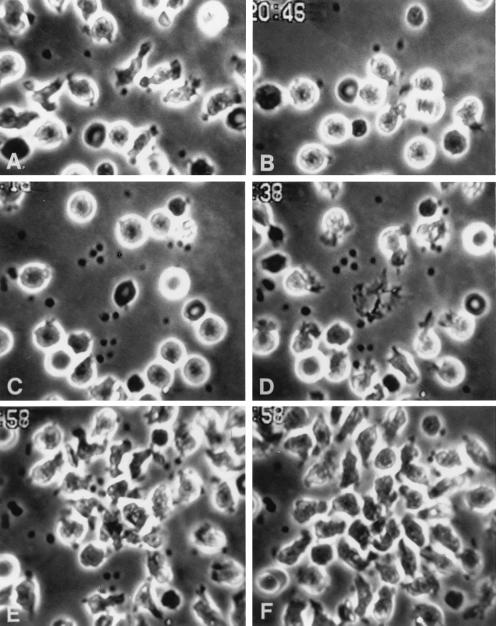
EDTA (10 mM) in thick preparations inhibits random locomotion but not chemotaxis of PMN. Slides were prepared as described in Results. (A) PMN often exhibit deformations while in suspension or when first attached, but with little or no displacement on substrate, then (B) round up and become largely motionless. In a different field (C), several such cells are seen before laser destruction of the central erythrocyte. On chemotactic stimulation (seen here 49 sec after the laser flash), the same cells orient (D) and make their way to the target (E), seen here about 3 min after the laser flash, often, however, with slipping and sliding, indicating poor purchase on substrate. During these periods of drift, they generally maintain their orientation toward the target. By 5 min after the flash (F), considerable numbers of PMN have arrived from outside the field (approx. ×580).
Figure 3
Figure 3
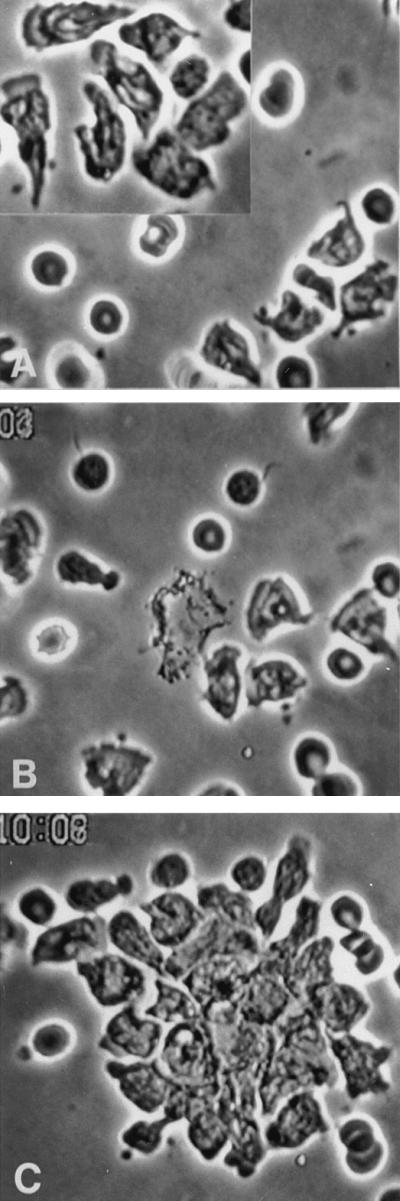
Antibody to β2 (CD18) integrins (70 μg/ml) in either thin or thick preparations does not inhibit either random locomotion or chemotaxis of PMN. Thin preparations are shown. (A) PMN are locomoting freely on substrate and did so even when the concentration of antibody was increased to 200 μg/ml (Inset). Note also the two motile monocytes at lower right of the inset. (B) Forty-one seconds after the laser flash, PMN are orienting toward the central target. (C) About 10 min later, PMN are surrounding the target. Results were the same when we added mAb to β1 and αvβ3 integrins and to IAP, and none of these antibodies added anything to the effects of EDTA alone (approx. ×520).
Figure 4
Figure 4
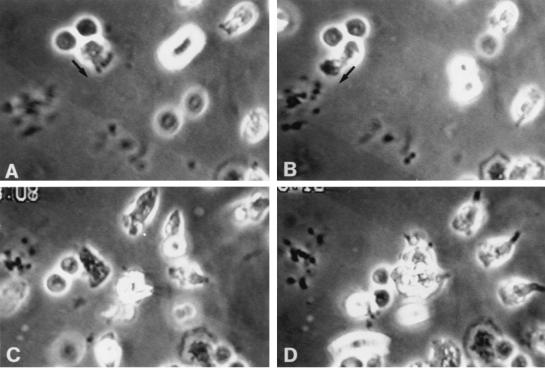
Antibody to β2 (CD18) integrins (10 μg/ml) in very thick preparations causes PMN to adhere by their uropods, or by uropod-associated filaments, to substrate or to other cells. Slides were prepared as described in Results. Points of reference are a clump of platelets at 9 o’clock and a partially seen monocyte at 7 o’clock. (A) A PMN, oriented toward lower right (arrow), has two lymphocytes in tow and is stuck to the substrate by its uropod. (B) Seventy seconds later it randomly has reoriented toward lower left, but remains anchored to substrate, as do several other PMN in the field. (C) After creation of a chemotactic gradient, the index PMN has pulled itself free (as did others), and now, about 3 min later, nears the target (center), the lymphocytes still in tow. (D) About 2 min later, the initial PMN have merged with the target. (Right) Three new PMN have entered the field; note their prominent posterior filaments (approx. ×580).

References

    1. Mariscalco M M, Smith C W. Fetal and Neonatal Physiology. Philadelphia: Saunders; 1997. , in press.
    1. Springer T. Annu Rev Physiol. 1995;57:827–872. - PubMed
    1. Bessis M. Nouv Rev Fr Hematol. 1973;13:285–290. - PubMed
    1. Malawista S E, de Boisfleury Chevance A. J Leukocyte Biol. 1997;61:58–62. - PubMed
    1. Malawista S E, de Boisfleury Chevance A. J Leukocyte Biol. 1991;50:313–315. - PubMed

Publication types

MeSH terms