. 1997 Oct 14;94(21):11583-8.
doi: 10.1073/pnas.94.21.11583.

Panhandle PCR strategy to amplify MLL genomic breakpoints in treatment-related leukemias

Affiliations

Panhandle PCR strategy to amplify MLL genomic breakpoints in treatment-related leukemias

M D Megonigal et al. Proc Natl Acad Sci U S A. .

Abstract

Panhandle PCR amplifies genomic DNA with known 5' and unknown 3' sequences from a template with an intrastrand loop schematically shaped like a pan with a handle. We used panhandle PCR to clone MLL genomic breakpoints in two pediatric treatment-related leukemias. The karyotype in a case of treatment-related acute lymphoblastic leukemia showed the t(4;11)(q21;q23). Panhandle PCR amplified the translocation breakpoint at position 2158 in intron 6 in the 5' MLL breakpoint cluster region (bcr). The karyotype in a case of treatment-related acute myeloid leukemia was normal, but Southern blot analysis showed a single MLL gene rearrangement. Panhandle PCR amplified the breakpoint at position 1493 in MLL intron 6. Screening of somatic cell hybrid and radiation hybrid DNAs by PCR and reverse transcriptase-PCR analysis of the leukemic cells indicated that panhandle PCR identified a fusion of MLL intron 6 with a previously uncharacterized sequence in MLL intron 1, consistent with a partial duplication. In both cases, the breakpoints in the MLL bcr were in Alu repeats, and there were Alu repeats in proximity to the breakpoints in the partner DNAs, suggesting that Alu sequences were relevant to these rearrangements. This study shows that panhandle PCR is an effective method for cloning MLL genomic breakpoints in treatment-related leukemias. Analysis of additional pediatric cases will determine whether breakpoint distribution deviates from the predilection for 3' distribution in the bcr that has been found in adult cases.


Figures
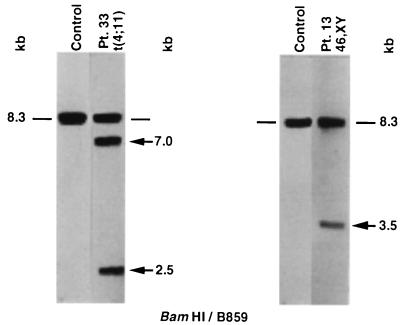
Figure 1
Figure 1
Identification of rearrangements within the MLL bcr in treatment-related leukemias by Southern blot analysis. BamHI-digested DNAs were hybridized with B859 MLL cDNA probe-spanning exons 5–11 (22). The 8.3-kb fragment is from the unrearranged allele (dash marks). Control DNAs show a germline pattern. Numbers above the lanes correspond to patient numbers in Table 1. Arrows show rearrangements. Southern blot analysis in the case of patient 13 has been described (8).
Figure 2
Figure 2
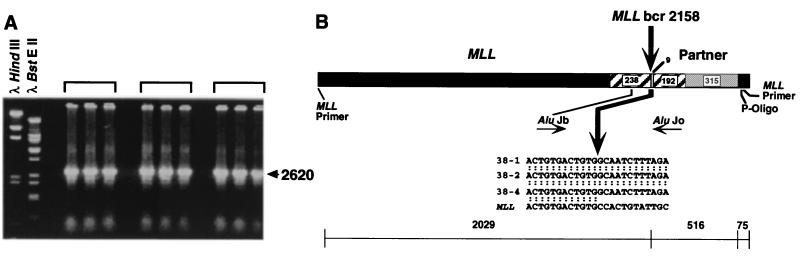
(A) Panhandle PCR products from der(11) chromosome of t(4;11)(q21;q23) in treatment-related ALL of patient 33. Brackets indicate separate panhandle PCRs where identical 2620-bp products were obtained. (B) Sequence of t(4;11) breakpoint junction in individual subclones, 38–1, 38–2, and 38–4, from panhandle PCR. The 5′ 2029 bp include MLL forward nested primer and MLL bcr sequence; 516 bp of 3′ sequence are partner DNA, and 75 bp of 3′ sequence extend from ligated oligonucleotide (P-Oligo) through reverse nested primer. Comparison with normal sequence identified the breakpoint at nucleotide 2158 in MLL intron 6 (bold arrow). AluJ repeats in MLL and partner DNA are shown. Sequences were the same in all three subclones.
Figure 3
Figure 3
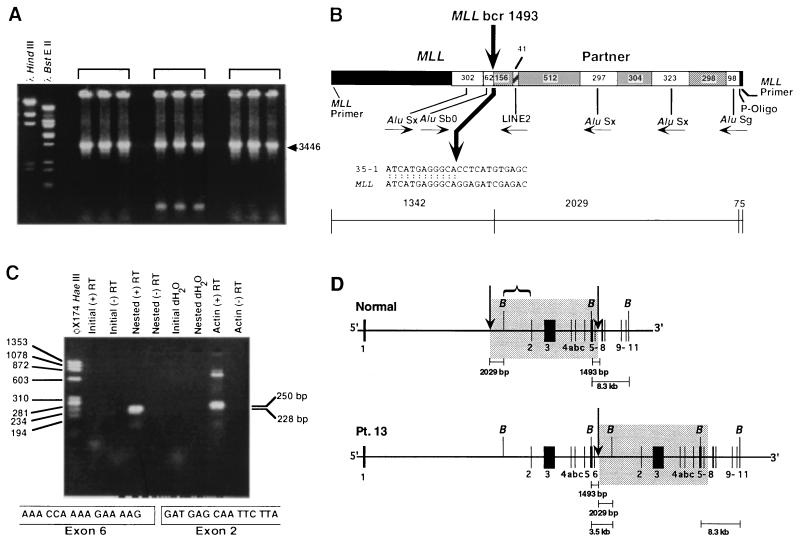
(A) Panhandle PCR products from treatment-related AML of patient 13 involving unknown partner DNA. Brackets show three separate reactions in which identical 3446-bp products were obtained. (B) Breakpoint junction in subclone 35–1 from panhandle PCR. Comparison with normal sequence identified the breakpoint in MLL bcr at nucleotide 1493 in intron 6 (bold arrow). The 5′ 1342 bp include MLL forward nested primer and MLL bcr sequence to nucleotide 1493. Somatic cell hybrid and radiation hybrid screens and RT-PCR analysis (c.f. Fig. 3C) showed that 2029 bp of sequence 3′ of the breakpoint originated from a previously uncharacterized region of MLL intron 1. AluS repeats in MLL bcr and MLL intron 1 are shown. Nonrepetitive sequences are gray. (C) RT-PCR analysis of total RNA from leukemic cells of patient 13 indicating MLL partial duplication. Nested reactions with sense and antisense primers from MLL exons 6 and 3, respectively, gave a single 228-bp product (Upper). Direct sequencing of the products of three reactions revealed an in-frame fusion of exon 6 to exon 2 (Lower). Reactions using β-actin primers (positive control) and RNA negative control (dH2O) are shown (Upper). (D) Comparison of normal MLL genomic structure [Upper, adapted from Rasio (27)] with MLL partial duplication in treatment-related AML of patient 13 (Lower). Arrows indicate breakpoint positions in MLL introns 6 and 1 in AML of patient 13. The intron 1 breakpoint, which produced a 3.5-kb rearranged BamHI fragment, was 5′ of the intron 1 BamHI site. Box indicates duplicated region. Bracket shows region of involvement 3′ of intron 1 BamHI site, resulting in rearranged BamHI fragments of larger sizes in previously reported partial duplications (12, 14, 16, 18).

References

    1. Berger J M, Gamblin S J, Harrison S C, Wang J C. Nature (London) 1996;379:225–233. - PubMed
    1. Corbett A, Osheroff N. Chem Res Toxicol. 1993;6:585–597. - PubMed
    1. Pui C-H, Hancock M L, Raimondi S C, Head D R, Thompson E, Wilimas J, Kun L E, Bowman L C, Crist W M, Pratt C B. Lancet. 1990;336:417–421. - PubMed
    1. Pui C-H, Ribeiro R C, Hancock M L, Rivera G K, Evans W E, Raimondi S C, Head D R, Behm F G, Mahmoud M H, Sandlund J T, Crist W M. N Engl J Med. 1991;325:1682–1687. - PubMed
    1. Winick N, McKenna R W, Shuster J J, Schneider N R, Borowitz M J, Bowman W P, Jacaruso D, Kamen B A, Buchanan G R. J Clin Oncol. 1993;11:209–217. - PubMed

Publication types

MeSH terms

Associated data