


cAMP response element-binding protein in the amygdala is required for long- but not short-term conditioned taste aversion memory
- PMID: 9334416
- PMCID: PMC6573742
- DOI: 10.1523/JNEUROSCI.17-21-08443.1997
cAMP response element-binding protein in the amygdala is required for long- but not short-term conditioned taste aversion memory
Abstract
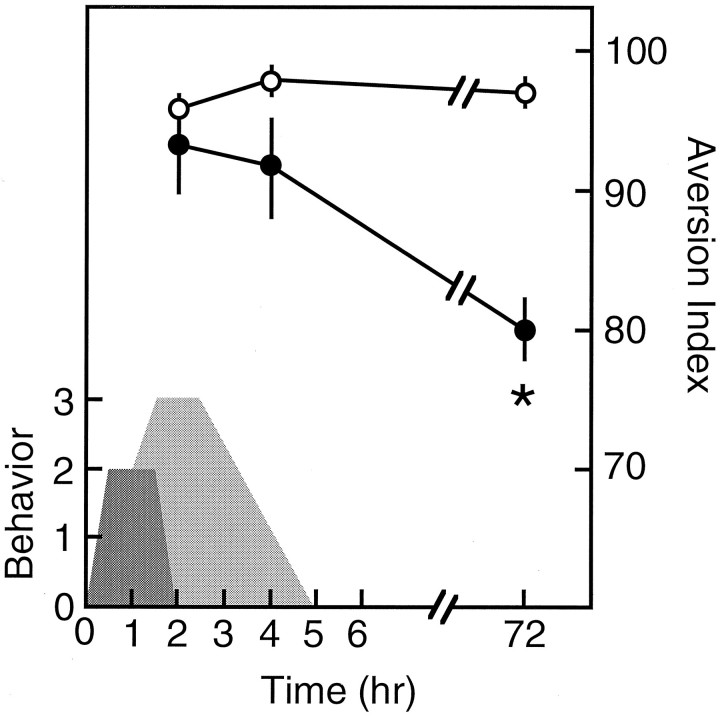
In conditioned taste aversion (CTA) organisms learn to avoid a taste if the first encounter with that taste is followed by transient poisoning. The neural mechanisms that subserve this robust and long-lasting association of taste and malaise have not yet been elucidated, but several brain areas have been implicated in the process, including the amygdala. In this study we investigated the role of amygdala in general, and the cAMP response element-binding protein (CREB) in the amygdala in particular, in CTA learning and memory. Toward that end, we combined antisense technology in vivo with behavioral, molecular, and histochemical analysis. Local microinjection of phosphorothioate-modified oligodeoxynucleotides (ODNs) antisense to CREB into the rat amygdala several hours before CTA training transiently reduced the level of CREB protein during training and impaired CTA memory when tested 3-5 d later. In comparison, sense ODNs had no effect on memory. The effect of antisense was not attributable to differential tissue damage and was site-specific. CREB antisense in the amygdala had no effect on retrieval of CTA memory once it had been formed, and did not affect short-term CTA memory. We propose that the amygdala, specifically the central nucleus, is required for the establishment of long-term CTA memory in the behaving rat; that the process involves long-term changes, subserved by CRE-regulated gene expression, in amygdala neurons; and that the amygdala may retain some CTA-relevant information over time rather than merely modulating the gustatory trace during acquisition of CTA.
Figures


References
-
- Bartsch D, Ghirardi M, Skehel PA, Karl KA, Herder SP, Chen M, Bailey CH, Kandel ER. Aplysia CREB2 represses long-term facilitation: relief of repression converts transient facilitation into long-term functional and structural change. Cell. 1995;83:979–992. - PubMed
-
- Bermudez-Rattoni F, Grijalva CV, Kiefer SW, Garcia J. Flavor-illness aversions: the role of the amygdala in the acquisition of taste-potentiated odor aversions. Physiol Behav. 1986;38:503–508. - PubMed
-
- Bourtchuladze R, Frenguelli B, Blendy J, Cioffi D, Schutz G, Silva AJ. Deficient long-term memory in mice with a targeted mutation of the cAMP-responsive element-binding protein. Cell. 1994;79:59–68. - PubMed
-
- Bures J, Buresova O, Kriveanek J. Brain and behavior: paradigms for research on neuronal mechanisms. Wiley; New York: 1988.
-
- Burnette WW. Western blotting: electrophoretic transfer of proteins from sodium dodecyl sulfate-polyacrylamide gels to unmodified nitrocellulose and radiographic detection with antibody and radioiodinated protein A. Anal Biochem. 1981;112:195–203. - PubMed
Publication types
MeSH terms
Substances
LinkOut - more resources
Full Text Sources
Other Literature Sources
Medical
