. 1997 Nov 1;17(21):8498-505.
doi: 10.1523/JNEUROSCI.17-21-08498.1997.

Substantia nigra D1 receptors and stimulation of striatal cholinergic interneurons by dopamine: a proposed circuit mechanism

Affiliations

Substantia nigra D1 receptors and stimulation of striatal cholinergic interneurons by dopamine: a proposed circuit mechanism

E D Abercrombie et al. J Neurosci. .

Abstract

Dopamine release can regulate striatal acetylcholine efflux in vivo through at least two receptor mechanisms: (1) direct inhibition by dopamine D2 receptors on the cholinergic neurons, and (2) excitation initiated by dopamine D1 receptors. The neuroanatomical locus of the latter population of D1 receptors and the pathway(s) involved in the expression of their influence are controversial issues. We have tested the hypothesis that D1 receptors in substantia nigra pars reticulata are involved in the excitatory component of dopaminergic actions on striatal acetylcholine output. In vivo microdialysis was used in awake rats. Infusion of the selective D1 receptor agonist R(+)-1-Phenyl-2,3,4,5-tetrahydro-1H-3-benzazepine-7,8-diol (SKF 38393) hydrochloride into pars reticulata of substantia nigra elicited a significant increase in striatal acetylcholine efflux. Likewise, D-amphetamine applied into pars reticulata of substantia nigra by reverse dialysis produced an elevation in acetylcholine output measured at a second microdialysis probe in the striatum. Application of D-amphetamine in the striatum by reverse dialysis elicited a decrease in striatal acetylcholine efflux that could be reversed subsequently by local application of D-amphetamine in substantia nigra pars reticulata. A 2 mg/kg intraperitoneal dose of D-amphetamine, which has no net effect on striatal acetylcholine output under control conditions, elicited a significant decrease in acetylcholine efflux when the D1 receptor antagonist R(+)-7-Chloro-8-hydroxy-3-methyl-1-phenyl-2,3,4, 5-tetrahydro-1H-3-benzazepine (SCH 23390) hydrochloride was applied simultaneously via a second microdialysis probe in substantia nigra pars reticulata. Thus, an excitatory D1-mediated influence on striatal acetylcholine output is initiated in substantia nigra pars reticulata, and this influence contributes to the effects of indirect dopaminergic agonists such as D-amphetamine on striatal acetylcholine efflux. These results indicate an important role of somatodendritic dopamine release, in addition to nerve terminal dopamine release, in the regulation of activity in basal ganglia circuits.


Figures
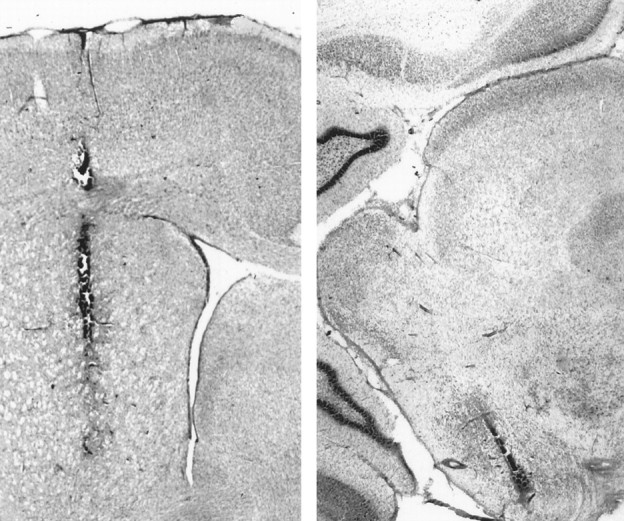
Fig. 1.
Fig. 1.
Digitized photographic montages of histological sections showing the localization of microdialysis probes in the striatum (left) and in substantia nigra pars reticulata (right).
Fig. 2.
Fig. 2.
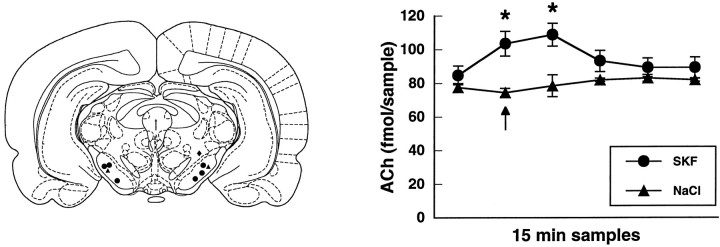
Left, Locations of intracerebral injection sites (adapted from Paxinos and Watson, 1997). •, Sites at which injection of the D1 agonist SKF 38393 (0.5 μg/0.5 μl) was effective in increasing striatal ACh efflux. ▴, Injection sites of the aCSF vehicle (0.5 μl). ♦, Site at which injection of SKF 38393 (0.5 μg/0.5 μl) had no significant effect on striatal ACh efflux. Right, Effect of intranigral injection of the D1 agonist SKF 38393 (0.5 μg/0.5 μl;circles) or the aCSF vehicle (0.5 μl;triangles) on the output of striatal ACh. Injection of SKF 38393 or aCSF took place between minutes 5 and 10 of the 15 min dialysis sample (arrow). Data are femtomoles of ACh/20 μl sample of dialysate (mean ± SEM). *p < 0.01, compared with baseline.
Fig. 3.
Fig. 3.
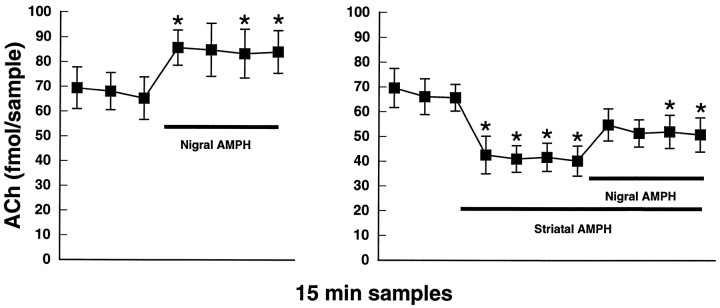
Left, Intranigral infusion of amphetamine (AMPH; 100 μm) by reverse dialysis produces a significant increase in striatal ACh output.Right, The inhibitory effect of striatal amphetamine application (10 μm) is reversed by subsequent application of amphetamine (100 μm) into substantia nigra.Black bars represent the indicated drug application intervals. Data are femtomoles of ACh/20 μl sample of dialysate (mean ± SEM). *p < 0.01, compared with the final baseline sample.
Fig. 4.
Fig. 4.
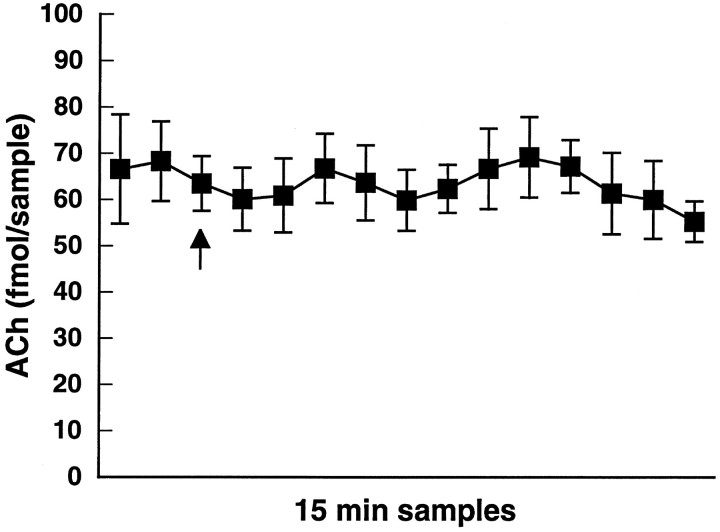
Systemic administration of amphetamine at 2 mg/kg intraperitoneally (arrow) did not affect striatal ACh output. Data are femtomoles of ACh/20 μl sample of dialysate (mean ± SEM).
Fig. 5.
Fig. 5.
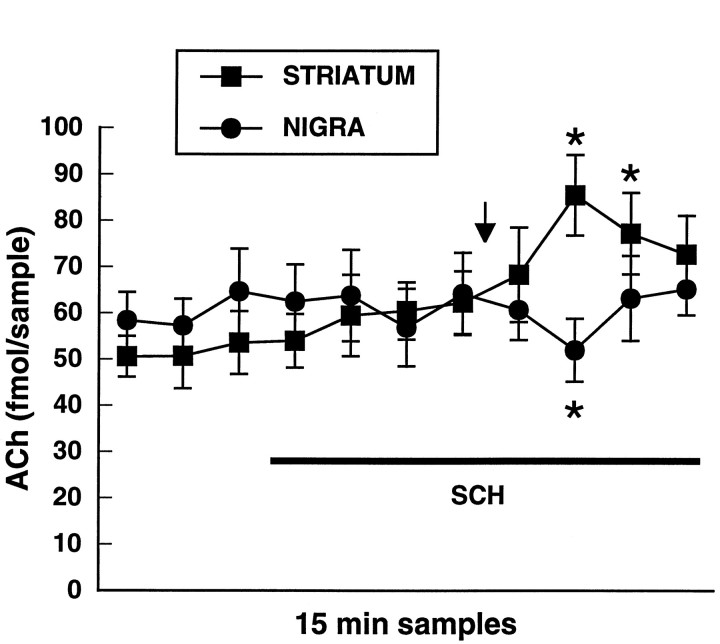
Effect of local antagonism of dopamine D1 receptors in the striatum (squares) or in substantia nigra (circles) on the release profile of striatal ACh in response to amphetamine at 2 mg/kg intraperitoneally. The D1 dopamine receptor antagonist SCH 23390 (100 μm) was applied via reverse dialysis into either the striatum or substantia nigra during the interval indicated by theblack bar and systemic amphetamine was administered at the arrow. Data are femtomoles of ACh/20 μl sample of dialysate (mean ± SEM). *p < 0.01, compared with the final baseline sample.
Fig. 6.
Fig. 6.
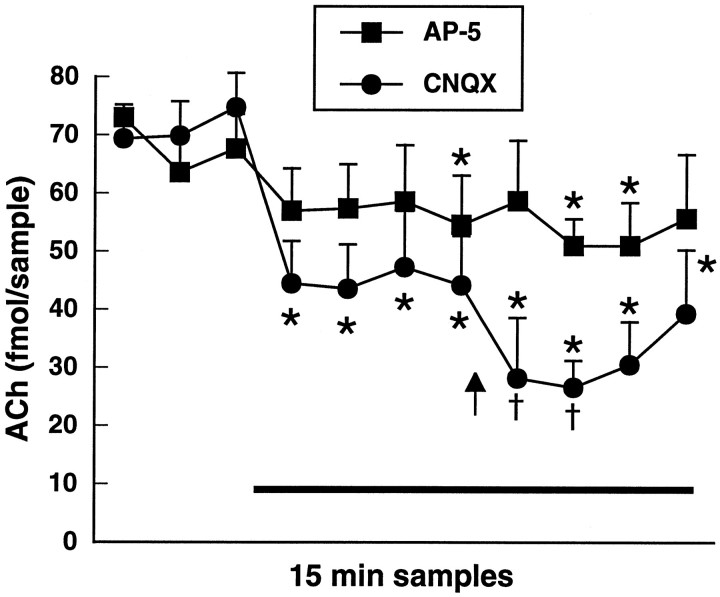
Effect of local antagonism of NMDA receptors with AP-5 (100 μm; squares) or of non-NMDA receptors with CNQX (10 μm; circles) on the release profile of striatal ACh in response to amphetamine at 2 mg/kg intraperitoneally. AP-5 or CNQX was applied into the striatum via reverse dialysis during the interval indicated by the black bar and systemic amphetamine was administered at thearrow. Data are femtomoles of ACh/20 μl sample of dialysate (mean ± SEM). *p < 0.01, compared with the final baseline sample. p < 0.01, compared with the final preamphetamine sample.
Fig. 7.
Fig. 7.
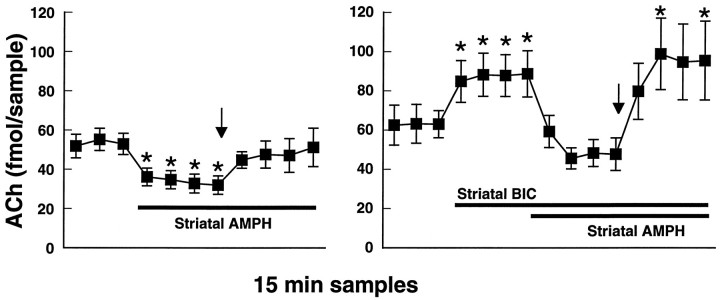
Left, The direct inhibitory effect of striatal amphetamine application (AMPH; 10 μm) is reversed by subsequent administration of amphetamine at 2 mg/kg intraperitoneally (arrow).Right, The experiment was repeated in the presence of the GABAA receptor antagonist bicuculline (BIC; 10 μm) that by itself raised extracellular ACh levels in the striatum. Addition of amphetamine (10 μm) to the perfusion solution decreased striatal ACh output to baseline levels, and subsequent administration of amphetamine at 2 mg/kg intraperitoneally (arrow) reversed this effect. Black bars represent the indicated drug application intervals. Data are femtomoles of ACh/20 μl sample of dialysate (mean ± SEM). *p < 0.01, compared with the final baseline sample.
Fig. 8.
Fig. 8.
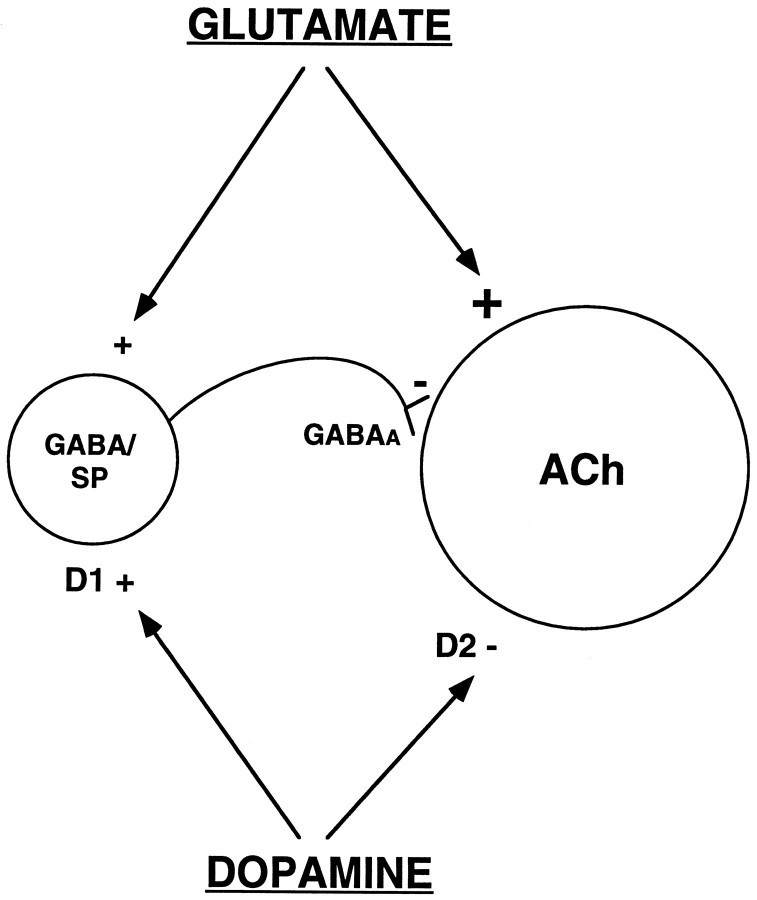
Schematic diagram illustrating the hypothesized interactions that are involved in determining the striatal ACh response to administration of indirect dopaminergic agonists such as amphetamine. Stimulation of dopamine D1 receptors in substantia nigra elicits an increase in glutamate input to striatal neurons. Within the striatum, dopamine D2 receptor activation directly inhibits the cholinergic interneuron. Stimulation of dopamine D1 receptors on striatal GABA/substance P (SP) neurons may provide an indirect inhibitory influence on the cholinergic interneuron; enhanced glutamate input may play a permissive role in this latter effect.

References

    1. Abercrombie ED, Finlay JM. Monitoring extracellular norepinephrine in brain using in vivo microdialysis and HPLC-EC. In: Robinson TE, Justice JB Jr, editors. Microdialysis in the neurosciences. Elsevier; Amsterdam: 1991. pp. 253–274.
    1. Acquas E, Wilson C, Fibiger HC. Nonstriatal dopamine D1 receptors regulate striatal acetylcholine release in vivo. J Pharmacol Exp Ther. 1997;281:360–368. - PubMed
    1. Ajima A, Yamaguchi T, Kato T. Modulation of acetylcholine release by D1, D2 dopamine receptors in rat striatum under freely moving conditions. Brain Res. 1990;518:193–198. - PubMed
    1. Anderson JJ, Kuo S, Chase TN, Engber TM. GABAA and GABAB receptors differentially regulate striatal acetylcholine release in vivo. Neurosci Lett. 1993;160:126–130. - PubMed
    1. Anderson JJ, Kuo S, Chase TN, Engber TM. Dopamine D1 receptor-stimulated release of acetylcholine in rat striatum is mediated indirectly by activation of striatal neurokinin1 receptors. J Pharmacol Exp Ther. 1994a;269:1144–1151. - PubMed

Publication types

MeSH terms

LinkOut - more resources