. 1997 Nov 1;17(21):8528-35.
doi: 10.1523/JNEUROSCI.17-21-08528.1997.

Supranormal stimulation of D1 dopamine receptors in the rodent prefrontal cortex impairs spatial working memory performance

Affiliations

Supranormal stimulation of D1 dopamine receptors in the rodent prefrontal cortex impairs spatial working memory performance

J Zahrt et al. J Neurosci. .

Abstract

Although previous research has emphasized the beneficial effects of dopamine (DA) on functions of the prefrontal cortex (PFC), recent studies of animals exposed to mild stress indicate that excessive DA receptor stimulation may be detrimental to the spatial working memory functions of the PFC (Arnsten and Goldman-Rakic, 1990; Murphy et al., 1994, 1996a,b, 1997). In particular, these studies have suggested that supranormal stimulation of D1 receptors may contribute to the detrimental actions of DA in the PFC (Murphy et al., 1994, 1996a). The current study directly tested this hypothesis by examining the effects of infusing a full D1 receptor agonist, SKF 81297, into the PFC of rats performing a spatial working memory task, delayed alternation. SKF 81297 produced a dose-related impairment in delayed-alternation performance. The impairment was reversed by pretreatment with a D1 receptor antagonist, SCH 23390, consistent with drug actions at D1 receptors. SCH 23390 by itself had no effect on performance, although slightly higher doses impaired performance (Murphy et al., 1994, 1996a). There was a significant relationship between infusion location and drug efficacy; animals with cannulae anterior to the PFC were not impaired by SKF 81297 infusions. Taken together, these results demonstrate that supranormal D1 receptor stimulation in the PFC is sufficient to impair PFC working memory function. These cognitive data are consistent with recent electrophysiological studies of D1 receptor mechanisms affecting the PFC (Williams and Goldman-Rakic, 1995; Yang and Seamans, 1996). Increased D1 receptor stimulation during stress may serve to take the PFC "off-line" to allow posterior cortical and subcortical structures to regulate behavior, but may contribute to the vulnerability of the PFC in many neuropsychiatric disorders.


Figures
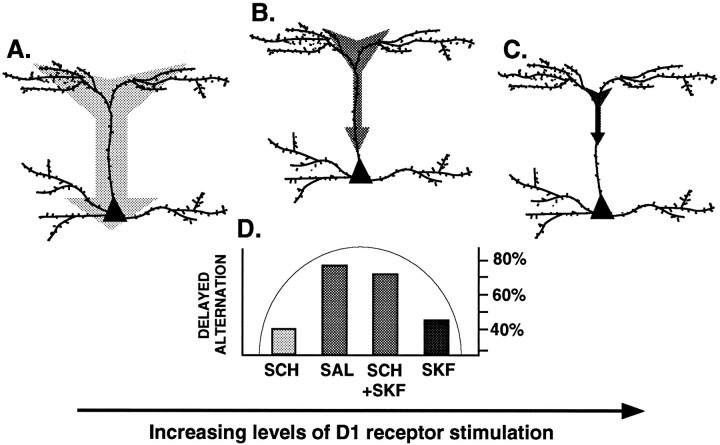
Fig. 6.
Fig. 6.
Highly schematized representation of a model describing D1 receptor mechanisms influencing PFC function, based on the electrophysiological findings of Yang and Seamans (1996)and the cognitive data discussed in the current paper. Yang and Seamans have shown that D1 receptor stimulation alters signal transfer from apical dendrites to the soma by attenuating the high threshold calcium spikes that propagate signals along the dendrite. These D1 actions are particularly prominent along the apical dendritic stem (i.e., primary dendritic branch). They have proposed that with insufficient D1 receptor stimulation (A), signals are unfocused temporally and spatially, whereas with optimal levels of D1 receptor stimulation (B), signals are sharpened for optimal transfer to the soma [based on Yang and Seamans (1996), their Fig. 9A,B]. However, with increasing levels of D1 receptor stimulation, signals are oversharpened and would not reach the soma because of abolition of high threshold calcium spikes (C). This inverted U dose–response curve is also observed at the behavioral level in studies of PFC cognitive function (D; results from current study shown as mean percent correct). Thus, either insufficient D1 receptor stimulation (0.035 mg/kg SCH 23390, i.p.; SCH) or excessive D1 receptor stimulation (0.1 μg of SKF 81297 intra-PFC infusion; SKF) results in impaired delayed-alternation performance, whereas optimal levels of D1 receptor stimulation (saline, SAL; or 0.03 mg/kg SCH 23390 + 0.1 μg of SKF 81297 intra-PFC infusion,SCH+SKF) result in superior cognitive performance.
Fig. 1.
Fig. 1.
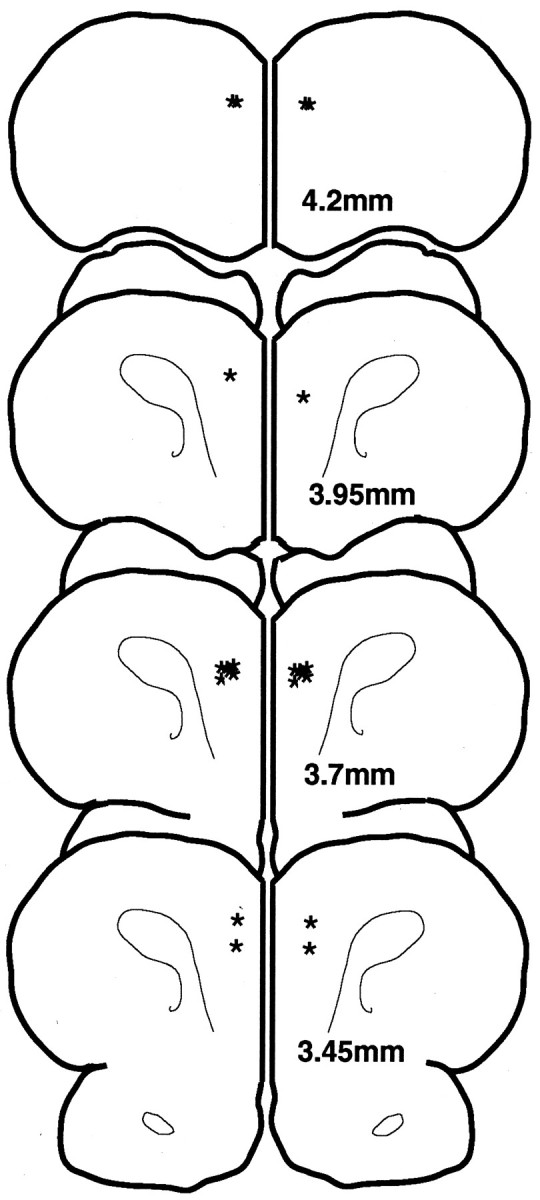
Location of the ventral tips (stars) of the guide cannulae in the rat brains used in this study. Sections indicate millimeters anterior to bregma.
Fig. 2.
Fig. 2.
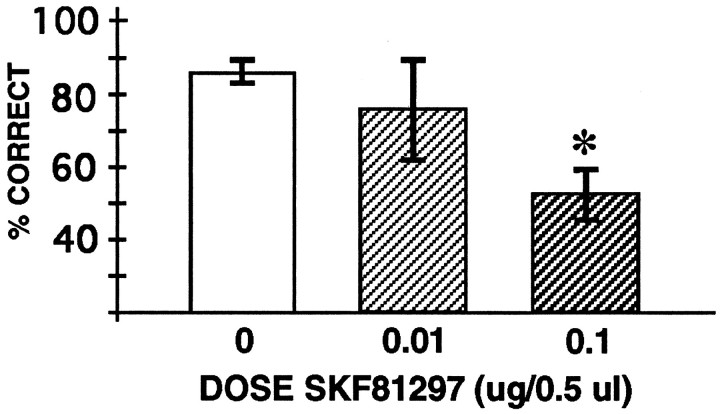
The effects of bilateral intra-PFC infusions of the D1 DA full agonist SKF 81297 (0, 0.01, and 0.1 μg/0.5 μl) on accuracy of performance on the delayed-alternation task. Results represent mean percent correct ± SEM;n = 5 rats in experiment 1; *significantly different from saline (0 μg) infusion performance.
Fig. 3.
Fig. 3.
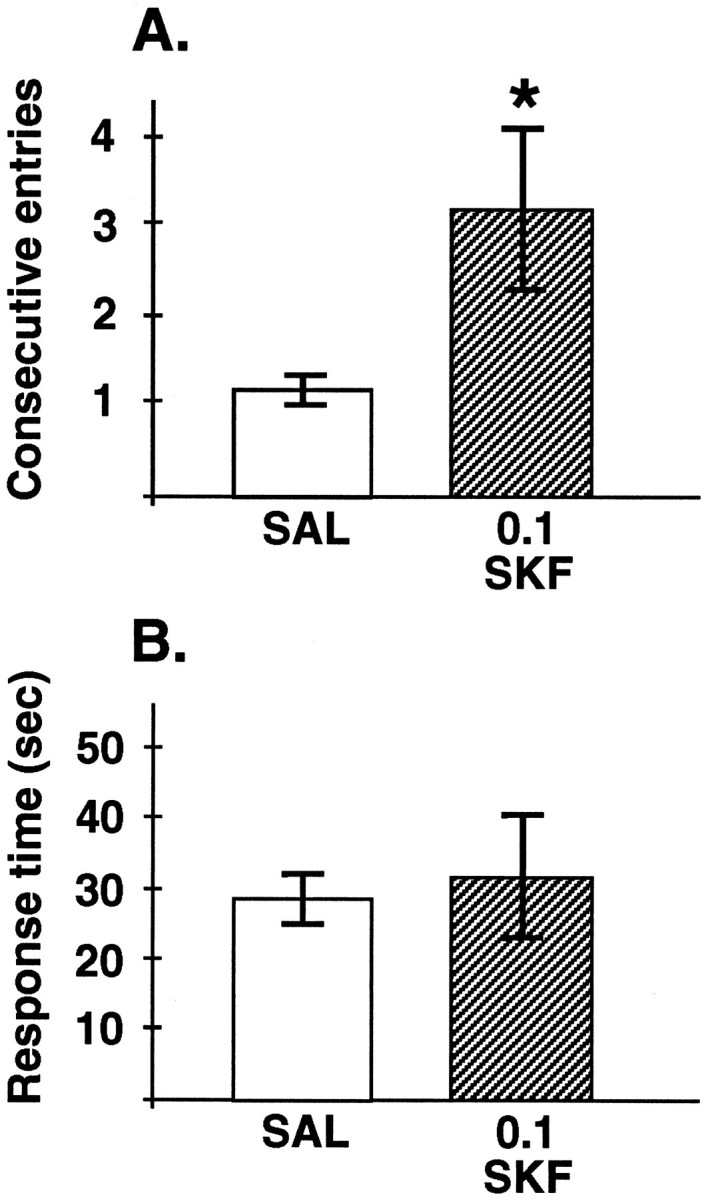
Further characterization of the SKF 81297 (0.1 μg) response. A, The effects of bilateral intra-PFC infusions of the D1 DA full agonist SKF 81297 (0.1 μg) versus saline on a measure of perseverative responding: the greatest number of consecutive entries into a single arm during delayed-alternation performance. Results represent mean number of entries ± SEM; n = 5 rats. SKF 81297 significantly increased measures of perseverative responding, including the absolute difference between entries into the left versus right arm (see Results); *significantly different from saline infusions.B, The effects of bilateral intra-PFC infusions of the D1 DA full agonist SKF 81297 (0.1 μg) versus saline on response times during delayed-alternation performance. Results represent mean response time (sec) ± SEM; n = 5 rats.
Fig. 4.
Fig. 4.
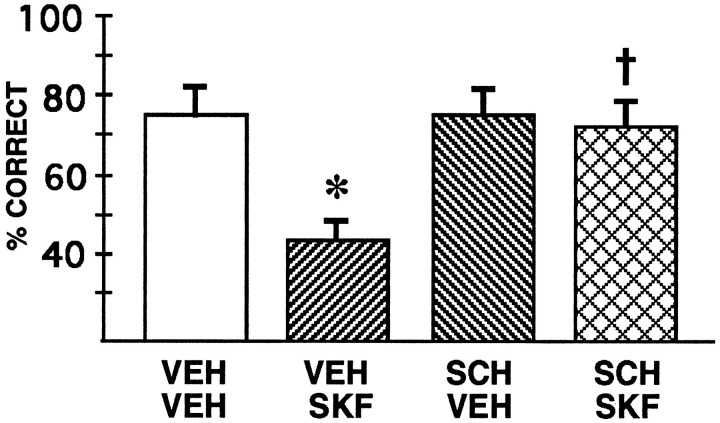
The effects of SCH 23390 pretreatment on the cognitive deficits induced by bilateral intra-PFC SKF 81297 infusions in experiment 2. Results represent mean percent correct ± SEM;n = 5 rats. VEH VEH, Both systemic and intra-PFC administration of saline vehicle; VEH SKF, systemic administration of saline vehicle and intra-PFC infusion of 0.1 μg of SKF 81297; SCH VEH, systemic administration of SCH 23390 and intra-PFC infusion of saline vehicle; and SCH SKF, systemic administration of SCH 23390 and intra-PFC infusion of 0.1 μg of SKF 81297. *Significantly different fromVEH VEH performance; significantly different from VEH SKF performance.
Fig. 5.
Fig. 5.
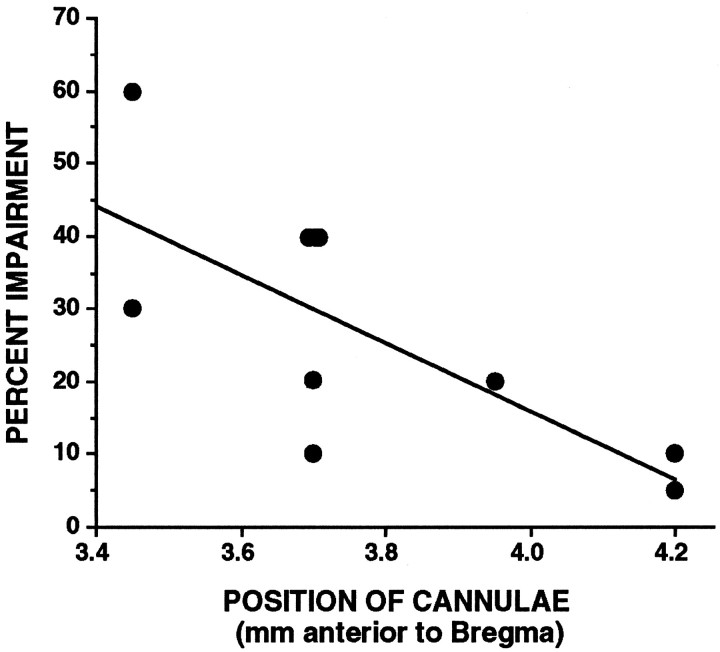
The correlation between cannula location (millimeters anterior to bregma) and efficacy of the SKF 81297 response (percent impairment relative to saline infusion). Data include the animals from experiments 1 and 2 with cannulae 4.2 mm anterior to bregma.

References

    1. Andersen PH, Jansen JA. Dopamine receptor agonists: selectivity and D1 receptor efficacy. Eur J Pharmacol. 1990;188:335–347. - PubMed
    1. Arnsten AFT. Catecholamine regulation of the prefrontal cortex. J Psychopharmacol. 1997;11:151–162. - PubMed
    1. Arnsten AFT, Goldman-Rakic PS. Reversal of stress-induced delayed response deficits in rhesus monkeys by clonidine and naloxone. Soc Neurosci Abstr. 1986;12:1464.
    1. Arnsten AFT, Goldman-Rakic PS. Stress impairs prefrontal cortex cognitive function in monkeys: role of dopamine. Soc Neurosci Abstr. 1990;16:164.
    1. Arnsten AFT, Cai JX, Murphy BL, Goldman-Rakic PS. Dopamine D1 receptor mechanisms in the cognitive performance of young adult and aged monkeys. Psychopharmacology (Berl) 1994;116:143–151. - PubMed

Publication types

MeSH terms