. 1997 Oct 28;94(22):11893-8.
doi: 10.1073/pnas.94.22.11893.

Participation of the nuclear cap binding complex in pre-mRNA 3' processing

Affiliations

Participation of the nuclear cap binding complex in pre-mRNA 3' processing

S M Flaherty et al. Proc Natl Acad Sci U S A. .

Abstract

Communication between the 5' and 3' ends is a common feature of several aspects of eukaryotic mRNA metabolism. In the nucleus, the pre-mRNA 5' end is bound by the nuclear cap binding complex (CBC). This RNA-protein complex plays an active role in both splicing and RNA export. We provide evidence for participation of CBC in the processing of the 3' end of the message. Depletion of CBC from HeLa cell nuclear extract strongly reduced the endonucleolytic cleavage step of the cleavage and polyadenylation process. Cleavage was restored by addition of recombinant CBC. CBC depletion was found to reduce the stability of poly(A) site cleavage complexes formed in nuclear extract. We also provide evidence that the communication between the 5' and 3' ends of the pre-mRNA during processing is mediated by the physical association of the CBC/cap complex with 3' processing factors bound at the poly(A) site. These observations, along with previous data on the function of CBC in splicing, illustrate the key role played by CBC in pre-mRNA recognition and processing. The data provides further support for the hypothesis that pre-mRNAs and mRNAs may exist and be functional in the form of "closed-loops," due to interactions between factors bound at their 5' and 3' ends.


Figures
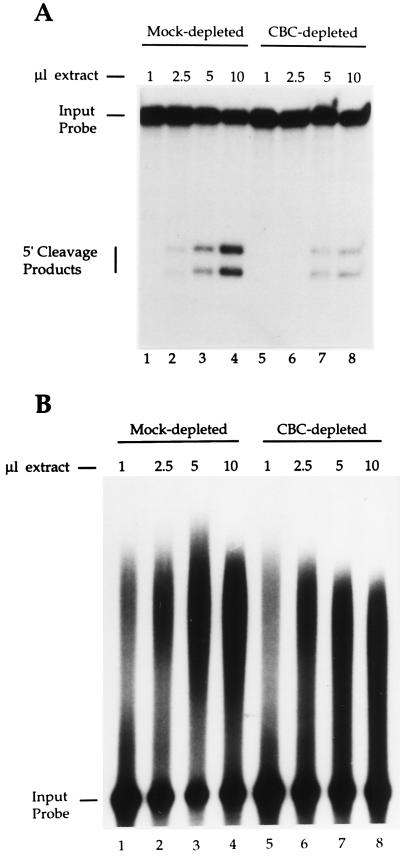
Figure 1
Figure 1
Inhibition of poly(A) site cleavage by CBC depletion. (A) An m7GpppG-capped pre-mRNA containing the L3 poly(A) site was incubated with increasing amounts of either a mock-depleted (lanes 1–4) or a CBC-depleted (lanes 5–8) HeLa cell nuclear extract in the presence of 3′ dATP. Products of the cleavage reaction were resolved on a denaturing 10% polyacrylamide gel. (B) An m7GpppG-capped precleaved RNA (extending only to the poly(A) cleavage site) containing the HIV-1 poly(A) site was incubated with increasing amounts of either mock-depleted (lanes 1–4) or CBC-depleted (lanes 5–8) HeLa cell nuclear extract in the presence of ATP. The reaction products were resolved on a denaturing 5% polyacrylamide gel.
Figure 2
Figure 2
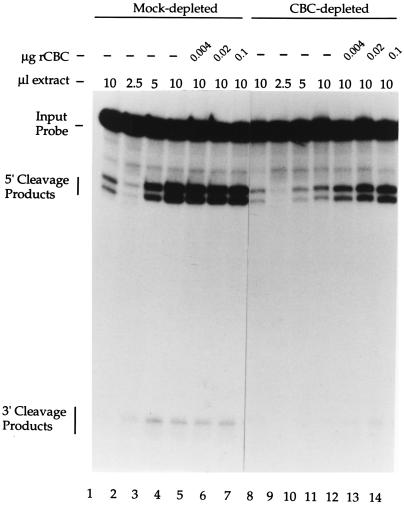
rCBC restores poly(A) site cleavage efficiency to a CBC-depleted HeLa cell nuclear extract. Uncapped (pppG, lanes 1 and 8) or capped (m7GpppG, lanes 2–7 and 9–14) pre-mRNAs containing the L3 poly(A) site were incubated in mock-depleted (lanes 1–7) or CBC-depleted (lanes 8–14) HeLa cell nuclear extract in the presence of 3′ dATP. The extracts were supplemented with the indicated amount of recombinant CBC (lanes 5–7 and 12–14). The reaction products were resolved on a denaturing 10% polyacrylamide gel.
Figure 3
Figure 3
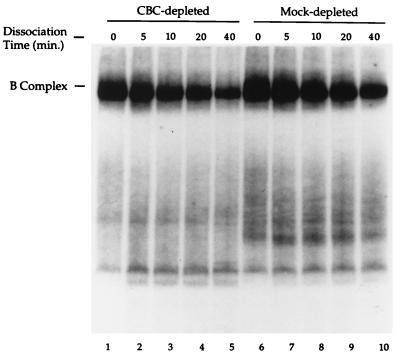
CBC contributes to B complex stability. A 32P-labeled m7GpppG-capped pre-mRNA containing the HIV-1 poly(A) site was incubated with either CBC-depleted (lanes 1–5) or mock-depleted (lanes 6–10) nuclear extract. 3′ processing complexes were allowed to form for 10 min at 30°C. An aliquot was removed, denoted time 0, and treated with heparin at 0°C. A 100-fold molar excess of unlabeled m7GpppG-capped pre-mRNA was added to the remaining reaction and aliquots were removed after an additional incubation for 5, 10, 20, and 40 min. The RNA/protein complexes were resolved on a nondenaturing 3% polyacrylamide gel. The B complex contains both CPSF and CstF (9).
Figure 4
Figure 4
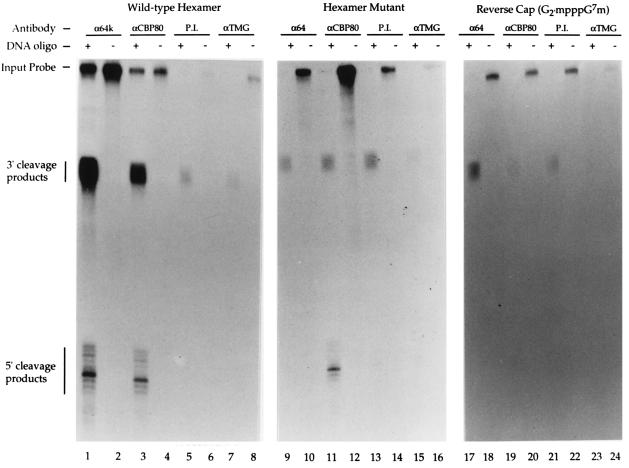
Physical interaction of the CBC/cap and 3′ processing complexes. m7GpppG-capped pre-mRNAs containing either a wild-type HIV-1 poly(A) site (lanes 1–8) or an HIV-1 poly(A) site containing a hexamer mutation (AAUAAA to CCACCC), and a Gm2′pppG7m-capped (reverse capped) RNA containing a wild-type HIV-1 poly(A) site (lanes 17–24) were incubated in HeLa cell nuclear extract in the presence (odd-numbered lanes) or absence (even-numbered lanes) of a DNA oligonucleotide complementary to a region between the cap and poly(A) site. After 10 min at 30°C, EDTA was added to block the endogenous extract RNase H activity. Immunoprecipitations were then conducted with the following antibodies: anti-64k CstF (lanes 1, 2, 9, 10, 17, and 18), anti-CBP80 (lanes 3, 4, 11, 12, 19, and 20), preimmune (P.I.) serum (lanes 5, 6, 13, 14, 21, and 22), and anti-TMG (lanes 7, 8, 15, 16, 23, and 24). The RNA was extracted from the immunoprecipitates and electrophoresed on a denaturing 10% polyacrylamide gel.

References

    1. Rasmussen E B, Lis J T. Proc Natl Acad Sci USA. 1993;90:7923–7927. - PMC - PubMed
    1. Salditt-Georgieff M M, Harpold M, Che-Kiang S, Darnell J. Cell. 1980;19:69–78. - PubMed
    1. Sharp P A. Cell. 1994;77:805–815. - PubMed
    1. Keller W. Cell. 1995;81:829–832. - PubMed
    1. Wahle E. Biochim Biophys Acta. 1995;1261:183–194. - PubMed

Publication types