


Alternative genetic pathways in colorectal carcinogenesis
- PMID: 9342373
- PMCID: PMC23723
- DOI: 10.1073/pnas.94.22.12122
Alternative genetic pathways in colorectal carcinogenesis
Abstract
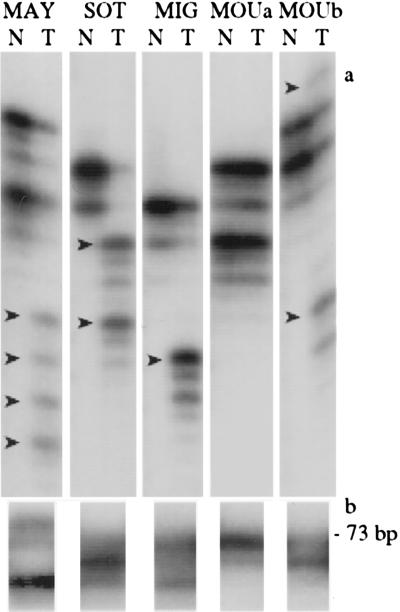
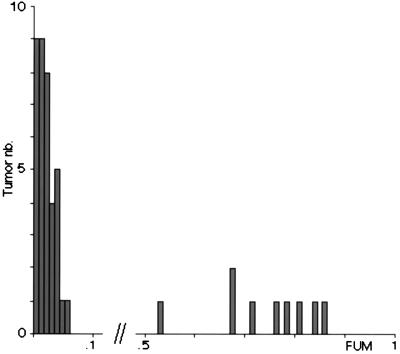
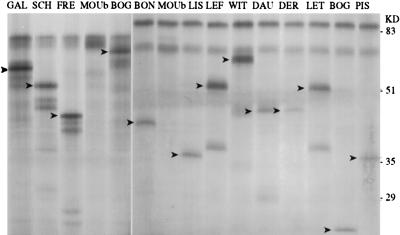
The comparative typing of matched tumor and blood DNAs at dinucleotide repeat (microsatellite) loci has revealed in tumor DNA the presence of alleles that are not observed in normal DNA. The occurrence of these additional alleles is possibly due to replication errors (RERs). Although this observation has led to the recognition of a subtype of colorectal cancer with a high incidence of RERs (caused by a deficiency in DNA mismatch repair), a thorough analysis of the RER frequency in a consecutive series of colorectal cancers had not been reported. It is shown here that the extensive typing of 88 colorectal tumors reveals a bimodal distribution for the frequency of RER at microsatellite loci. Within the major mode (75 tumors, RER- subtype), the probability that a locus exhibited instability did not differ significantly among loci and tumors, being 0.02. The subsequent development of a statistical test for an operational discrimination between the RER- and RER+ subtypes indicated that the probability of misclassification did not exceed 0.001 in this series. The frequency of K-ras mutation was found to be equivalent in the two subtypes. However, in the RER+ tumors, the p53 gene mutation was less frequently detected, the adenomatous polyposis coli (APC) mutation was rare, and the biallelic inactivation of either of these genes was not observed. Furthermore, the concomitant occurrence of APC and tumor growth factor beta receptor type II gene alterations was found only once. These data suggest that the repertoires of genes that are frequently altered in RER+ and RER- tumors may be more different than previously thought.
Figures
References
-
- Vogelstein B, Fearon E R, Hamilton S R, Kern S E, Preisinger A C, Leppert M, Nakamura Y, White R, Smits A M, Bos J L. N Engl J Med. 1988;319:525–532. - PubMed
-
- Delattre O, Olschwang S, Law D J, Melot T, Remvikos Y, Salmon R J, Sastre X, Validire P, Feinberg A P, Thomas G. Lancet. 1989;ii:353–356. - PubMed
-
- Baker S J, Fearon E R, Nigro J M, Hamilton S R, Preisinger A C, Jessup J M, vanTuinen P, Ledbetter D H, Barker D F, Nakamura Y. Science. 1989;244:217–221. - PubMed
-
- Powell S M, Zilz N, Beazer-Barclay Y, Bryan T M, Hamilton S R, Thibodeau S N, Vogelstein B, Kinzler K W. Nature (London) 1992;359:235–237. - PubMed
-
- Baker S J, Preisinger A C, Jessup J M, Paraskeva C, Markowitz S, Willson J K, Hamilton S, Vogelstein B. Cancer Res. 1990;50:7717–7722. - PubMed
Publication types
MeSH terms
Substances
LinkOut - more resources
Full Text Sources
Medical
Research Materials
Miscellaneous
