. 1997 Oct 28;94(22):12157-61.
doi: 10.1073/pnas.94.22.12157.

Loss of haloperidol induced gene expression and catalepsy in protein kinase A-deficient mice

Affiliations

Loss of haloperidol induced gene expression and catalepsy in protein kinase A-deficient mice

M R Adams et al. Proc Natl Acad Sci U S A. .

Abstract

The antipsychotic drug, haloperidol, elicits the expression of neurotensin and c-fos mRNA in the dorsal lateral region of the striatum and produces an acute cataleptic response in rodents that correlates with the motor side effects of haloperidol in humans. Mice harboring a targeted disruption of the RIIbeta subunit of protein kinase A have a profound deficit in cAMP-stimulated kinase activity in the striatum. When treated with haloperidol, RIIbeta mutant mice fail to induce either c-fos or neurotensin mRNA and the acute cataleptic response is blocked. However, both wild-type and mutant mice become cataleptic when neurotensin peptide is directly injected into the lateral ventricle, demonstrating that the kinase deficiency does not interfere with the action of neurotensin but rather its synthesis and release. These results establish a direct role for protein kinase A as a mediator of haloperidol induced gene induction and cataleptic behavior.


Figures
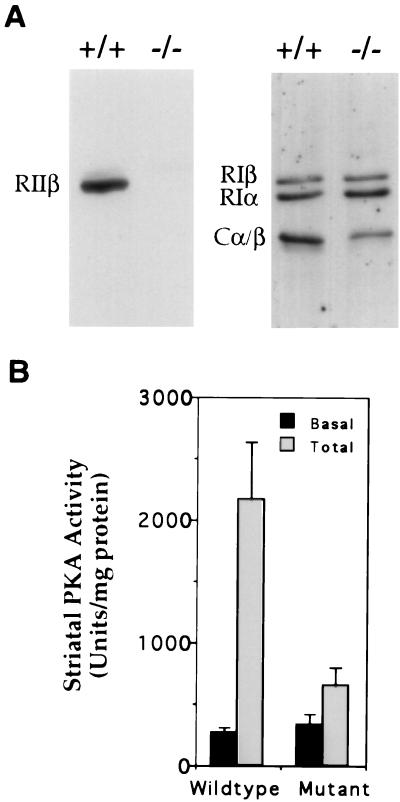
Figure 1
Figure 1
Absence of RIIβ protein and reduction of PKA activity in the DLST of RIIβ−/− mice. (A) Immunoblot analysis of DLST homogenates from RIIβ mutant (−/−) mice and their wild-type controls (+/+) using antisera that specifically recognizes RIIβ, RIα, RIβ, or C. (B) PKA activity was measured in the striatum of wild-type controls and mutant RIIβ mice. Each bar represents PKI inhibitable activity ± SD (n = 3).
Figure 2
Figure 2
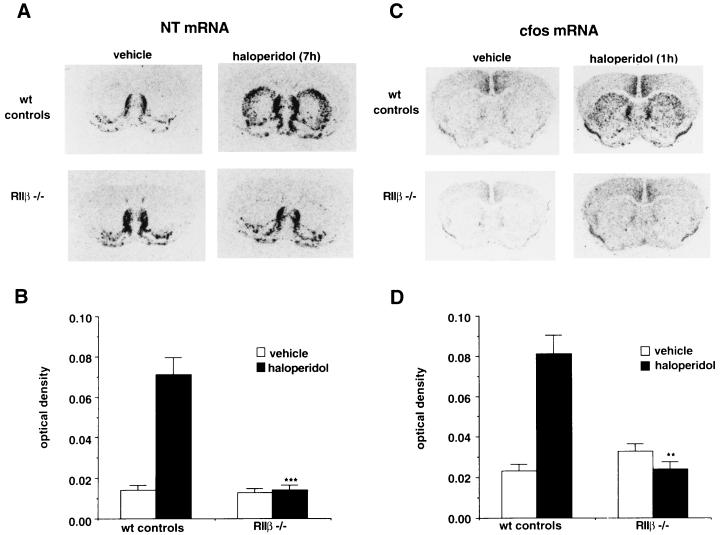
Induction of NT mRNA by haloperidol in the striatum. (A) In situ hybridization depicting the expression of NT mRNA 7 h following either vehicle or haloperidol (1 mg/kg, i.p.) treatment in wild-type (wt) controls (n = 12 and 23, vehicle and haloperidol, respectively) and RIIβ−/− (n = 7 and 11, vehicle and haloperidol, respectively). (B) Quantitation of the NT mRNA hybridization signal in the DLST was carried out by densitometric analysis. Each bar represents mean film optical density ± SEM. Statistical differences were determined using ANOVA; ∗∗∗, P < 0.001. (C) In situ hybridization for c-fos mRNA expression in the striatum 1 h following either vehicle or haloperidol treatment in wild-type controls (n = 8 and 9, vehicle and haloperidol, respectively) and RIIβ−/− (n = 4 and 4, vehicle and haloperidol, respectively) mice. (D) Graphical representation of the c-fos mRNA hybridization signal in the DLST using densitometric analysis. Each bar represents mean optical density ± SEM. Statistical differences were determined using ANOVA; ∗∗, P < 0.01.
Figure 3
Figure 3
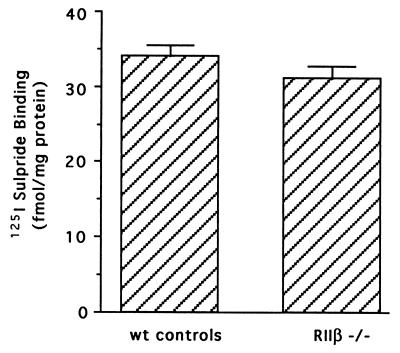
The density of dopamine D2 receptors are normal in the striatum of RIIβ−/− mice. [125I]Sulpride binding in the striatum of wild-type controls and RIIβ−/− mice was determined by quantitative autoradiography using 125I standards to calibrate the optical density and convert to tissue equivalent ligand concentrations. Each bar represents specific binding of [125I]sulpride ±SEM.
Figure 4
Figure 4
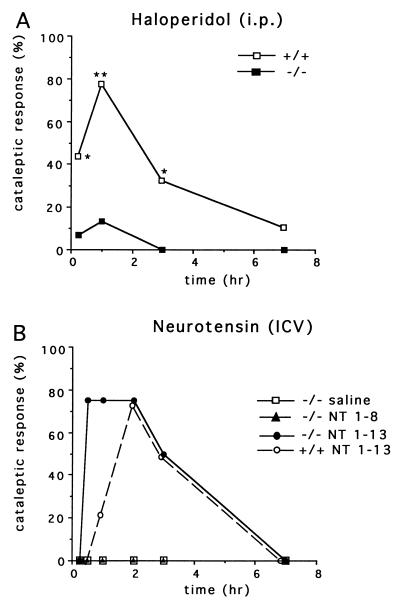
The cataleptic response to haloperidol is significantly attenuated in RIIβ−/− mice, but they remain responsive to centrally administered NT. (A) Catalepsy was measured 15 min, 1 h, 3 h, and 7 h following administration of haloperidol (4 mg/kg, i.p.) in wild-type controls (n = 9) and RIIβ−/− (n = 15). Graph represents the percent of mice exhibiting catalepsy. Comparisons between groups were determined using Mann–Whitney U test; ∗, P < 0.05; ∗∗, P < 0.01. (B) Catalepsy was measured in RIIβ−/− (n = 4) mice at various times following administration of active NT 1–13, inactive NT 1–8, or saline. Wild-type mice (n = 4) were injected with the active NT 1–13 as a control.

References

    1. Creese I, Burt D R, Snyder S H. Science. 1976;192:481–483. - PubMed
    1. Seeman P, Lee T, Chau Wong M, Wong K. Nature (London) 1976;261:717–719. - PubMed
    1. Kaneko M, Sato K, Horikoshi R, Yaginuma M, Yaginuma N, Shiragata M, Kumashiro H. Prostaglandins Leukotrienes Essent Fatty Acids. 1992;46:53–57. - PubMed
    1. Gerfen C R, Engber T M, Mahan L C, Susel Z, Chase T N, Monsoma F J J, Sibley D R. Science. 1990;250:1429–1432. - PubMed
    1. Einhorn L C, Oxford G S. J Physiol (London) 1993;462:563–578. - PMC - PubMed

Publication types

MeSH terms

LinkOut - more resources