Comparative Study
. 1997 Oct 28;94(22):12186-91.
doi: 10.1073/pnas.94.22.12186.

Disruption of syntaxin-mediated protein interactions blocks neurotransmitter secretion

Affiliations
Comparative Study

Disruption of syntaxin-mediated protein interactions blocks neurotransmitter secretion

V O'Connor et al. Proc Natl Acad Sci U S A. .

Abstract

The membrane protein syntaxin participates in several protein-protein interactions that have been implicated in neurotransmitter release. To probe the physiological importance of these interactions, we microinjected into the squid giant presynaptic terminal botulinum toxin C1, which cleaves syntaxin, and the H3 domain of syntaxin, which mediates binding to other proteins. Both reagents inhibited synaptic transmission yet did not affect the number or distribution of synaptic vesicles at the presynaptic active zone. Recombinant H3 domain inhibited the interactions between syntaxin and SNAP-25 that underlie the formation of stable SNARE complexes in vitro. These data support the notion that syntaxin-mediated SNARE complexes are necessary for docked synaptic vesicles to fuse.


Figures
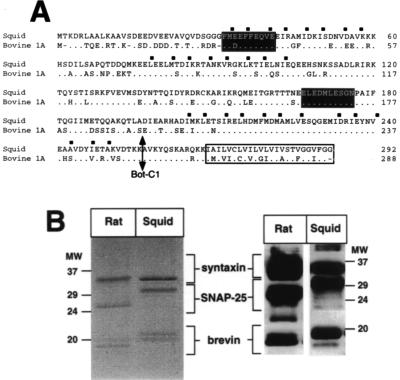
Figure 1
Figure 1
Molecular characterization of squid syntaxin. (A) Alignment of the deduced amino acid sequences of squid syntaxin and bovine syntaxin 1A. The hydrophobic residues defining predicted coiled-coil domains H1-H3 (7) are indicated by squares. Black shading shows the predicted toxin binding sites (24), and an arrow marks the Bot-C1 cleavage site (23). The putative transmembrane domain is boxed. (B) Syntaxin-associated proteins in detergent extracts of rat brain or squid optic lobe. SNARE complexes were immunoprecipitated with mAb 6D2 prior to SDS/PAGE and Coomassie blue staining or Western blotting with antibodies specific for synaptobrevin (18), syntaxin (22), and SNAP-25 (Alamone labs, Jerusalem). The band marked with an asterisk has been identified as myelin basic protein (16).
Figure 2
Figure 2
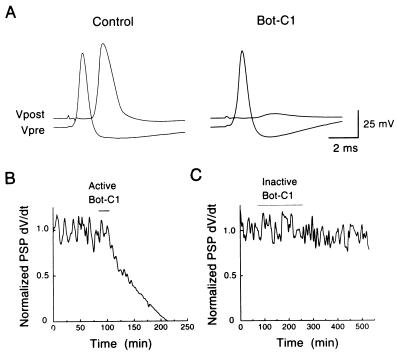
Bot-C1 inhibits neurotransmitter release. (A) Injection of recombinant Bot-C1 light chain (20 μM in pipette) into the squid giant synapse caused a slow, irreversible block of neurotransmitter release, as indicated by an almost complete loss of the postsynaptic potential. (B) Time course of Bot-C1 inhibition of transmitter release shown by the progressive reduction in the initial slope (dv/dt) of the postsynaptic potential. The period of Bot-C1 injection is indicated by a bar. (C) As in B, but an inactive Bot-C1 preparation was used.
Figure 3
Figure 3
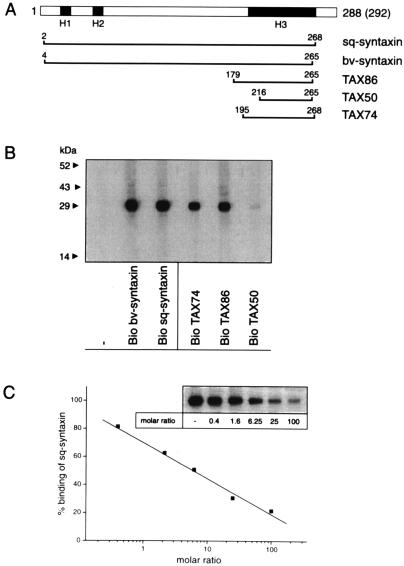
Analysis of syntaxin interactions in vitro. (A) Representation of the syntaxin fragments used. The three predicted coil-coiled domains (H1 to H3) are indicated in black. For amino acid numbering, see Fig. 1. (B) Syntaxin fragments containing the entire H3 domain bind to immobilized SNAP-25. (C) TAX86 competes with squid syntaxin for binding to SNAP-25. Immobilized squid optic lobe proteins were incubated with biotinylated sq-syntaxin (200 ng/ml) in the presence of increasing amounts of TAX86. The amount of bound biotinylated syntaxin, estimated by densitometry, is given as percentage bound in the absence of TAX86.
Figure 4
Figure 4
The H3 domain of syntaxin inhibits neurotransmitter release. (A) TAX86 injection into the giant terminal produced a reversible inhibition of neurotransmitter release. Prior to TAX86 injection (control), presynaptic stimulation caused a suprathreshold postsynaptic potential. Injection of TAX86 inhibited transmitter release, resulting in a subthreshold postsynaptic potentials. After terminating the injection, transmitter release recovered partially to suprathreshold levels. (B) Time course of TAX86 inhibition. Successive injections of TAX86 caused a strong inhibition of transmitter release that slowly reversed after terminating the injection. (C) Injection of TAX50 had little effect on release.
Figure 5
Figure 5
Interaction of the H3 domain with SNARE complexes. (A) TAX74 and TAX86, but not TAX50 (0.5 μg/ml each), promoted synaptobrevin (1 μg/ml) binding to SNAP-25 in the overlay assay (− SDS wash, Left). However, only sq-syntaxin generated trimeric complexes that fully resisted dissociation by SDS (+ SDS wash, Right). (B) Formation of SDS-resistant SNARE oligomers is inhibited by TAX86 upon prior SNARE disassembly. Extracts were incubated in the absence (−) or presence (+) of TAX86 before generating SNARE complexes. Immunoprecipitation with syntaxin antibodies followed by SDS/PAGE of unboiled samples and immunoblotting with mAb 6D2 revealed monomeric syntaxin and SNARE-containing oligomers (20). TAX86 did not affect preformed 7S and 20S complexes but inhibited complex formation after one (D20S, DR20S) or two (DRD20S) rounds of disassembly.
Figure 6
Figure 6
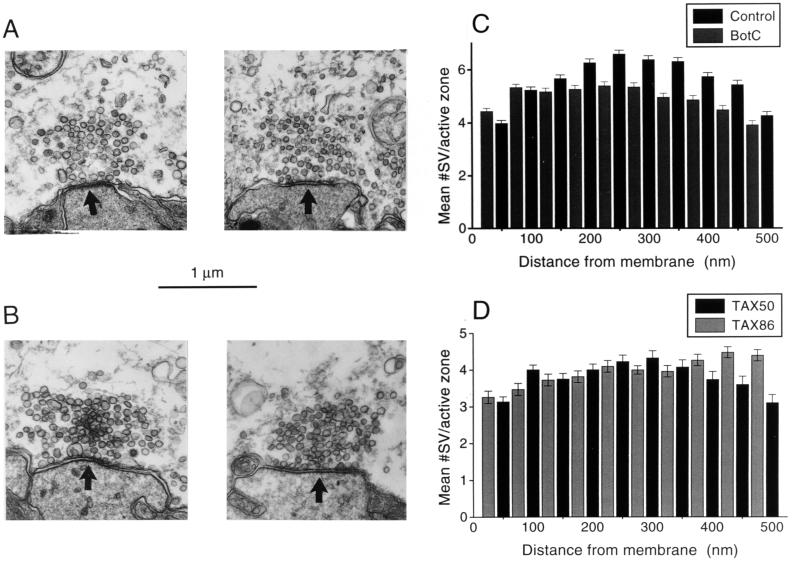
Ultrastructural effects of injecting Bot-C1 and TAX86. Presynaptic terminals inhibited by either Bot-C1 or TAX86 were analyzed by electron microscopy and compared with terminals injected with inactive Bot-C1 or TAX50, respectively. (A and B) Representative active-zone profiles from Bot-C1 (A) and TAX86 (B) treatments (Left) are displayed with controls (Right; inactive Bot-C1 and TAX50, respectively). Arrowheads located in the postsynaptic spines point toward active zones. (C and D) Quantitative analysis of active zone profiles assessed by counting synaptic vesicles at 50-nm intervals from the presynaptic membrane. (C) Data from Bot-C1-injected (gray bars, n = 398) and control-injected (black bars, n = 510) terminals. (D) Data from TAX86- (gray bars, n = 379) and TAX50- (black bars, n = 238) injected terminals. n, number of active zone profiles analyzed.

References

    1. Katz B. The Release of Neurotransmitter Substances. Liverpool: Liverpool Univ. Press; 1969.
    1. Heuser J E, Reese T S, Dennis M J, Jan Y, Jan L, Evans L. J Cell Biol. 1979;81:275–300. - PMC - PubMed
    1. Heuser J E, Reese T S. J Cell Biol. 1973;57:315–344. - PMC - PubMed
    1. Calakos N, Scheller H. Physiol Rev. 1996;76:1–29. - PubMed
    1. Augustine G J, Burns M E, DeBello W M, Pettit D L, Schweizer F E. Annu Rev Pharmacol Toxicol. 1996;36:659–701. - PubMed

Publication types

MeSH terms

Associated data

LinkOut - more resources