. 1997 Nov 11;94(23):12280-4.
doi: 10.1073/pnas.94.23.12280.

The ribosome-in-pieces: binding of elongation factor EF-G to oligoribonucleotides that mimic the sarcin/ricin and thiostrepton domains of 23S ribosomal RNA

Affiliations

The ribosome-in-pieces: binding of elongation factor EF-G to oligoribonucleotides that mimic the sarcin/ricin and thiostrepton domains of 23S ribosomal RNA

A Munishkin et al. Proc Natl Acad Sci U S A. .

Abstract

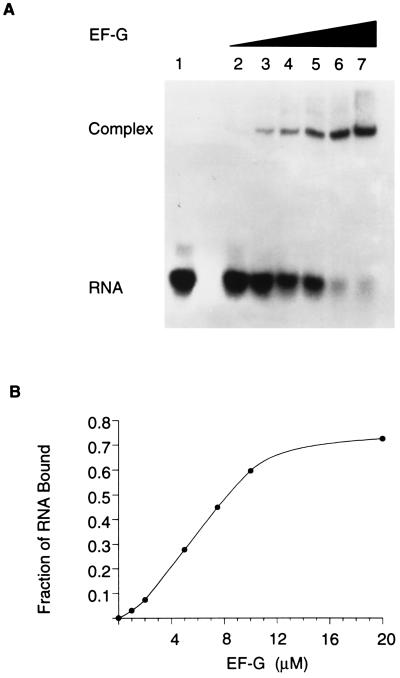
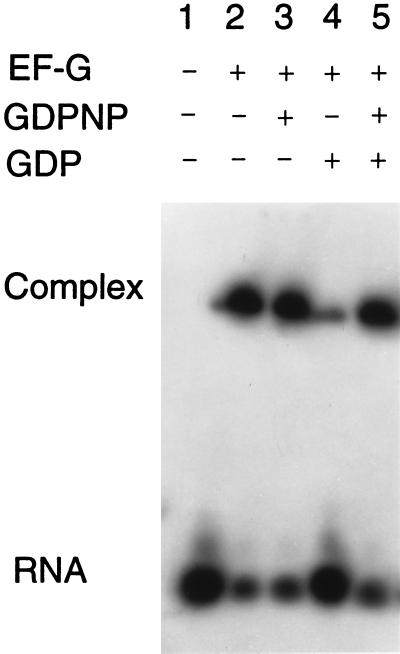
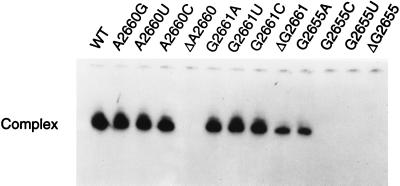
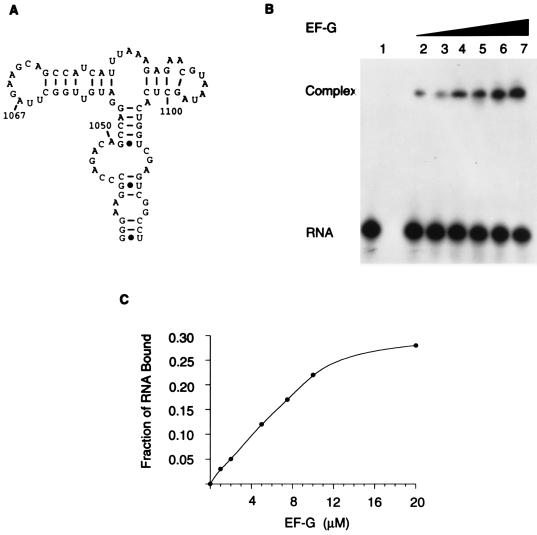
An oligoribonucleotide (a 27-mer) that mimics the sarcin/ricin (S/R) domain of Escherichia coli 23S rRNA binds elongation factor EF-G; the Kd is 6.9 microM, whereas for binding to ribosomes it is 0.7 microM. Binding saturates when EF-G and the S/R RNA are equimolar; at saturation 70% of the input RNA is in complexes with EF-G. Binding of EF-G to S/R RNA does not require GTP but is inhibited by GDP; the inhibition by GDP is overcome by GTP. The effects of mutations of the S/R domain nucleotides G2655, A2660, and G2661 suggest that EF-G recognizes the conformation of the RNA rather than the identity of the nucleotides. EF-G also binds to an oligoribonucleotide (an 84-mer) that has the thiostrepton region of 23S rRNA; however, EF-G binds independently to S/R and thiostrepton oligoribonucleotides.


Figures
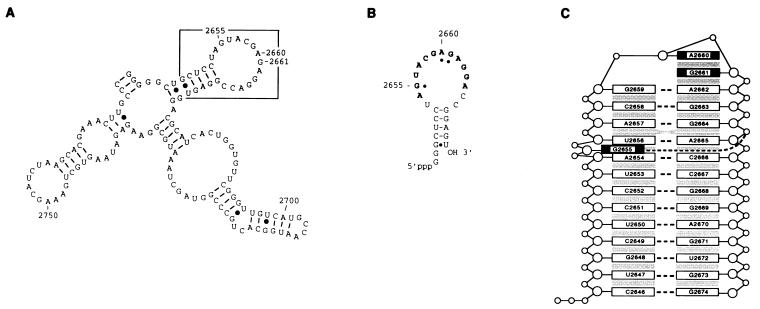
Figure 1
Figure 1
The S/R domain of 23S rRNA. (A) A portion of E. coli 23S rRNA with the S/R domain boxed. (B) An S/R oligoribonucleotide (a 27-mer) that mimics the sequence of the domain (nucleotides 2648–2672) and has in addition two 5′ guanosine residues that derive from the T7 promoter used to transcribe the RNA. The universal sequence is in boldface letters and the nucleotides protected from chemical modification by EF-G are designated by dots. (C) Representation of the three-dimensional conformation of an E. coli S/R domain oligoribonucleotide determined by NMR spectroscopy (K. Seggerson and P. Moore, personal communication) and based on the NMR determined structure of the closely related eukaryotic S/R domain RNA (14, 15). The numbering is the positions of nucleotides in E. coli 23S rRNA.
Figure 2
Figure 2
Binding of EF-G to an S/R domain oligoribonucleotide. (A) Gel-retardation assay of the binding of EF-G to radioactive S/R oligoribonucleotide (a 27-mer). The concentrations of EF-G were as follows: lane 1, 0 μM; lane 2, 1 μM; lane 3, 2 μM; lane 4, 5 μM; lane 5, 8 μM; lane 6, 10 μM; and lane 7, 20 μM. The concentration of RNA was 10 μM. (B) Results in A plotted to emphasize that binding saturates and that when the ligands are equimolar the complex contains 70% of the input RNA.
Figure 3
Figure 3
Effects of GDPNP and GDP on the binding of EF-G to an S/R domain oligoribonucleotide. The concentrations of the reactants were as follows: EF-G, 20 μM; radioactive S/R oligoribonucleotide, 10 μM; GDPNP, 1 mM; and GDP, 1 mM.
Figure 4
Figure 4
Effect of S/R oligoribonucleotide mutations on the binding of EF-G. The concentration of EF-G was 20 μM and that of the radioactive oligoribonucleotides 10 μM. The wild-type (WT) oligoribonucleotide is in Fig. 1B. See Table 1 for the dissociation constants.
Figure 5
Figure 5
Binding of EF-G to a thiostrepton domain oligoribonucleotide. (A) Thiostrepton region of E. coli 23S rRNA. (B) Gel-retardation assay of the binding of EF-G to radioactive thiostrepton oligoribonucleotide (an 84-mer; nucleotides 1036–1119). The concentrations of EF-G were the same as in Fig. 2; the concentration of RNA is 10 μM. (C) Results in B plotted to show the extent of binding.
Figure 6
Figure 6
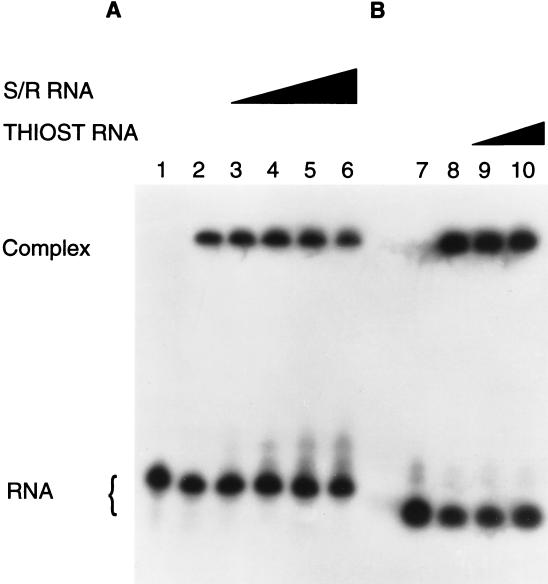
Independent binding of EF-G to S/R and thiostrepton oligoribonucleotides. (A) Binding of 10 μM EF-G (except in lane 1, where it was omitted) to radioactive thiostrepton (THIOST) RNA (10 μM) assessed in the presence of increasing concentrations of nonradioactive S/R RNA: lanes 1 and 2, 0 μM; lane 3, 10 μM; lane 4, 20 μM; lane 5, 50 μM; and lane 6, 100 μM. (B) Binding of 10 μM EF-G (except in lane 7, where it was omitted) to radioactive S/R RNA (10 μM) assessed in the presence of increasing concentrations of nonradioactive thiostrepton RNA: lane 8, 0 μM; lane 9, 20 μM; and lane 10, 50 μM.

References

    1. Pestka S. J Biol Chem. 1969;244:1533–1539. - PubMed
    1. Bodley J W, Zieve F J, Lin L. J Biol Chem. 1970;245:5662–5667. - PubMed
    1. Ævarsson A, Brazhnikov E, Garber M, Zheltonosova J, Chirgadze Y, Al-Karadaghi S, Svensson L A, Liljas A. EMBO J. 1994;13:3669–3677. - PMC - PubMed
    1. Czworkowski J, Wang J, Steitz T A, Moore P B. EMBO J. 1994;13:3661–3668. - PMC - PubMed
    1. Bodley J W, Lin L, Highland J H. Biochem Biophys Res Commun. 1970;41:1406–1411. - PubMed

Publication types

MeSH terms

LinkOut - more resources