. 1997 Nov 11;94(23):12521-6.
doi: 10.1073/pnas.94.23.12521.

CDC45 is required in conjunction with CDC7/DBF4 to trigger the initiation of DNA replication

Affiliations

CDC45 is required in conjunction with CDC7/DBF4 to trigger the initiation of DNA replication

J C Owens et al. Proc Natl Acad Sci U S A. .

Abstract

The initiation of DNA replication in Saccharomyces cerevisiae requires the protein product of the CDC45 gene. We report that although Cdc45p is present at essentially constant levels throughout the cell cycle, it completes its initiation function in late G1, after START and prior to DNA synthesis. Shortly after mitosis, cells prepare for initiation by assembling prereplicative complexes at their replication origins. These complexes are then triggered at the onset of S phase to commence DNA replication. Cells defective for CDC45 are incapable of activating the complexes to initiate DNA replication. In addition, Cdc45p and Cdc7p/Dbf4p, a kinase implicated in the G1/S phase transition, are dependent on one another for function. These data indicate that CDC45 functions in late G1 phase in concert with CDC7/DBF4 to trigger initiation at replication origins after the assembly of the prereplicative complexes.


Figures
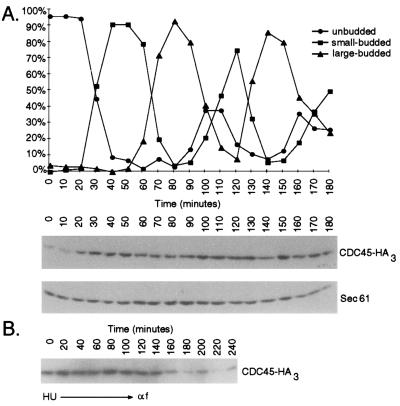
Figure 1
Figure 1
Cdc45p is present at constant levels in cycling cells. (A) CDC45-HA3 cells were synchronously released from an α-factor arrest. Whole-cell extracts were made at various time points and total cell protein extracts were made, resolved by SDS/PAGE, and immunoblotted with antibodies against the HA epitope (Lower). Blots were reprobed with anti-Sec61p antibodies as a loading control (18). Cell synchrony was evaluated by determining percent of unbudded, small-budded, and large-budded cells. (B) CDC45-HA3 cells were synchronously released from a HU arrest into medium containing α-factor. Total cell protein extracts were analyzed as described above. Cells reached the α-factor block 120 min after release from HU as monitored by flow cytometry (data not shown).
Figure 2
Figure 2
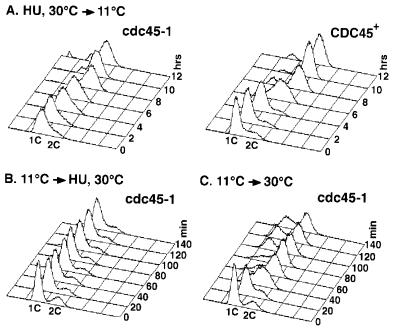
DNA elongation is dependent on CDC45 function. (A) cdc45-1 and CDC45 cultures were arrested in S phase with HU-containing media at 30°C. At 0 h, the cultures were released from the S phase arrest and shifted to 11°C. Samples were monitored flow cytometry and budding index. (B) A cdc45-1 culture was arrested by incubation in medium at 11°C, the cdc45-1-restrictive temperature. At 0 min, the culture was shifted to 30°C and HU was added. Samples were monitored by flow cytometry and budding index. (C) Samples were taken as in B, except no HU was added.
Figure 3
Figure 3
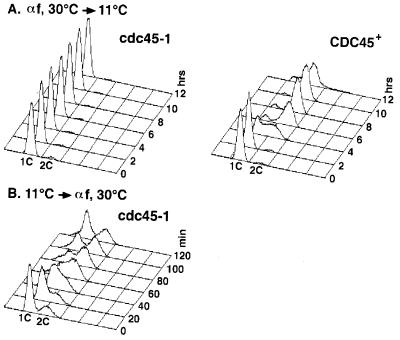
CDC45 function is dependent on START and is essential for DNA replication. (A) cdc45-1 and CDC45 cultures were arrested in G1 phase with α-factor-containing medium at 30°C. At 0 h, the cultures were released from the START arrest and shifted to 11°C. Samples were monitored by flow cytometry and budding index. (B) A cdc45-1 culture was arrested by incubation in medium at 11°C, the cdc45-1-restrictive temperature. At 0 min, the culture was shifted to 30°C and α factor was added. Samples were monitored by flow cytometry and budding index.
Figure 4
Figure 4
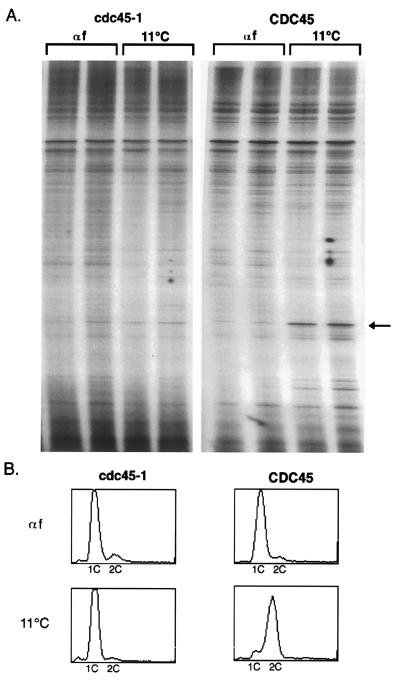
Genomic footprinting of cdc45-1 cells. CDC45 and cdc45-1 cells were arrested at START with α-factor-containing medium at 30°C (αf), and synchronously released at 11°C in the presence of nocodazole for 9 h (11°C). Each sample was processed in duplicate for genomic footprinting (A) and flow cytometry (B). The arrow indicates the hypersensitive site which is present at the 2-micron origin during S, G2, and M phases of the cell cycle.
Figure 5
Figure 5
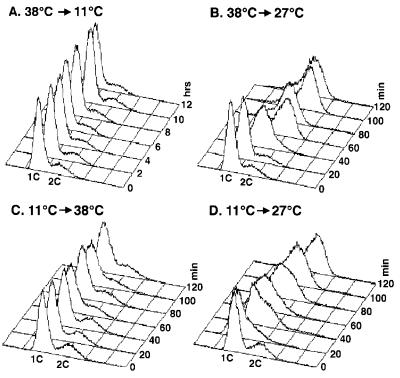
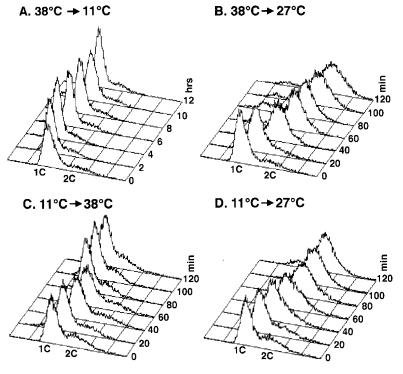
CDC45 and CDC7 are dependent on one another for function. (A) A cdc45-1 cdc7-4 culture was arrested at 38°C, the restrictive temperature for cdc7-4. At 0 h, the culture was released into medium at 11°C, the restrictive temperature for cdc45-1. Samples were monitored by flow cytometry. (B) Cells were arrested in medium at 38°C. At 0 min, the culture was released at 27°C, the permissive temperature for both cdc45-1 and cdc7-4. (C) Cells were arrested in medium at 11°C. At 0 min, the culture was released at 38°C. (D) Cells were arrested in medium at 11°C. At 0 min, the culture was released at 27°C.
Figure 6
Figure 6
CDC45 and DBF4 are dependent on one another for function. Experiments were performed identically to Fig. 5, except dbf4-1 was used instead of cdc7-4.

References

    1. Foss M, McNally F J, Laurenson P, Rine J. Science. 1993;262:1838–1844. - PubMed
    1. Fox C A, Loo S, Dillin A, Rine J. Genes Dev. 1995;9:911–924. - PubMed
    1. Bell S P, Kobayashi R, Stillman B. Science. 1993;262:1844–1849. - PubMed
    1. Li J J, Herskowitz I. Science. 1993;262:1870–1874. - PubMed
    1. Loo S, Fox C A, Rine J, Kobayashi R, Stillman B, Bell S. Mol Biol Cell. 1995;6:741–756. - PMC - PubMed

Publication types

MeSH terms

LinkOut - more resources