. 1997 Nov 11;94(23):12616-21.
doi: 10.1073/pnas.94.23.12616.

Inhibition of ubiquitin/proteasome-dependent protein degradation by the Gly-Ala repeat domain of the Epstein-Barr virus nuclear antigen 1

Affiliations

Inhibition of ubiquitin/proteasome-dependent protein degradation by the Gly-Ala repeat domain of the Epstein-Barr virus nuclear antigen 1

J Levitskaya et al. Proc Natl Acad Sci U S A. .

Abstract

The Epstein-Barr virus (EBV) encoded nuclear antigen (EBNA) 1 is expressed in latently infected B lymphocytes that persist for life in healthy virus carriers and is the only viral protein regularly detected in all EBV associated malignancies. The Gly-Ala repeat domain of EBNA1 was shown to inhibit in cis the presentation of major histocompatibility complex (MHC) class I restricted cytotoxic T cell epitopes from EBNA4. It appears that the majority of antigens presented via the MHC I pathway are subject to ATP-dependent ubiquitination and degradation by the proteasome. We have investigated the influence of the repeat on this process by comparing the degradation of EBNA1, EBNA4, and Gly-Ala containing EBNA4 chimeras in a cell-free system. EBNA4 was efficiently degraded in an ATP/ubiquitin/proteasome-dependent fashion whereas EBNA1 was resistant to degradation. Processing of EBNA1 was restored by deletion of the Gly-Ala domain whereas insertion of Gly-Ala repeats of various lengths and in different positions prevented the degradation of EBNA4 without appreciable effect on ubiquitination. Inhibition was also achieved by insertion of a Pro-Ala coding sequence. The results suggest that the repeat may affect MHC I restricted responses by inhibiting antigen processing via the ubiquitin/proteasome pathway. The presence of regularly interspersed Ala residues appears to be important for the effect.


Figures

Figure 1
Figure 1
Processing of EBNA4 in a cell-free system. The 35S-labeled EBNA4 was incubated for 2 hr at 37°C with crude reticulocyte lysate or fractionated components of the ubiquitin conjugation pathway in the presence (+ ATP) or absence (− ATP) of ATP. Control samples were kept on ice. The polypeptides were resolved by 8% SDS/PAGE and visualized by PhosphorImager. The identity of the radiolabeled bands was confirmed by Western blot analysis using specific reagents (data not shown). One representative experiment out of five is shown in the figure. (A) Degradation of EBNA4 by crude rabbit reticulocyte lysate. (B) Reconstitution experiments demonstrating that degradation is dependent on ubiquitin (Ub), ubiquitin-conjugating enzymes, and the 26S proteasome (Fr. II). (C) Accumulation of polyubiquitinated EBNA4 in the presence of ATP-γS. (D) Identity of the polyubiquitinated species demonstrated in reconstitution experiments using ATP-γS and ubiquitin aldehyde (Ubal). (E) Inhibition of ATP-dependent degradation by the proteasome inhibitor MG132. Degradation was assessed by monitoring the release of TCA-soluble radioactivity and percent degradation was calculated as described.
Figure 2
Figure 2
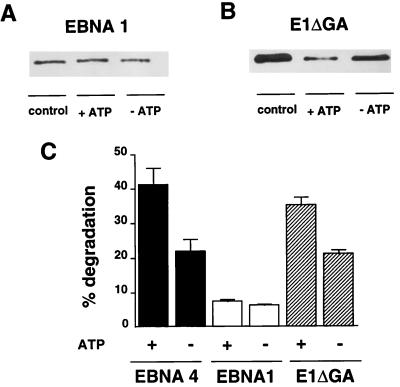
Processing of EBNA1 and E1-ΔGA. In vitro degradation of EBNA1 (A) and E1-ΔGA (B). One representative experiment out of five. (C) Degradation of EBNA4, EBNA1, and E1-ΔGA as monitored by the release of TCA-soluble radioactivity. Results are the mean ± SE of 16 experiments.
Figure 3
Figure 3
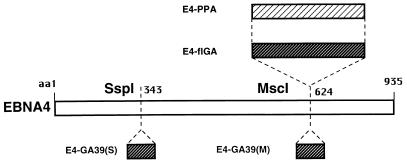
Schematic outline of the EBNA4 chimeras. Chimeric EBNA4 proteins were generated by in-frame insertion of sequences coding for the 239-amino acid-long Gly-Ala repeat of EBNA1 (flGA) or a 39-amino acid-long polypeptide containing a Gly-Ala 17 mer flanked by unique EBNA1 residues (GA39) in the MscI site [E4-flGA, E4-GA39(M)] or SspI site [E4-GA39(S)] of EBNA4. Insertion of the flGA cassette in the opposite orientation relative to the EBNA4 sequence yielded the E4-PPA chimera that contains a 238-amino acid-long Pro-Ala repeat.
Figure 4
Figure 4
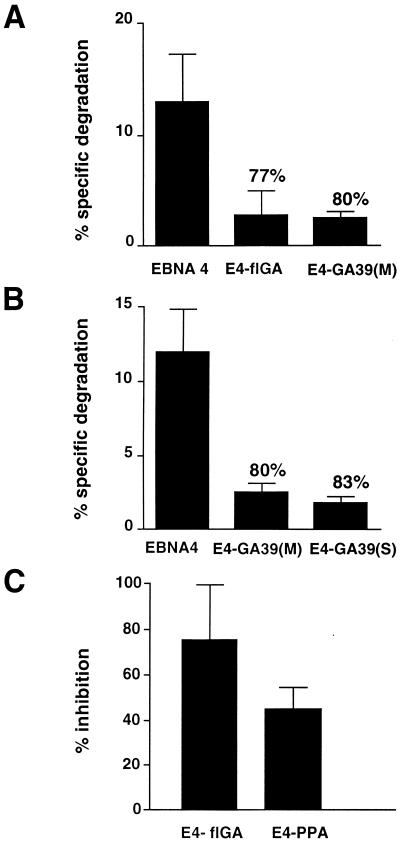
Sensitivity of the EBNA4 chimeras to ubiquitin/proteasome dependent degradation. The degradation of EBNA4 was inhibited by insertion of Gly-Ala repeats of different length (A) and in different positions (B). A weaker inhibition was achieved by insertion of a Pro-Ala repeat (C). Specific degradation was calculated from the release of TCA-soluble radioactivity as described in the legend to Fig. 1. Results are the mean ± SD of four experiments. The inhibitory effect of the repeat was calculated relative to the specific degradation of EBNA4.
Figure 5
Figure 5
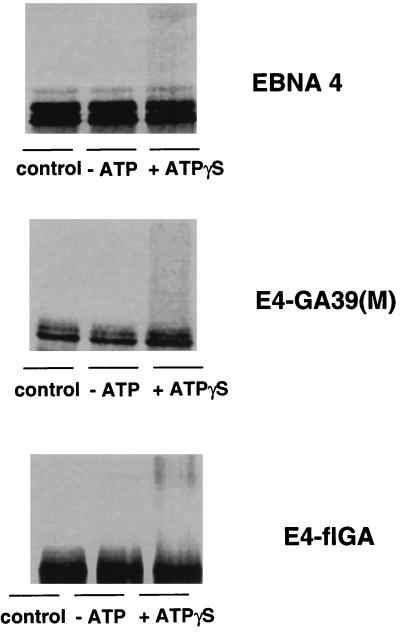
Ubiquitination of the Gly-Ala containing EBNA4 chimeras. In vitro-translated EBNA4, E4-flGA, and E4-GA39(M) were incubated for 2 hr at 37°C in crude rabbit reticulocyte lysate containing ATP-γS and ubiquitin aldehyde. Control samples were kept on ice or at 37°C under ATP-depleting conditions. One representative experiment out of three is shown in the figure.
Figure 6
Figure 6
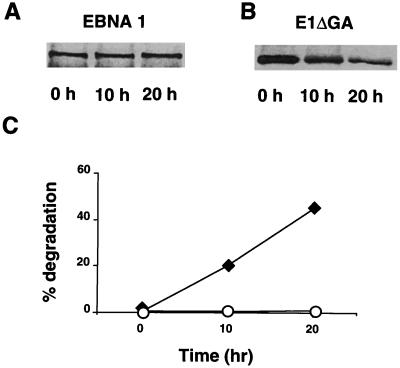
Influence of Gly-Ala repeat on the in vivo turnover of EBNA1. The in vivo turnover of EBNA1 and E1-ΔGA was monitored in pulse–chase experiments using CV1 cells infected with the corresponding recombinant vaccinia viruses. One representative experiment out of three. (A and B) In vivo-labeled polypeptides were immunoprecipitated using the OT1x mAb and resolved by SDS/PAGE. (C) The percent degradation was calculated from densitometry scans as follows: 1, intensity of the specific band at the indicated time/intensity of the specific band at time 0 × 100. ○, EBNA1; ⧫, E1-ΔGA.

References

    1. Masucci M G, Ernberg I. Trends Microbiol. 1994;2:125–130. - PubMed
    1. Steven N M, Leese A M, Annels N E, Lee S P, Rickinson A B. J Exp Med. 1996;184:1801–1813. - PMC - PubMed
    1. Murray R J, Kurilla M G, Brooks J M, Thomas W A, Rowe M, Kieff E, Rickinson A B. J Exp Med. 1992;176:157–168. - PMC - PubMed
    1. Khanna R, Burrows S R, Kurilla M G, Jacob C A, Misko I S, Sculley T B, Kieff E, Moss D J. J Exp Med. 1992;176:169–176. - PMC - PubMed
    1. Trivedi P, Masucci M, Wimberg G, Klein G. Int J Cancer. 1991;48:794–800. - PubMed

Publication types

MeSH terms