


Cerebral cortical astroglia from the trisomy 16 mouse, a model for down syndrome, produce neuronal cholinergic deficits in cell culture
- PMID: 9356503
- PMCID: PMC25068
- DOI: 10.1073/pnas.94.23.12644
Cerebral cortical astroglia from the trisomy 16 mouse, a model for down syndrome, produce neuronal cholinergic deficits in cell culture
Abstract
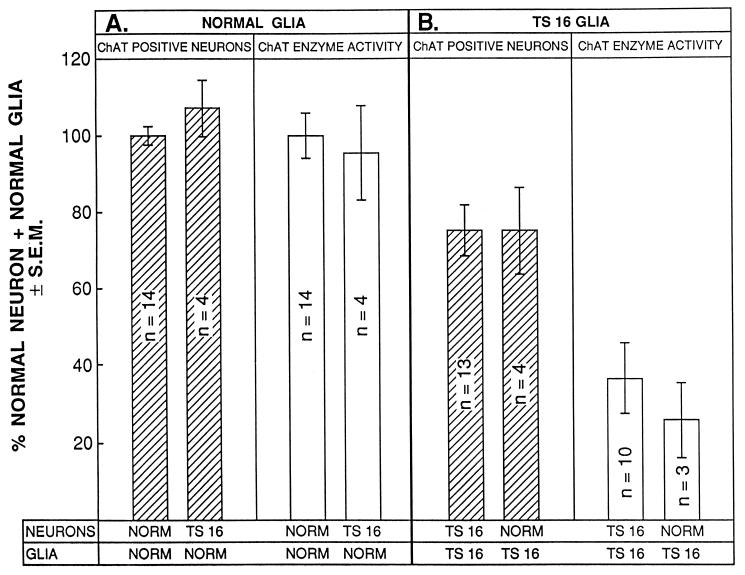
Trisomy 21 (Down syndrome) is associated with a high incidence of Alzheimer disease and with deficits in cholinergic function in humans. We used the trisomy 16 (Ts16) mouse model for Down syndrome to identify the cellular basis for the cholinergic dysfunction. Cholinergic neurons and cerebral cortical astroglia, obtained separately from Ts16 mouse fetuses and their euploid littermates, were cultured in various combinations. Choline acetyltransferase activity and cholinergic neuron number were both depressed in cultures in which both neurons and glia were derived from Ts16 fetuses. Cholinergic function of normal neurons was significantly down-regulated by coculture with Ts16 glia. Conversely, neurons from Ts16 animals could express normal cholinergic function when grown with normal glia. These observations indicate that astroglia may contribute strongly to the abnormal cholinergic function in the mouse Ts16 model for Down syndrome. The Ts16 glia could lack a cholinergic supporting factor present in normal glia or contain a factor that down-regulates cholinergic function.
Figures
References
-
- Muller H W, Junhans U, Kappler J. Pharmacol Ther. 1995;65:1–18. - PubMed
-
- Oster-Granite M L, Lacey-Casem M L. Ment Retard Dev Disabil Rev. 1995;1:227–236.
-
- Hayes A, Batshaw M L. Pediatr Clin North Am. 1993;40:523–535. - PubMed
-
- Smith D J, Stevens M E, Sudanagunta S P, Bronson R T, Makhinson M, Watabe A M, O’Dell T J, Fung J, Weier H-U, Cheng J-F, Rubin E M. Nat Genet. 1997;16:28–36. - PubMed
-
- Coyle J T, Oster-Granite M L, Reeves R H, Gearhart J D. Trends Neurosci. 1988;11:390–394. - PubMed
MeSH terms
Substances
LinkOut - more resources
Full Text Sources
Medical
