


Polymer models of meiotic and mitotic chromosomes
- PMID: 9362064
- PMCID: PMC25703
- DOI: 10.1091/mbc.8.11.2217
Polymer models of meiotic and mitotic chromosomes
Abstract
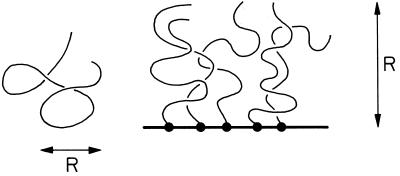
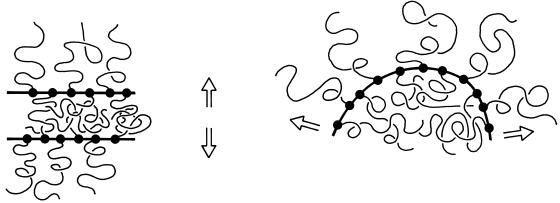
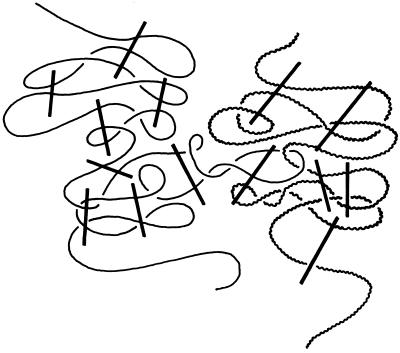
Polymers tied together by constraints exhibit an internal pressure; this idea is used to analyze physical properties of the bottle-brush-like chromosomes of meiotic prophase that consist of polymer-like flexible chromatin loops, attached to a central axis. Using a minimal number of experimental parameters, semiquantitative predictions are made for the bending rigidity, radius, and axial tension of such brushes, and the repulsion acting between brushes whose bristles are forced to overlap. The retraction of lampbrush loops when the nascent transcripts are stripped away, the oval shape of diplotene bivalents between chiasmata, and the rigidity of pachytene chromosomes are all manifestations of chromatin pressure. This two-phase (chromatin plus buffer) picture that suffices for meiotic chromosomes has to be supplemented by a third constituent, a chromatin glue to understand mitotic chromosomes, and explain how condensation can drive the resolution of entanglements. This process resembles a thermal annealing in that a parameter (the affinity of the glue for chromatin and/or the affinity of the chromatin for buffer) has to be tuned to achieve optimal results. Mechanical measurements to characterize this protein-chromatin matrix are proposed. Finally, the propensity for even slightly chemically dissimilar polymers to phase separate (cluster like with like) can explain the apparent segregation of the chromatin into A + T- and G + C-rich regions revealed by chromosome banding.
Figures
References
-
- Belmont AS, Braunfeld MB, Sedat JW, Agard DA. Large-scale chromatin structural domains within mitotic and interphase chromosomes in vivo and in vitro. Chromosoma. 1989;98:129–143. - PubMed
-
- Bickel SE, Orr-Weaver TL. Holding chromatids together to ensure they go their separate ways. Bioessays. 1996;18:293–300. - PubMed
-
- Boy de la Tour E, Laemmli UK. The metaphase scaffold is helically folded: sister chromatids have predominantly opposite helical handedness. Cell. 1988;55:937–944. - PubMed
-
- Bradbury EM. Reversible histone modifications and the chromosome cell cycle. Bioessays. 1992;1:9–16. - PubMed
-
- Callan HG. Lampbrush chromosomes. Proc R Soc Lond B. 1981;214:417–448. - PubMed
Publication types
MeSH terms
Substances
LinkOut - more resources
Full Text Sources
