


The carbamate kinase-like carbamoyl phosphate synthetase of the hyperthermophilic archaeon Pyrococcus furiosus, a missing link in the evolution of carbamoyl phosphate biosynthesis
- PMID: 9371756
- PMCID: PMC24219
- DOI: 10.1073/pnas.94.24.12803
The carbamate kinase-like carbamoyl phosphate synthetase of the hyperthermophilic archaeon Pyrococcus furiosus, a missing link in the evolution of carbamoyl phosphate biosynthesis
Abstract
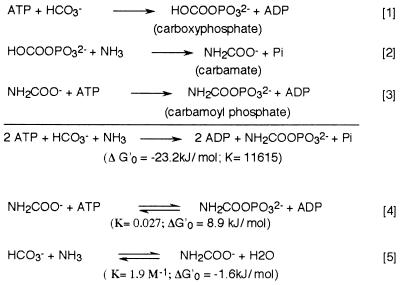
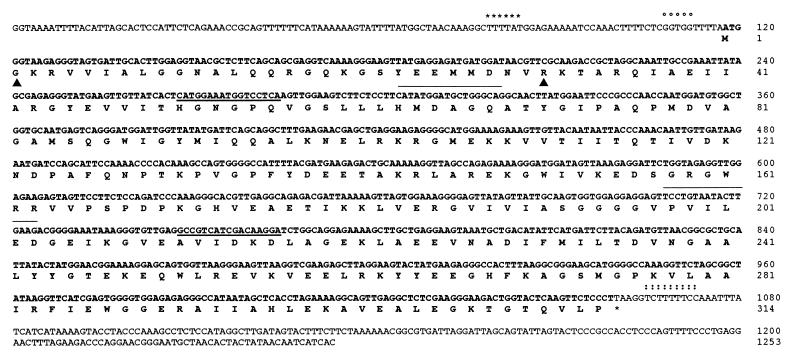
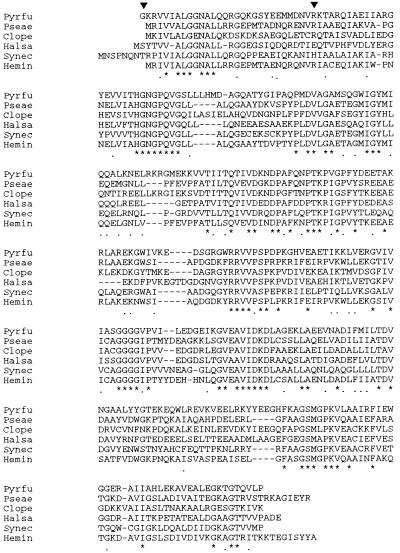
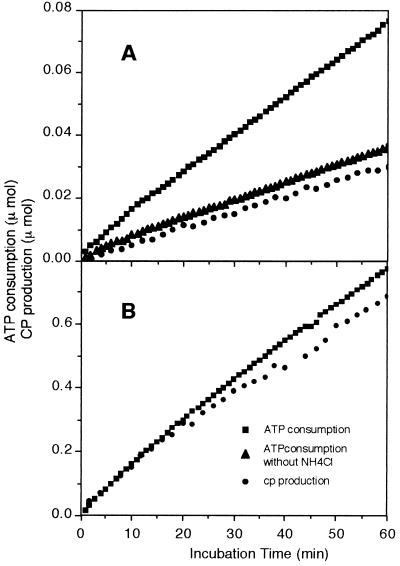
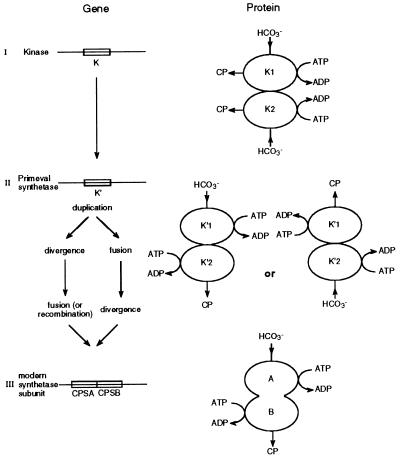
Microbial carbamoyl phosphate synthetases (CPS) use glutamine as nitrogen donor and are composed of two subunits (or domains), one exhibiting glutaminase activity, the other able to synthesize carbamoyl phosphate (CP) from bicarbonate, ATP, and ammonia. The pseudodimeric organization of this synthetase suggested that it has evolved by duplication of a smaller kinase, possibly a carbamate kinase (CK). In contrast to other prokaryotes the hyperthermophilic archaeon Pyrococcus furiosus was found to synthesize CP by using ammonia and not glutamine. We have purified the cognate enzyme and found it to be a dimer of two identical subunits of Mr 32,000. Its thermostability is considerable, 50% activity being retained after 1 h at 100 degrees C or 3 h at 95 degrees C. The corresponding gene was cloned by PCR and found to present about 50% amino acid identity with known CKs. The stoichiometry of the reaction (two ATP consumed per CP synthesized) and the ability of the enzyme to catalyze at high rate a bicarbonate-dependent ATPase reaction however clearly distinguish P. furiosus CPS from ordinary CKs. Thus the CPS of P. furiosus could represent a primeval step in the evolution of CPS from CK. Our results suggest that the first event in this evolution was the emergence of a primeval synthetase composed of subunits able to synthesize both carboxyphosphate and CP; this step would have preceded the duplication assumed to have generated the two subdomains of modern CPSs. The gene coding for this CK-like CPS was called cpkA.
Figures
References
-
- Meister A. Adv Enzymol. 1989;55:315–374. - PubMed
-
- Campbell J W, Anderson P M. In: Biochemistry and Molecular Biology of Fishes. Hochachka P W, Mommsen T P, editors. Amsterdam: Elsevier; 1991. pp. 43–76.
-
- Jones M E. Annu Rev Biochem. 1965;34:381–417. - PubMed
-
- Anderson P M, Meister A. Biochemistry. 1966;5:3157–3163. - PubMed
Publication types
MeSH terms
Substances
Associated data
- Actions
LinkOut - more resources
Full Text Sources
Other Literature Sources
Molecular Biology Databases
Research Materials
Miscellaneous
