. 1997 Sep 30;94(20):10693-8.
doi: 10.1073/pnas.94.20.10693.

Two sterol regulatory element-like sequences mediate up-regulation of caveolin gene transcription in response to low density lipoprotein free cholesterol

Affiliations

Two sterol regulatory element-like sequences mediate up-regulation of caveolin gene transcription in response to low density lipoprotein free cholesterol

A Bist et al. Proc Natl Acad Sci U S A. .

Abstract

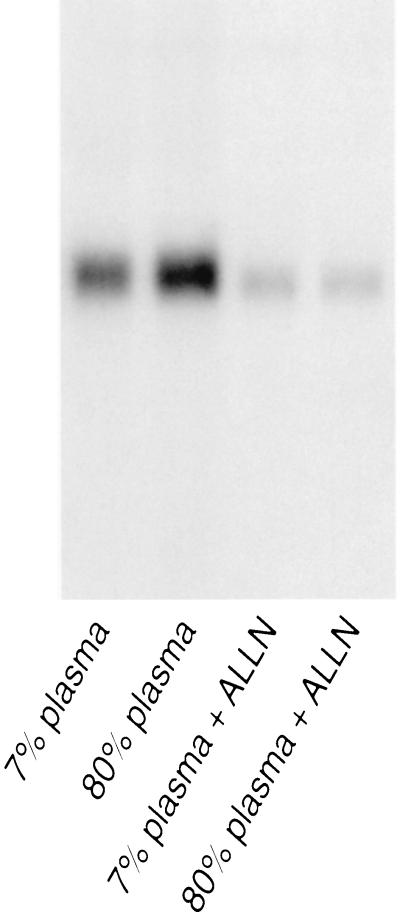
Caveolae form the terminus for a major pathway of intracellular free cholesterol (FC) transport. Caveolin mRNA levels in confluent human skin fibroblasts were up-regulated following increased uptake of low density lipoprotein (LDL) FC. The increase induced by FC was not associated with detectable change in mRNA stability, indicating that caveolin mRNA levels were mediated at the level of gene transcription. A total of 924 bp of 5' flanking region of the caveolin gene were cloned and sequenced. The promoter sequence included three G+C-rich potential sterol regulatory elements (SREs), a CAAT sequence and a Sp1 consensus sequence. Deletional mutagenesis of individual SRE-like sequences indicated that of these two (at -646 and -395 bp) were essential for the increased transcription rates mediated by LDL-FC, whereas the third was inconsequential. Gel shift analysis of protein binding from nuclear extracts to these caveolin promoter DNA sequences, together with DNase I footprinting, confirmed nucleoprotein binding to the SRE-like elements as part of the transcriptional response to LDL-FC. A supershift obtained with antibody to SRE-binding protein 1 (SPEBP-1) indicated that this protein binds at -395 bp. There was no reaction at -395 bp with anti-Sp1 antibody nor with either antibody at -646 bp. The cysteine protease inhibitor N-acetyl-leu-leu-norleucinal (ALLN), which inhibits SREBP catabolism, superinhibited caveolin mRNA levels regardless of LDL-FC. This finding suggests that SREBP inhibits caveolin gene transcription in contrast to its stimulating effect on other promoters. The findings of this study are consistent with the postulated role for caveolin as a regulator of cellular FC homeostasis in quiescent peripheral cells, and the coordinate regulation by SREBP of FC influx and efflux.


Figures
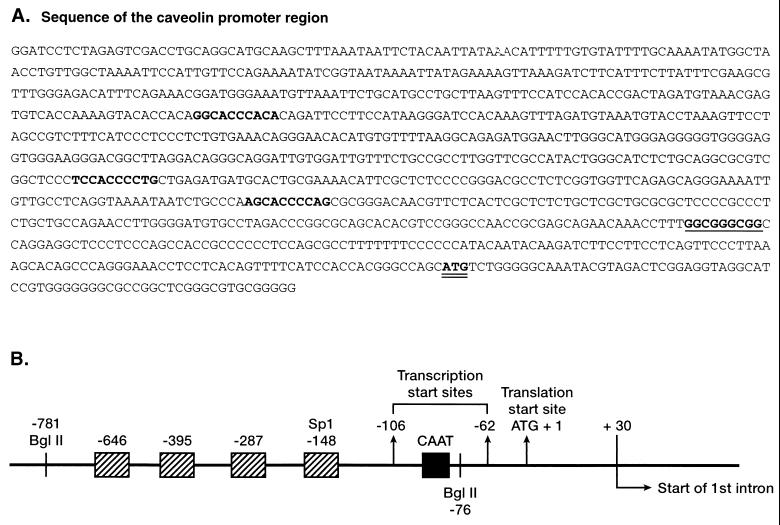
Figure 1
Figure 1
The 5′ flanking region, exon 1, and part of intron 1 of the human caveolin gene sequence. Promoter structure of the caveolin gene. Three potential SREs are in bold face. The Sp1 consensus site is in bold face underlined. The translational ATG start site is shown double underlined.
Figure 2
Figure 2
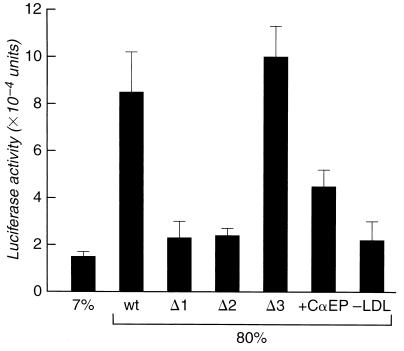
Luciferase activity from pGL3 driven by wild-type or mutant caveolin promoters. Δ1, Δ2, and Δ3 refer to promoter mutants from which SRE-like sequences at −646, −395, and −287 bp (Fig. 1) had been deleted. Fibroblast monolayers transiently transfected with wild-type or mutant caveolin promoters (Δ1, Δ2, or Δ3) were incubated with 80% (vol/vol) native human plasma for 3 h at 37°C. Other transfected cells monolayers were incubated with 80% (vol/vol) native plasma in the presence of 50 μM cholesterol α-epoxide (CαEP) or with plasma from which LDL had been removed by heparin affinity chromatography. Values shown are means ± one SD for three to five determinations. Luciferase yield, determined as described, did not differ significantly from baseline values when the wild-type caveolin promoter was inserted in reverse orientation, or in the absence of cell lysate (data not shown).
Figure 3
Figure 3
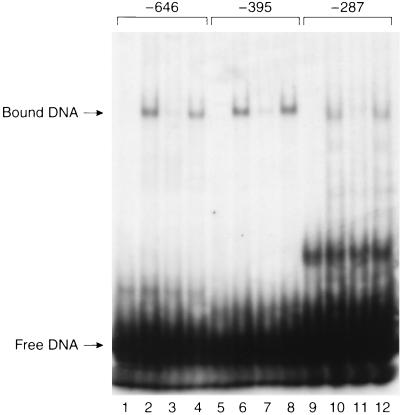
Gel shift assays of wild-type or mutant DNA fragments including the SRE-like sequences at −646, −395, and −287 bp. 32P-labeled synthetic oligonucleotides (cav-646, cav-395, cav-287) were incubated in the absence of nuclear extract (lanes 1, 5, and 9), in the presence of nuclear extract (lanes 2, 6, and 10), with both nuclear extract and cold homologous DNA (lanes 3, 7, and 11) or with both nuclear extract and unlabeled mutant DNA (Δ1, Δ2, or Δ3 for cav-646, cav-395, or cav-287, respectively)(lanes 4, 8, and 12). The bound and unbound DNA fractions were resolved on polyacrylamide gels as described.
Figure 4
Figure 4
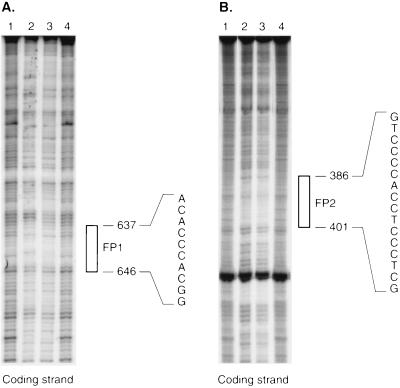
(A) Footprinting of the DNA fragment including SRE-like sequence at −646 bp. (B) Footprinting of the DNA fragment including the SRE-like sequence at −395 bp. Both probes had been end-labeled as described and were incubated in the presence of 5 or 30 μg of nuclear extract (lanes 2 and 3) or without nuclear extract (lanes 1 and 4). Following digestion with DNase I, G+A Maxam–Gilbert sequencing reactions were carried out on the same end-labeled fragments to serve as size markers. The protected regions are shown as FP-1 (corresponding to SRE-like sequence 1) and FP-2 (corresponding to SRE-like sequence 2).
Figure 5
Figure 5
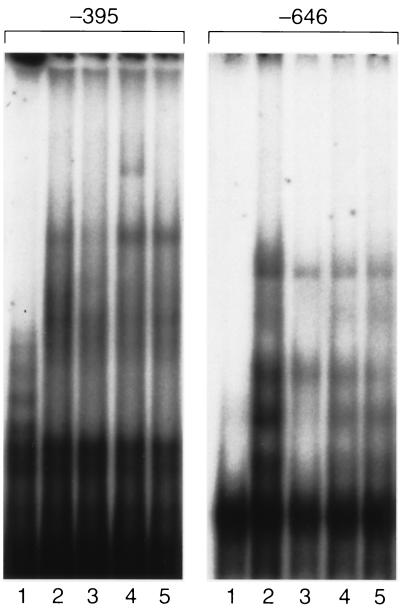
Gel supershift assays of the essential SRE-like sequences at −646 and −395 bp in the presence of antibodies against SREBP-1 and Sp1. Nuclear extract was preincubated with 5 μg of anti-SREBP-1 or anti-Sp1 as described. Lanes: 1, free probe; 2, probe plus 4 μg nuclear extract; 3, probe plus nuclear extract plus cold DNA; 4, probe plus nuclear extract plus anti-SREBP-1; 5, probe plus nuclear extract plus anti-Sp1.
Figure 6
Figure 6
Effects of ALLN on caveolin mRNA levels. Cells in 7% or 80% human plasma–DMEM were incubated (3 h, 37°C) in the presence or absence of 25 μM ALLN. Following incubation, mRNA was extracted and purified as described. Following electrophoresis, Northern blot analysis was carried out using full-length 32P-labeled caveolin cDNA.

References

    1. Fielding C J, Fielding P E. J Lipid Res. 1997;38:1503–1521. - PubMed
    1. Fielding P E, Fielding C J. Biochemistry. 1995;34:14288–14292. - PubMed
    1. Fielding P E, Fielding C J. Biochemistry. 1996;35:14932–14938. - PubMed
    1. Parton R G, Simons K. Science. 1995;269:1398–1399. - PubMed
    1. Fra A M, Williamson E, Simons K, Parton R G. J Biol Chem. 1994;269:30745–30748. - PubMed

Publication types

MeSH terms

Associated data

LinkOut - more resources