


The unique hetero-oligomeric nature of the subunits in the catalytic cooperativity of the yeast Cct chaperonin complex
- PMID: 9380710
- PMCID: PMC23484
- DOI: 10.1073/pnas.94.20.10780
The unique hetero-oligomeric nature of the subunits in the catalytic cooperativity of the yeast Cct chaperonin complex
Erratum in
- Proc Natl Acad Sci U S A 1997 Dec 23;94(26):14976
Abstract
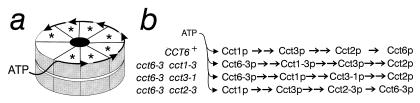
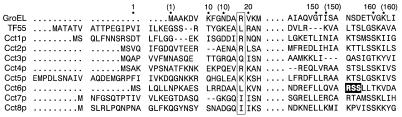
The structural and functional organization of the Cct complex was addressed by genetic analyses of subunit interactions and catalytic cooperativity among five of the eight different essential subunits, Cct1p-Cct8p, in the yeast Saccharomyces cerevisiae. The cct1-1, cct2-3, and cct3-1 alleles, containing mutations at the conserved putative ATP-binding motif, GDGTT, are cold-sensitive, whereas single and multiple replacements of the corresponding motif in Cct6p are well tolerated by the cell. We demonstrated herein that cct6-3 (L19S), but not the parolog cct1-5 (R26I), specifically suppresses the cct1-1, cct2-3, and cct3-1 alleles, and that this suppression can be modulated by mutations in a putative phosphorylation motif, RXS, and the putative ATP-binding pocket of Cct6p. Our results suggest that the Cct ring is comprised of a single hetero-oligomer containing eight subunits of differential functional hierarchy, in which catalytic cooperativity of ATP-binding/hydrolysis takes place in a sequential manner different from the concerted cooperativity proposed for GroEL.
Figures

References
Publication types
MeSH terms
Substances
LinkOut - more resources
Full Text Sources
Other Literature Sources
Molecular Biology Databases
Research Materials
Miscellaneous
