. 1997 Sep 30;94(20):11019-24.
doi: 10.1073/pnas.94.20.11019.

Functional consequences of NR2 subunit composition in single recombinant N-methyl-D-aspartate receptors

Affiliations

Functional consequences of NR2 subunit composition in single recombinant N-methyl-D-aspartate receptors

J C Brimecombe et al. Proc Natl Acad Sci U S A. .

Abstract

Single-channel recordings were obtained from Chinese hamster ovary cells transfected with the N-methyl-D-aspartate (NMDA) receptor subunit NR1 in combination with NR2A, NR2B, NR2C, or NR2A/NR2B. NMDA-activated currents were recorded under control conditions and in the presence of a thiol reductant (DTT), an oxidant (5, 5'-dithio-bis[2-nitrobenzoic acid], DTNB), or the noncompetitive antagonist CP101,606 (CP). For all subunit combinations, DTT increased the frequency of channel opening when compared with DTNB. In addition, channels obtained from NR1/NR2A-transfected cells also exhibited a pronounced difference in mean open dwell-time between redox conditions. CP dramatically reduced both the open dwell-time and frequency of channel opening of NR1/NR2B-containing receptors, but only modestly inhibited NR1/NR2A and NR1/NR2C channel activity. A small number of patches obtained from cells transfected with NR1/NR2A/NR2B had channels with properties intermediate to NR1/NR2A and NR1/NR2B receptors, including insensitivity to CP block but redox properties similar to NR1/NR2B, consistent with the coassembly of NR2A with NR2B. Hence, NMDA receptors containing multiple types of NR2 subunits can have functionally distinguishable attributes.


Figures
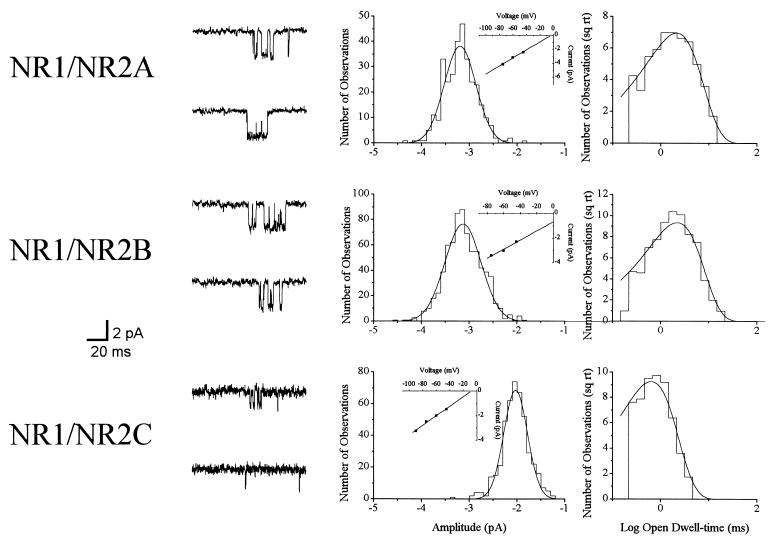
Figure 1
Figure 1
Single-channel properties of NMDA receptors expressed in CHO cells. (Left) Representative NR1/NR2A, NR1/NR2B, and NR1/NR2C channels recorded from outside-out patches during continuous exposure to 10 μM NMDA at −60 mV. (Center) The amplitude histograms obtained from these events were fit with single Gaussian functions. Similar measurements recorded at other holding voltages were used to generate I–V relations (Insets) with slope conductances of 55 pS for NR1/NR2A, 47 pS for NR1/NR2B, and 36 pS for NR1/NR2C. (Right) The open dwell-time distributions were best-fit with single exponential functions with time constants of 2.2, 2.0, and 0.8 ms for the three subunit combinations, respectively. Similar events were recorded in different patches for each receptor configuration in the absence of any other drug treatments.
Figure 2
Figure 2
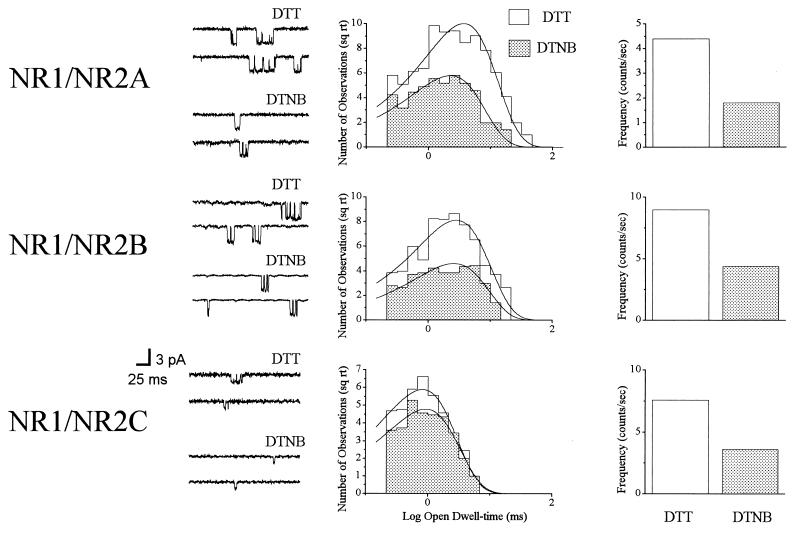
Redox properties of recombinant NMDA receptors. Representative NMDA (10 μM)-activated single channels obtained from outside-out patches excised from CHO cells transfected with NR1/NR2A (n = 9), NR1/NR2B (n = 9), and NR1/NR2C (n = 4). (Left) Representative events shown were recorded during continuous exposure to 1.0 mM DTT or 0.1 mM DTNB at −60 mV. The amplitudes of the events were not altered by the redox treatments for all receptor configurations (not shown) and were essentially identical to control channels. (Center) Open dwell-time histograms for these events were best-fit by single exponential functions; only the NR1/NR2A mean open dwell-time constants were significantly altered by the redox treatments. (Right) Frequency of channel opening was similarly altered by the redox treatments for all receptor configurations.
Figure 3
Figure 3
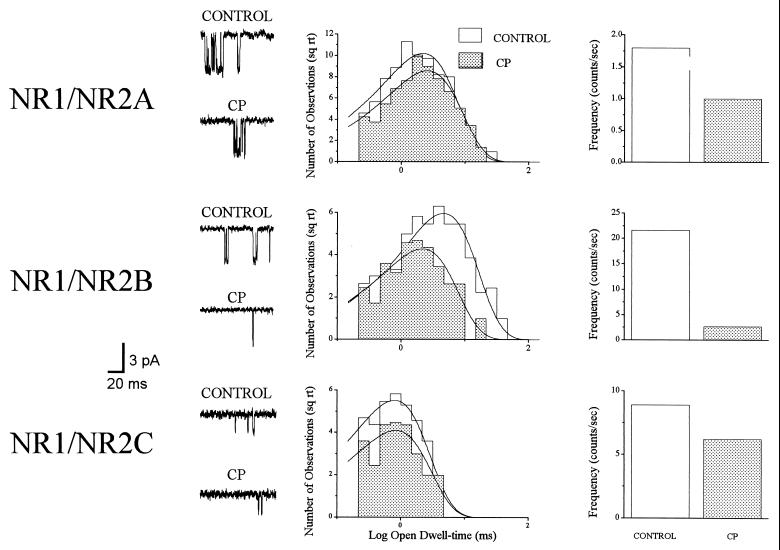
CP is a selective NR1/NR2B antagonist. (Left) Representative 10 μM NMDA-activated events before and after treatment with 1 μM CP in patches excised from cells transfected with NR1/NR2A, NR1/NR2B, and NR1/NR2C. (Center) Open dwell-time histograms for the events evoked from these patches revealed that NR1/NR2A receptors are relatively unaffected by the presence of CP; although the frequency of channel opening of this channel (Right) is reduced by the antagonist. Similar results were obtained with NR1/NR2C channels. In contrast, the NR1/NR2B open time decreased to a large degree in the presence of CP. The frequency of channel opening for the NR1/NR2B channel also decreased substantially in the presence of this drug. Similar results were obtained in a total of six NR1/NR2A, eight NR1/NR2B, and three NR1/NR2C channels.
Figure 4
Figure 4
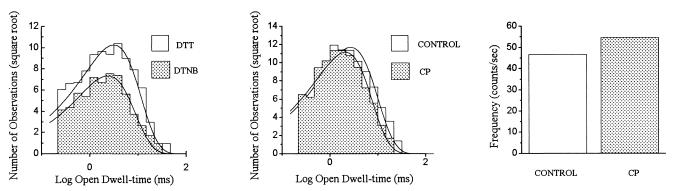
Putative coassembly of NR1/NR2A/NR2B. (Left) Open dwell-time histogram for events elicited with 10 μM NMDA in the presence of either 1 mM DTT or 0.1 mM DTNB revealed that the open dwell-times of these patches were unaffected by redox agents. Treatment of these patches with 1 μM CP did not alter the open dwell-time constants (Center) or the frequency of channel opening (Right). Similar results were obtained in a total of three channels from patches excised from cells transfected with NR1/NR2A/NR2B subunits.

References

    1. Moriyoshi K, Masu M, Ishii T, Shigemoto R, Mizuno N, Nakanishi S. Nature (London) 1991;354:31–37. - PubMed
    1. Zukin R S, Bennett M V. Trends Neurosci. 1995;18:306–313. - PubMed
    1. Ikeda K, Nagasawa H, Mori H, Araki K, Sakimura K, Watanabe M, Inoue Y, Mishina M. FEBS Lett. 1992;313:34–38. - PubMed
    1. Kutsuwada T, Kashiwabuchi N, Mori H, Sakimura K, Kushiya E, Araki K, Meguro H, Masaki H, Kumanishi T, Arakawa M, Mishina M. Nature (London) 1992;358:36–41. - PubMed
    1. Meguro H, Mori H, Araki K, Kushiya E, Kutsuwada T, Yamazaki M, Kumanishi T, Arakawa M, Sakimura K, Mishina M. Nature (London) 1992;357:70–74. - PubMed

Publication types

MeSH terms

LinkOut - more resources