. 1997 Sep 30;94(20):11031-6.
doi: 10.1073/pnas.94.20.11031.

The interaction of the general anesthetic etomidate with the gamma-aminobutyric acid type A receptor is influenced by a single amino acid

Affiliations

The interaction of the general anesthetic etomidate with the gamma-aminobutyric acid type A receptor is influenced by a single amino acid

D Belelli et al. Proc Natl Acad Sci U S A. .

Abstract

The gamma-aminobutyric acid type A (GABAA) receptor is a transmitter-gated ion channel mediating the majority of fast inhibitory synaptic transmission within the brain. The receptor is a pentameric assembly of subunits drawn from multiple classes (alpha1-6, beta1-3, gamma1-3, delta1, and epsilon1). Positive allosteric modulation of GABAA receptor activity by general anesthetics represents one logical mechanism for central nervous system depression. The ability of the intravenous general anesthetic etomidate to modulate and activate GABAA receptors is uniquely dependent upon the beta subunit subtype present within the receptor. Receptors containing beta2- or beta3-, but not beta1 subunits, are highly sensitive to the agent. Here, chimeric beta1/beta2 subunits coexpressed in Xenopus laevis oocytes with human alpha6 and gamma2 subunits identified a region distal to the extracellular N-terminal domain as a determinant of the selectivity of etomidate. The mutation of an amino acid (Asn-289) present within the channel domain of the beta3 subunit to Ser (the homologous residue in beta1), strongly suppressed the GABA-modulatory and GABA-mimetic effects of etomidate. The replacement of the beta1 subunit Ser-290 by Asn produced the converse effect. When applied intracellularly to mouse L(tk-) cells stably expressing the alpha6beta3gamma2 subunit combination, etomidate was inert. Hence, the effects of a clinically utilized general anesthetic upon a physiologically relevant target protein are dramatically influenced by a single amino acid. Together with the lack of effect of intracellular etomidate, the data argue against a unitary, lipid-based theory of anesthesia.


Figures
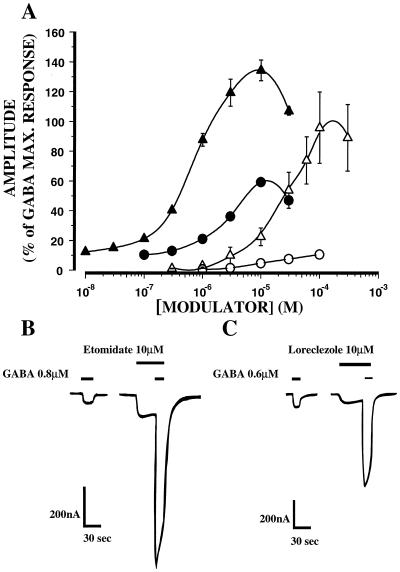
Figure 1
Figure 1
Comparison of the actions of etomidate and loreclezole on GABAA6β3γ2L) receptors expressed in X. laevis oocytes. (A) Graph showing the concentration-effect relationship for the GABA-modulatory (solid symbols) and GABA-mimetic (open symbols) of etomidate (triangles) and loreclezole (circles) expressed as a percentage of the peak amplitude of the current produced by a maximally effective concentration of GABA (3 mM). Each point represents the mean ± SEM determined from 3–5 oocytes. The curves, fitted by eye, have no theoretical significance. (B and C) Exemplar traces illustrating the effects of a maximally effective concentration (10 μM) of etomidate (B) or loreclezole (C) on the inward current induced by GABA applied at EC10. Note the direct inward current elicited by the pre-application of these agents prior to the addition of GABA.
Figure 2
Figure 2
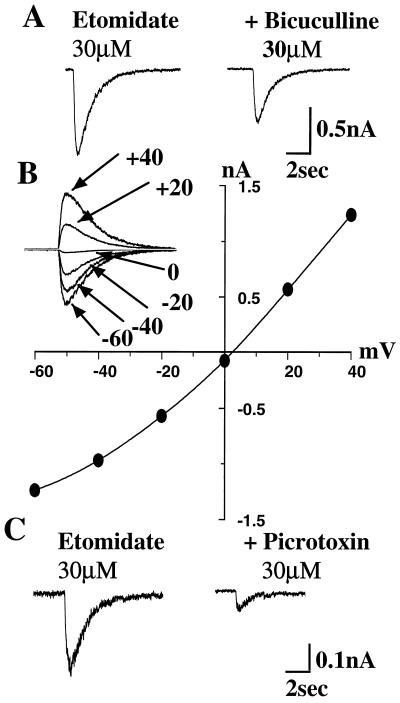
The GABA-mimetic effects of etomidate. (A) Traces illustrating inward currents (holding potential = −40 mV) evoked by the brief local application of etomidate (30 μM) to an L(tk−) cell stably transfected with human α6β3γ2S receptor subunits. Currents evoked by etomidate are antagonized by 30 μM bath-applied bicuculline. (B) Representative current-voltage plot depicting the relationship between holding potential and the peak amplitude of responses induced by 30 μM etomidate recorded from an L(tk−) cell expressing the α6β3γ2S receptor subunits. (Inset) Family of currents from which the graph was derived. (C) Brief application of 30 μM etomidate to a cerebellar granule cell (holding potential = −60 mV) induces an inward current that is antagonized by 30 μM picrotoxin.
Figure 3
Figure 3
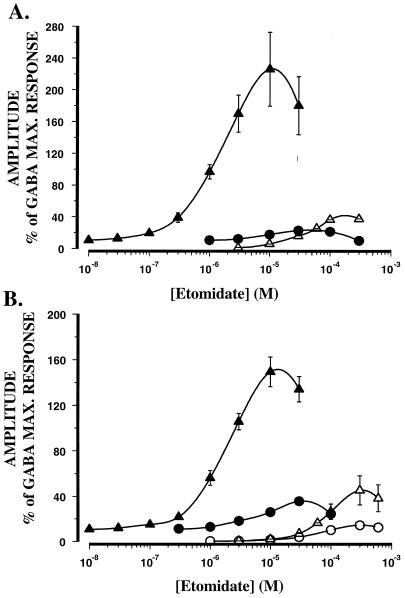
The potency and efficacy of the modulatory and agonist actions of etomidate varies across GABAA receptors incorporating chimeric and point-mutant β subunits. (A) Graph depicting the modulatory (solid symbols) and agonist (open symbols) actions of etomidate at the β1–2 (triangles) and β2–1 (circles) subunit chimeras coexpressed with the wild-type α6 and γ2 subunits in X. laevis oocytes. For clarity, data for the extremely weak agonist activity of etomidate at the chimeric β2–1 subunit-containing receptor are omitted. (B) Graph showing the concentration-effect relationship for the GABA-modulatory (solid symbols) and GABA-mimetic (open symbols) of etomidate at the β subunit point mutants β1 S290N (triangles) or β3 N289S (circles) coexpressed with the wild-type α6 and γ2 subunits. Data are expressed relative to the maximal response elicited by a saturating concentration of GABA. Each point represents the mean data determined from 2 to 5 oocytes and the associated SEM where appropriate and exceeding the size of the symbol. The curves, fitted by eye, have no theoretical significance.
Figure 4
Figure 4
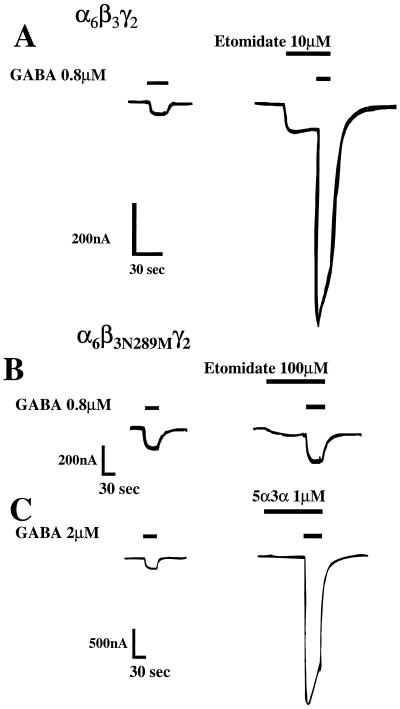
Suppression of the modulatory and agonist actions of etomidate by a site-directed mutation of the β3 subunit. (A) Traces illustrating the potentiation by a maximally effective concentration of etomidate (10 μM) of the inward current response evoked by GABA at EC10 at receptors composed of wild-type α6 β3 and γ2 subunits expressed in X. laevis oocytes. Note the prominent inward current evoked by the pre-application of etomidate. (B) Traces illustrating the virtual absence of effect of a high concentration of etomidate (100 μM) of the inward current response evoked by GABA at EC10 at receptors composed of wild-type α6, γ2, and mutant β3 N289M subunits. (C) 5α-Pregnan-3α-ol-20-one (1 μM) retains GABA-modulatory activity at receptors composed of wild-type α6, γ2, and mutant β3 N289M subunits.
Figure 5
Figure 5
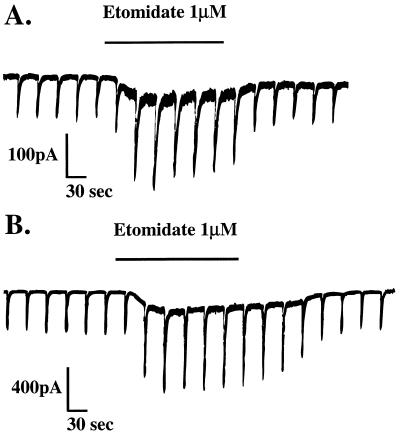
Intracellularly applied etomidate does not affect the GABAA receptor. Traces depicting inward current responses elicited by the repetitive local application of 3 μM GABA to L(tk−) cells stably expressing the α6β3γ2S subunit combination. Responses were recorded under whole-cell voltage clamp at holding potential of −40 mV from cells dialyzed with the standard pipette solution (A) or pipette solution supplemented with 10 μM etomidate (B). Approximately 10 min after establishing the whole-cell recording, the cells were challenged with 1 μM of bath-applied etomidate. In either instance, etomidate caused a clear potentiation of the GABA-evoked current and directly elicited an inward current response.

References

    1. Rushman G B, Davies N J H, Atkinson R S. A Short History of Anaesthesia. Oxford: Butterworth–Heinemann; 1996. pp. 1–218.
    1. Franks N P, Lieb W R. Nature (London) 1994;367:607–614. - PubMed
    1. Franks N P, Lieb W R. Trends Pharmacol Sci. 1987;8:169–174.
    1. Raines D E, Miller K W. Anesth Analg. 1994;79:1031–1033. - PubMed
    1. Liu J, Laster M J, Taheri S, Eger E I, II, Chortkoff B, Halsey M J. Anesth Analg. 1994;79:1049–1055. - PubMed

Publication types

MeSH terms

LinkOut - more resources