


doi: 10.1073/pnas.94.25.13771.
Replacement of Fhit in cancer cells suppresses tumorigenicity
Affiliations
- PMID: 9391102
- PMCID: PMC28382
- DOI: 10.1073/pnas.94.25.13771
Item in Clipboard
Replacement of Fhit in cancer cells suppresses tumorigenicity
Proc Natl Acad Sci U S A.
.
Abstract
The candidate tumor suppressor gene, FHIT, encompasses the common human chromosomal fragile site at 3p14.2, the hereditary renal cancer translocation breakpoint, and cancer cell homozygous deletions. Fhit hydrolyzes dinucleotide 5',5"'-P1,P3-triphosphate in vitro and mutation of a central histidine abolishes hydrolase activity. To study Fhit function, wild-type and mutant FHIT genes were transfected into cancer cell lines that lacked endogenous Fhit. No consistent effect of exogenous Fhit on growth in culture was observed, but Fhit and hydrolase "dead" Fhit mutant proteins suppressed tumorigenicity in nude mice, indicating that 5',5"'-P1, P3-triphosphate hydrolysis is not required for tumor suppression.
Figures
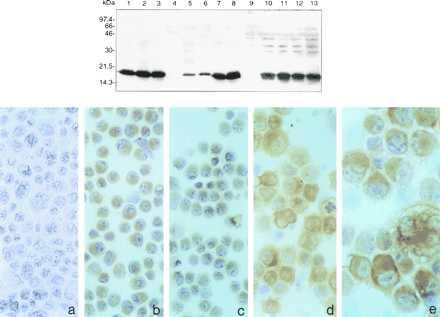
Fhit expression in stably transfected cell lines. (Upper) Detection of Fhit expression of transfectant clones after immunoblotting of 50–100 μg/lane of protein from the following lysates: Lane 1, control Cos cells transiently transfected with pRcFHIT; lane 2, RC48/FHIT cl15; lane 3, RC48/FHITH96N cl1; lane 4, RC48/CMV, lane 5, HKI/FHIT cl26; lane 6, AGS/FHIT cl25; lane 7, 293/FHIT cl56; lane 8, 293/FHITH96N cl24; lane 9, MKN74/CMV; lane 10, MKN74/FHIT clA66; lane 11, MKN74/FHIT clA116; lane 12, MKN74/FHITH96N clB27; and lane 13, MKN74/FHITH96N clB59. Protein in lanes 1–8 was detected by using the monoclonal M2 anti-FLAG antibody; protein in lanes 9–13 was detected by using rabbit polyclonal anti-Fhit antiserum (1:5,000). (Lower) Detection of Fhit expression by immunocytochemistry. Cytospins of H460 cells and pRcFHIT transfected clones were tested for Fhit-FLAG expression by immunocytochemistry by using rabbit polyclonal anti-GST Fhit antiserum (1:500) followed by detection by using immunocoupled horseradish peroxidase: (a) H460 cells; (b) Fhit expressing transfected clone 1.2; (c) clone 3.2; (d) clone 2.I; and (e) clone 2.3.
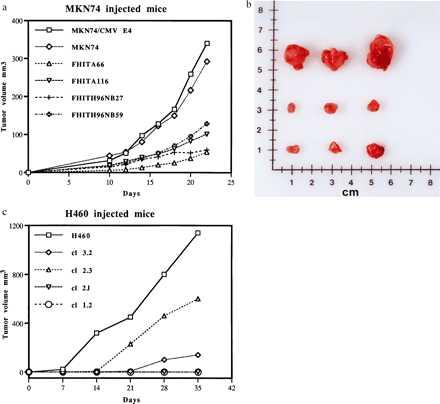
Stable Fhit wild-type and H96N mutant expression in transfected cancer cell clones suppresses tumor growth in nude mice. (a) MKN74 transfectants. Two MKN74 clones stably expressing wild-type or H96N mutant Fhit protein were injected (5 × 10⁶ cells/mouse) into nude mice (5 mice per cell line), and tumor growth was compared with growth in mice injected with 5 × 10⁶ MKN74 parental cells or a MKN/CMV clone. Tumor dimensions were measured for each mouse over a 3-week period, and tumor volumes were determined. Volumes were averaged for each time point for the five mice injected with the individual clones. Although there is clonal variation in size of tumors, all tumors of Fhit wild-type or mutant expressor clones were two to three times smaller than the MKN74 or MKN74/CMV tumors. (b) MKN74 tumors. (Top) MKN74/CMV tumors. (Middle) MKN74/FHIT tumors. (Bottom) MKN74/FHITH96N mutant tumors. (c) H460 transfectants. Nude mice were inoculated in the right flank with 2 × 10⁶ H460 cells (10 mice) or 2 × 10⁶ cells of individual Fhit expressing clones (5 mice each) and mice were observed over a 5-week period. Animals without tumors were not included in calculation of average tumor volumes.
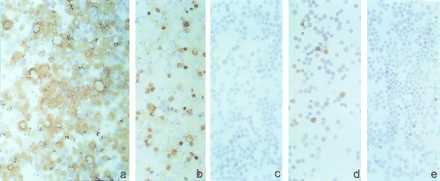
Immunocytochemical detection of Fhit in tumor-derived cells. Fhit protein expression, evaluated by immunocytochemistry, of clone 2.I (a), clone 2.3 after several tissue culture passages (b), and cultured cells from tumors of mice injected with clone 2.3 (c–e).
References
-
- Ohta M, Inoue H, Cotticelli M G, Kastury K, Baffa R, Palazzo J, Siprashvili Z, Mori M, McCue P, Druck T, Croce C M, Huebner K. Cell. 1996;84:587–597. - PubMed
-
- Sozzi G, Veronese M L, Negrini M, Baffa R, Cotticelli M G, Inoue H, Tornielli S, Pilotti S, DeGregorio L, Pastorino V, Pierotti M A, Ohta M, Huebner K, Croce C M. Cell. 1996;85:17–26. - PubMed
-
- Fong K M, Biesterveld E J, Virmani A, Wistuba I, Sekido Y, Bader S A, Ahmadian M, Ong S T, Rassool F V, Zimmerman P V, Ciaccone G, Gazdar A F, Minna J A. Cancer Res. 1997;57:2256–2267. - PubMed
-
- Negrini M, Monaco C, Vorechovsky I, Ohta M, Druck T, Baffa R, Huebner K, Croce C M. Cancer Res. 1996;56:3173–3179. - PubMed
Publication types
MeSH terms
Substances
Grants and funding
LinkOut - more resources
Full Text Sources
Other Literature Sources
