. 1997 Dec 9;94(25):13844-9.
doi: 10.1073/pnas.94.25.13844.

Interferon-gamma impacts at multiple points during the progression of autoimmune diabetes

Affiliations

Interferon-gamma impacts at multiple points during the progression of autoimmune diabetes

B Wang et al. Proc Natl Acad Sci U S A. .

Abstract

The role of interferon-gamma in autoimmune diabetes was assessed by breeding a null mutation of the interferon-gamma receptor alpha chain into the nonobese diabetic mouse strain, as well as into a simplified T cell receptor transgenic model of diabetes. In contrast to a previous report on abrogation of the interferon-gamma gene, mutation of the gene encoding its receptor led to drastic effects on disease in both mouse lines. Nonobese diabetic mice showed a marked inhibition of insulitis-both the kinetics and penetrance-and no signs of diabetes; the transgenic model exhibited near-normal insulitis, but this never evolved into diabetes, either spontaneously or after experimental provocation. This failure could not be explained by perturbations in the ratio of T helper cell phenotypes; rather, it reflected a defect in antigen-presenting cells or in the islet beta cell targets.


Figures
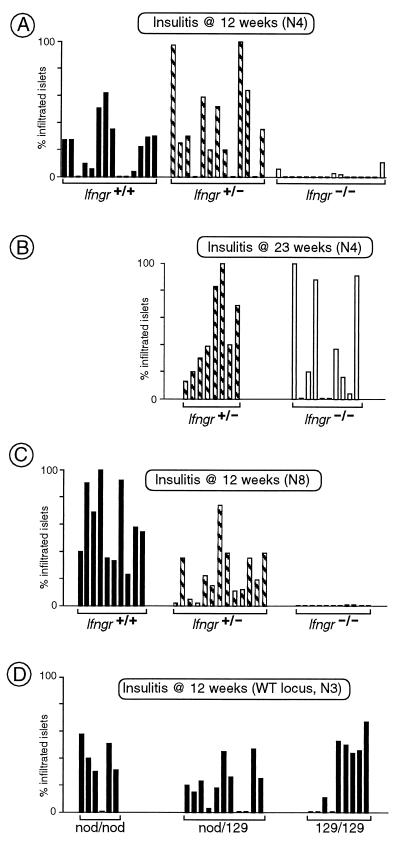
Figure 1
Figure 1
IFN-γRα is necessary for efficient autoimmune insulitis. (A) Insulitis in NOD mice (at the fourth generation of backcross), homozygous for the Ifngr-null mutation, and heterozygous or wild-type controls. Pancreata were examined histologically at 12 weeks of age, and insulitis was scored on several sections for each mouse. Each bar represents an individual mouse and shows the percentage of islets displaying infiltration. (B) As in A, except that the mice were 23 weeks of age. (C) As in A, except that the intercross was set up after eight generations of backcross. (D) After three generations’ backcross to NOD of the Ifngr locus from the 129 inbred strain, a large cohort of littermates was produced by intercrossing, and mice of the three resulting genotypes were tested for insulitis as in A.
Figure 2
Figure 2
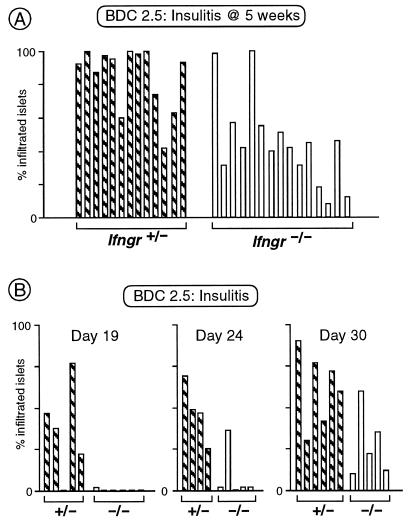
Absence of IFN-γRα delays insulitis in the context of the BDC2.5 transgene. (A) Insulitis scored as in Fig. 1 in littermates carrying the BDC2.5 TCR transgene, and heterozygous or homozygous for the Ifngr-null mutation (in 5-week-old mice, because insulitis progresses faster in the transgenic context). (B) The onset of insulitis was tested in littermates carrying the BDC2.5 TCR transgene, and heterozygous or homozygous for the Ifngr-null mutation, at three different ages.
Figure 3
Figure 3
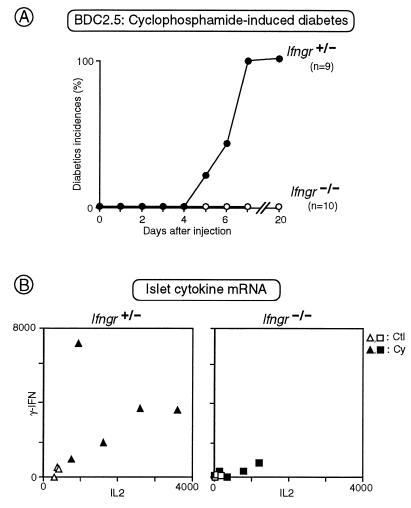
IFN-γRα is required for cyclophosphamide-induced diabetes in BDC2.5 transgenics. (A) Littermates carrying the BDC2.5 TCR transgene, and heterozygous or homozygous for the Ifngr-null mutation, were treated with a single injection of cyclophosphamide, and diabetes was monitored in the following days. The cumulative incidence of diabetes is plotted here. (B) The amount of IL-2 and IFN-γ mRNAs present in islets were evaluated by semiquantitative PCR either before (open symbols) or after (solid symbols) treatment with cyclophosphamide, in littermates carrying the BDC2.5 TCR transgene, and heterozygous (Left) or homozygous (Right) for the Ifngr-null mutation. Each point represents an individual mouse; units are on an arbitrary scale.
Figure 4
Figure 4
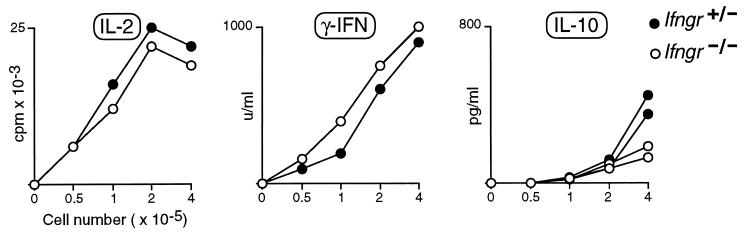
Comparable cytokine production by splenocytes from IFN-γRα-deficient and control animals. Splenocytes from littermates heterozygous or homozygous for the Ifngr-null mutation were stimulated in vitro with anti-CD3, and the cytokines released into the medium evaluated by ELISA (IFN-γ, IL-10) or bioassay (IL-2). These profiles are representative of four different experiments, with or without the BDC2.5 transgene.
Figure 5
Figure 5
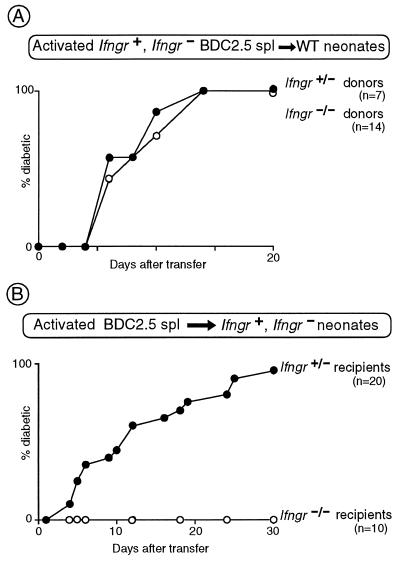
IFN-γRα is required on stromal cells, not on T cells. (A) Con A-activated splenocytes were prepared from littermates carrying the BDC2.5 TCR transgene, and heterozygous or homozygous for the Ifngr-null mutation, and transferred to NOD neonates. The recipients were monitored for diabetes, and the cumulative incidence of disease is plotted. (B) Splenocytes from 10-week-old BDC2.5 transgenic mice (wild type at the Ifngr locus) were activated with Con A in vitro and transferred to neonatal mice, heterozygous or homozygous for the Ifngr-null mutation, as indicated. The recipients were monitored for diabetes, and the cumulative incidence of disease is plotted.

References

    1. Tisch R, McDevitt H. Cell. 1996;85:291–297. - PubMed
    1. Bach J F. Endocr Rev. 1994;15:516–542. - PubMed
    1. Wicker L S, Todd J A, Peterson L B. Annu Rev Immunol. 1995;13:179–200. - PubMed
    1. André I, Gonzalez A, Katz J, Wang B, Benoist C, Mathis D. Proc Natl Acad Sci USA. 1996;93:2260–2263. - PMC - PubMed
    1. Serreze D V, Chapman H D, Varnum D S, Hanson M S, Reifsnyder P C, Richard S D, Fleming S A, Leiter E H, Shultz L D. J Exp Med. 1996;184:2049–2053. - PMC - PubMed

Publication types