. 1997 Dec 23;94(26):14559-63.
doi: 10.1073/pnas.94.26.14559.

Spatio-temporally controlled site-specific somatic mutagenesis in the mouse

Affiliations

Spatio-temporally controlled site-specific somatic mutagenesis in the mouse

J Brocard et al. Proc Natl Acad Sci U S A. .

Abstract

The efficient introduction of somatic mutations in a given gene, at a given time, in a specific cell type will facilitate studies of gene function and the generation of animal models for human diseases. We have shown previously that conditional recombination-excision between two loxP sites can be achieved in mice by using the Cre recombinase fused to a mutated ligand binding domain of the human estrogen receptor (Cre-ERT), which binds tamoxifen but not estrogens. DNA excision was induced in a number of tissues after administration of tamoxifen to transgenic mice expressing Cre-ERT under the control of the cytomegalovirus promoter. However, the efficiency of excision varied between tissues, and the highest level ( approximately 40%) was obtained in the skin. To determine the efficiency of excision mediated by Cre-ERT in a given cell type, we have now crossed Cre-ERT-expressing mice with reporter mice in which expression of Escherichia coli beta-galactosidase can be induced through Cre-mediated recombination. The efficiency and kinetics of this recombination were analyzed at the cellular level in the epidermis of 6- to 8-week-old double transgenic mice. We show that site-specific excision occurred within a few days of tamoxifen treatment in essentially all epidermis cells expressing Cre-ERT. These results indicate that cell-specific expression of Cre-ERT in transgenic mice can be used for efficient tamoxifen-dependent, Cre-mediated recombination at loci containing loxP sites to generate site-specific somatic mutations in a spatio-temporally controlled manner.


Figures
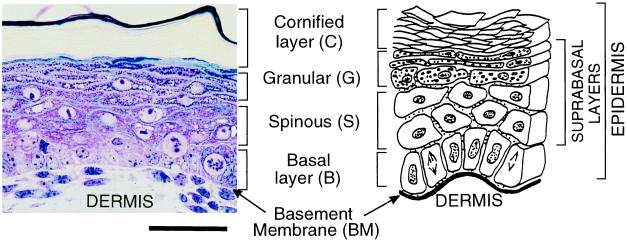
Figure 1
Figure 1
Epidermal stratification of mouse skin. Toluidine blue-stained, 2-μm, semi-thin section of newborn dorsal skin. A diagrammatic representation is given on the right side. Note that mitosis is restricted to the proliferative basal cells. (Bar = 25 μm.)
Figure 2
Figure 2
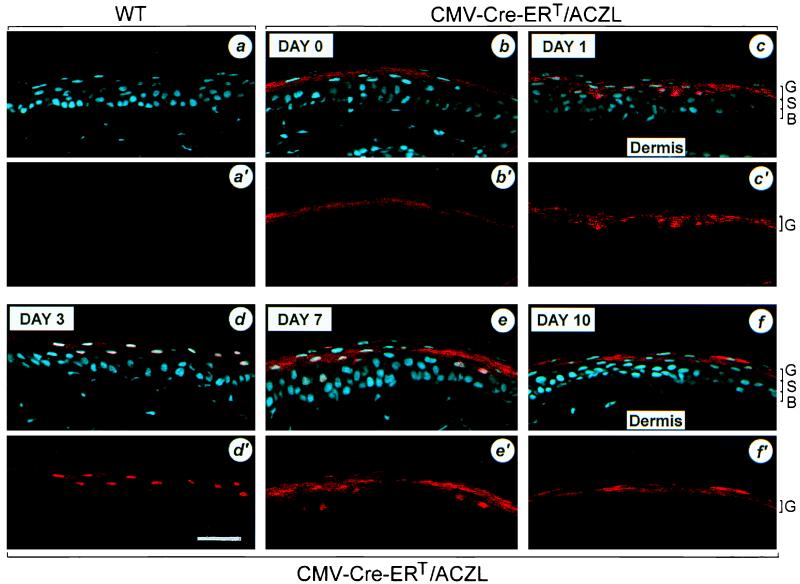
Pattern of Cre-ERT expression in the tail epidermis of double transgenic mice. Immunohistochemistry with anti-Cre antibody was performed on sections (10 μm-thick) of tail biopsies of 6- to 8-week-old wild-type (WT; a, a′) and CMV-Cre-ERT/ACZL double heterozygous transgenic mice (bf, b′–f′). Double transgenic mice were injected for 5 consecutive days (days 0–4) with tamoxifen (1 mg/day). Sections were stained with DAPI and anti-Cre antibody. DAY 0 (b, b′), before the first tamoxifen injection; DAY 1 (c, c′) and DAY 3 (d, d′), after 1 and 3 days of tamoxifen treatment, respectively; DAY 7 (e, e′) and DAY 10 (f, f′), 3 and 6 days after the last tamoxifen injection, respectively. The cyan color corresponds to the DAPI staining (af), and the red color corresponds to the staining of Cre-ERT (af, a′–f′). B, S, and G, basal, spinous, and granular layers, respectively (see Fig. 1). (Bar = 25 μm.)
Figure 3
Figure 3
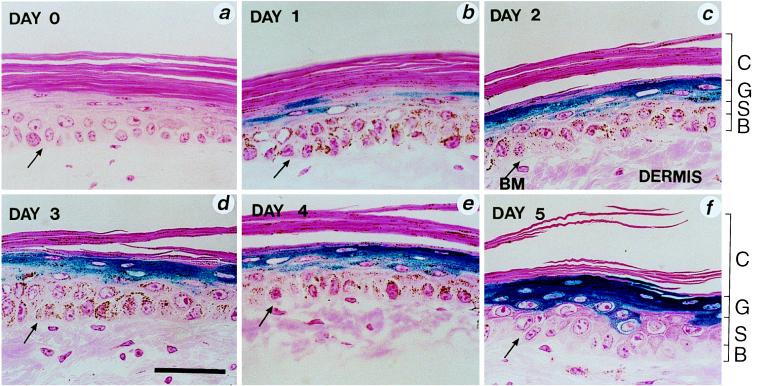
Kinetics of β-galactosidase expression in tail epidermis granular layer of CMV-Cre-ERT/ACZL double heterozygous mice. CMV-Cre-ERT/ACZL double heterozygous mice (6–8 weeks old) were injected daily with tamoxifen from day 0 to 4 (see legend to Fig. 2). Tail biopsies were collected just before the first tamoxifen injection (DAY 0, a) and at DAYS 1–5 (bf) and treated as described in Materials and Methods (2-μm, semi-thin sections). Arrows point to the basement membrane (BM). B, S, G, and C, basal, spinous, granular, and cornified layers, respectively (see Fig. 1). (Bar = 25 μm.)
Figure 4
Figure 4
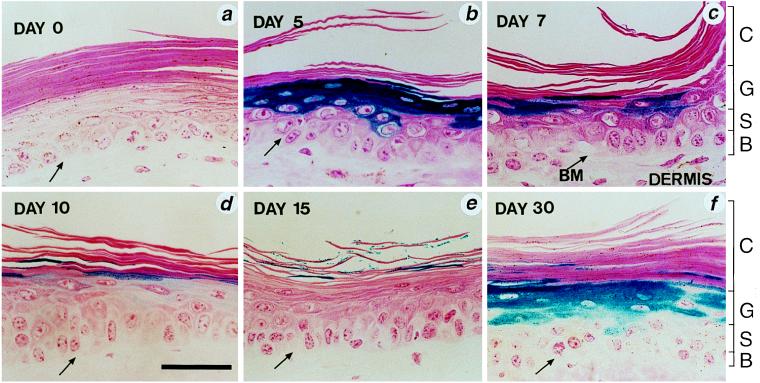
Vertical migration of granular layer-restricted β-galactosidase expression in tail epidermis of CMV-Cre-ERT/ACZL double heterozygous mice. Two series of daily tamoxifen injection, from day 0 to 4 and from day 25 to 29, were administered to 6- to 8-week-old CMV-Cre-ERT/ACZL double heterozygous mice. Tail biopsies were collected just before the first tamoxifen injection (DAY 0, a) and at different days after the first injection, as indicated (bf). BM arrows, B, S, G, and C are as defined in legend to Fig. 3. (Bar = 25 μm.)

References

    1. Capecchi M R. Trends Genet. 1989;5:70–76. - PubMed
    1. Jaenisch R. Science. 1988;240:1468–1474. - PubMed
    1. Rajewsky K, Gu H, Kühn R, Betz U A K, Müller W, Roes J, Schwenk F. J Clin Invest. 1996;98:600–603. - PMC - PubMed
    1. Olson E N, Arnold H H, Rigby P W J, Wold B J. Cell. 1996;85:1–4. - PubMed
    1. Sauer B, Henderson N. Nucleic Acids Res. 1989;17:147–161. - PMC - PubMed

Publication types

LinkOut - more resources