


The restriction-modification genes of Escherichia coli K-12 may not be selfish: they do not resist loss and are readily replaced by alleles conferring different specificities
- PMID: 9405658
- PMCID: PMC25066
- DOI: 10.1073/pnas.94.26.14596
The restriction-modification genes of Escherichia coli K-12 may not be selfish: they do not resist loss and are readily replaced by alleles conferring different specificities
Abstract
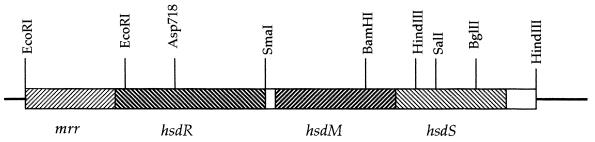
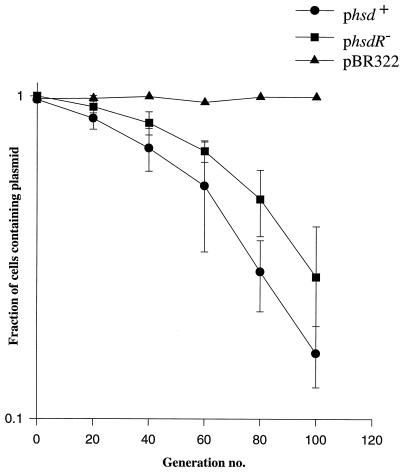
Type II restriction and modification (R-M) genes have been described as selfish because they have been shown to impose selection for the maintenance of the plasmid that encodes them. In our experiments, the type I R-M system EcoKI does not behave in the same way. The genes specifying EcoKI are, however, normally residents of the chromosome and therefore our analyses were extended to monitor the deletion of chromosomal genes rather than loss of plasmid vector. If EcoKI were to behave in the same way as the plasmid-encoded type II R-M systems, the loss of the relevant chromosomal genes by mutation or recombination should lead to cell death because the cell would become deficient in modification enzyme and the bacterial chromosome would be vulnerable to the restriction endonuclease. Our data contradict this prediction; they reveal that functional type I R-M genes in the chromosome are readily replaced by mutant alleles and by alleles encoding a type I R-M system of different specificity. The acquisition of allelic genes conferring a new sequence specificity, but not the loss of the resident genes, is dependent on the product of an unlinked gene, one predicted [Prakash-Cheng, A., Chung, S. S. & Ryu, J. (1993) Mol. Gen. Genet. 241, 491-496] to be relevant to control of expression of the genes that encode EcoKI. Our evidence suggests that not all R-M systems are evolving as "selfish" units; rather, the diversity and distribution of the family of type I enzymes we have investigated require an alternative selective pressure.
Figures
References
-
- Barcus V A, Murray N E. In: Population Genetics of Bacteria. Baumberg S, Young J P W, Saunders S R, Wellington E M H, editors. Cambridge, U.K.: Cambridge Univ. Press; 1995. pp. 31–58.
-
- Redaschi N, Bickle T A. In: Escherichia coli and Salmonella typhimurium: Cellular and Molecular Biology. 2nd Ed. Neidhardt F C, Curtiss R, Ingrahm J L, Lin E C C, Low K B, Magasanik B, Reznikoff W S, Riley M, Schaechter M, Umbarger H E, editors. Washington, D.C.: Am. Soc. Microbiol.; 1996. pp. 773–781.
-
- Naito T, Kusano K, Kobayashi I. Science. 1995;267:897–898. - PubMed
-
- Yarmolinsky M B. Science. 1995;267:836–837. - PubMed
Publication types
MeSH terms
Substances
LinkOut - more resources
Full Text Sources
Molecular Biology Databases
