. 1997 Dec 23;94(26):14837-42.
doi: 10.1073/pnas.94.26.14837.

A genetic screen for mutations that disrupt an auditory response in Drosophila melanogaster

Affiliations

A genetic screen for mutations that disrupt an auditory response in Drosophila melanogaster

D F Eberl et al. Proc Natl Acad Sci U S A. .

Abstract

Hearing is one of the last sensory modalities to be subjected to genetic analysis in Drosophila melanogaster. We describe a behavioral assay for auditory function involving courtship among groups of males triggered by the pulse component of the courtship song. In a mutagenesis screen for mutations that disrupt the auditory response, we have recovered 15 mutations that either reduce or abolish this response. Mutant audiograms indicate that seven mutants reduced the amplitude of the response at all intensities. Another seven abolished the response altogether. The other mutant, 5L3, responded only at high sound intensities, indicating that the threshold was shifted in this mutant. Six mutants were characterized in greater detail. 5L3 had a general courtship defect; courtship of females by 5L3 males also was affected strongly. 5P1 males courted females normally but had reduced success at copulation. 5P1 and 5N18 showed a significant decrement in olfactory response, indicating that the defects in these mutations are not specific to the auditory pathway. Two other mutants, 5M8 and 5N30, produced amotile sperm although in 5N30 this phenotype was genetically separable from the auditory phenotype. Finally, a new adult circling behavior phenotype, the pirouette phenotype, associated with massive neurodegeneration in the brain, was discovered in two mutants, 5G10 and 5N18. This study provides the basis for a genetic and molecular dissection of auditory mechanosensation and auditory behavior.


Figures
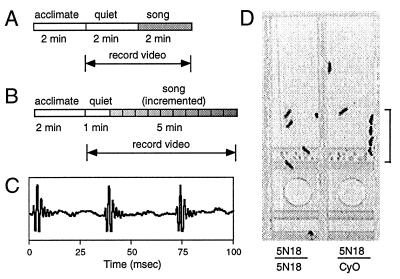
Figure 1
Figure 1
Auditory behavior assay. The pulse song triggers groups of males to court one another (13). Groups of six males were tested for this auditory response in Plexiglas chambers with nylon mesh at the ends to allow acoustic stimulation from the speaker, and the behavior was videotaped. (A and B) Acoustic stimulation protocols for the single intensity test (A) and for the audiogram, or incremented intensity, test (B). (C) Trace of computer-synthesized pulse song as recorded from the speaker at playback. (D) A video frame of 5N18 mutant homozygotes (left) and heterozygous controls (right) during presentation of song. The chain of courting males (bracket) was scored as 4 in the audiogram.
Figure 2
Figure 2
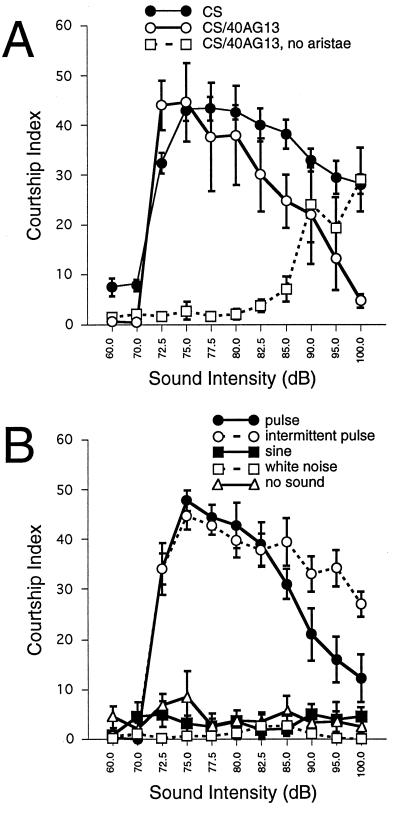
Wild-type audiograms. (A) Computer-generated continuous pulse song was played back at 30-s increments of sound intensity. The background noise level in the room was ≈60 dB. Sound intensity doubles approximately every 3 dB. Courtship was quantified with a maximum courtship index of 60 if all males were courting in every 3-s interval. Males were from the Canton-S wild-type strain or hybrids between Canton-S and the 40A-G13 strain used for mutagenesis. Means ± SEM for three runs are plotted. (B) Male courtship is triggered only by the pulse song, whether presented as a continuous train of pulses or as 2-s bursts of pulse song alternating with 3 s of silence. Neither sine song nor uniform white noise elicited courtship. Means ± SEM for four runs are plotted.
Figure 3
Figure 3
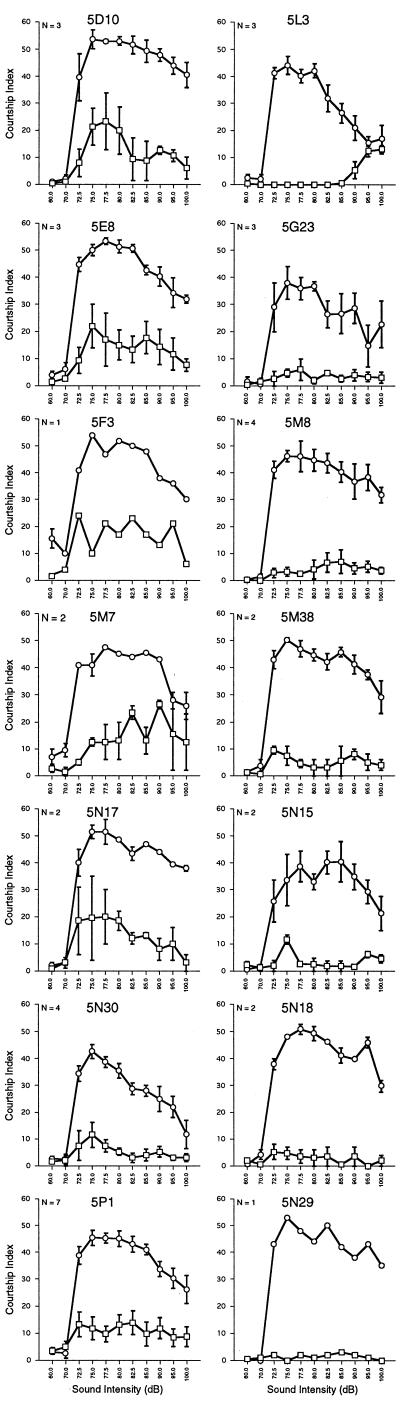
Audiograms of 14 mutants. For each mutation, audiograms are shown for the mutant homozygotes (squares) and their balancer heterozygote controls (circles). Means ± SEM for N runs are plotted. For other details, see legend of Fig. 2. The audiogram for pir (5G10) was not determined.
Figure 4
Figure 4
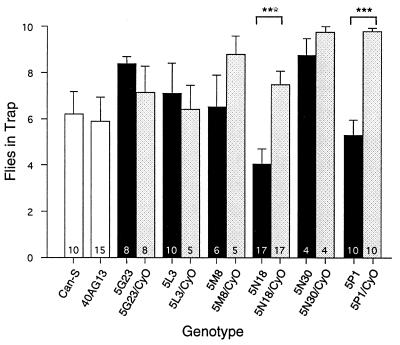
Olfactory behavior test. Olfactory traps were constructed as described (25) by using standard Drosophila medium as the attractant. Ten males of the indicated genotype were placed with each trap, and the numbers that entered the trap in 60 h were plotted. White bars, wild-type strains; black bars, homozygous mutants; shaded bars, balancer heterozygous controls. The number at the base of each bar indicates the number of traps tested. There were no significant differences except that the olfactory responses of 5N18 and 5P1 homozygotes were reduced significantly (∗∗∗, P < 0.001).
Figure 6
Figure 6
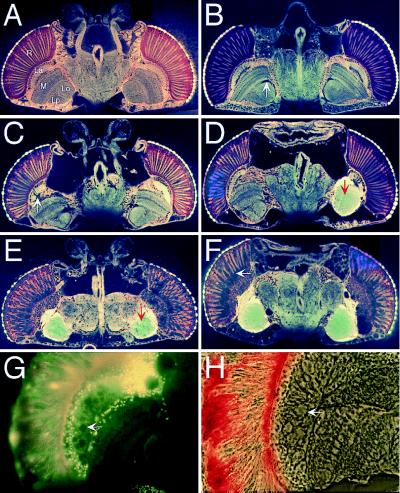
Brain morphology of circling mutants. Horizontal plastic-embedded (Spurr’s medium) heads were sectioned at 5–8 μm and photographed by using autofluorescence. (A) Wild-type head. Optic lobes: R, retina; La, lamina; M, medulla; Lo, lobula; Lp, lobula plate. (B) pir homozygote (18 days old) with no behavioral defect and very slight morphological defect (arrow). (C and D) pir homozygotes (1 day old) that showed the about-face behavior shown in Fig. 5B. Degeneration of the brain was often asymmetrical. Defects were particularly apparent in the optic lobes, such as the lamina (arrow in C). In D, the optic lobes have coalesced into a common sack of amorphous tissue (arrow). (E and F) pir homozygotes (4 days old) that exhibited the severe spinning behavior shown in Fig. 5D. Degeneration was much more severe, again with coalesced optic lobes (arrow in E), and cohesion between subregions of the brain was reduced. All neural connections from the retina to the optic lobes of the brain have been lost, the basement membrane has dissociated from the retina, and photoreceptors have dissociated from one another (arrow in F). (A, C, and E) Sections at the level of the antennal nerve. (D and F) More dorsal sections. (G and H) Section of a 6-week-old 5N18 homozygote that walked in small circles; G shows autofluorescence view, and H shows phase–contrast view. Vacuole-like holes are seen in the lamina (arrows) and other optic lobes, and the integrity of the retina is reduced.
Figure 5
Figure 5
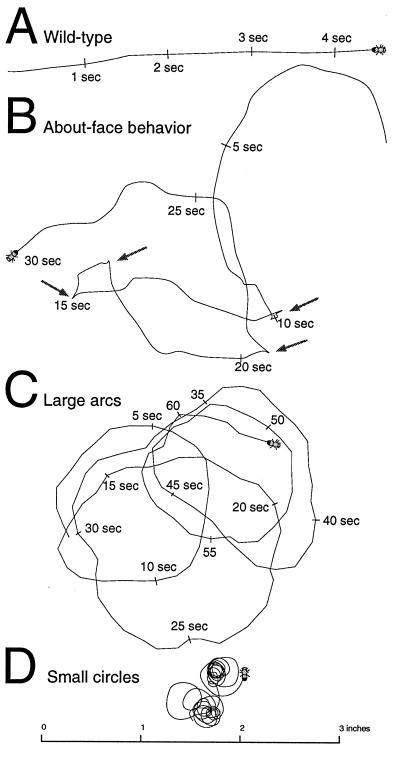
Pirouette adult circling behavior. Walking paths of flies on gridded paper were traced from videotapes. Wild-type flies walked in straight lines (A). (B) The earliest unusual behavior detected in pir5G10 homozygotes was wandering with occasional “about-faces,” 180° turns. With age, pir flies progressed through stages of walking in large arcs or circles usually at 2–5 days old (C) and then smaller and smaller circles at 3–10 days old (D). In A-C, the positions of the flies at regular time points are indicated. The path in D represents 20 revolutions in 1 min. In the final day before death, they no longer walked, and their legs were often seen trembling.

References

    1. García-Añoveros J, Corey D P. Annu Rev Neurosci. 1997;20:567–594. - PubMed
    1. Kernan M, Cowan D, Zuker C. Neuron. 1994;12:1195–1206. - PubMed
    1. Gillespie P G. Curr Opin Neurobiol. 1995;5:449–455. - PubMed
    1. Steel K P, Brown S D M. Curr Opin Neurobiol. 1996;6:520–525. - PubMed
    1. Hall J C. Science. 1994;264:1702–1714. - PubMed

Publication types

LinkOut - more resources