. 1997 Dec 23;94(26):14948-53.
doi: 10.1073/pnas.94.26.14948.

Leaf-specifically expressed genes for polypeptides destined for chloroplasts with domains of sigma70 factors of bacterial RNA polymerases in Arabidopsis thaliana

Affiliations

Leaf-specifically expressed genes for polypeptides destined for chloroplasts with domains of sigma70 factors of bacterial RNA polymerases in Arabidopsis thaliana

K Isono et al. Proc Natl Acad Sci U S A. .

Abstract

Genes for sigma-like factors of bacterial-type RNA polymerase have not been characterized from any multicellular eukaryotes, although they probably play a crucial role in the expression of plastid photosynthesis genes. We have cloned three distinct cDNAs, designated SIG1, SIG2, and SIG3, for polypeptides possessing amino acid sequences for domains conserved in sigma70 factors of bacterial RNA polymerases from the higher plant Arabidopsis thaliana. Each gene is present as one copy per haploid genome without any additional sequences hybridized in the genome. Transient expression assays using green fluorescent protein demonstrated that N-terminal regions of the SIG2 and SIG3 ORFs could function as transit peptides for import into chloroplasts. Transcripts for all three SIG genes were detected in leaves but not in roots, and were induced in leaves of dark-adapted plants in rapid response to light illumination. Together with results of our previous analysis of tissue-specific regulation of transcription of plastid photosynthesis genes, these results indicate that expressed levels of the genes may influence transcription by regulating RNA polymerase activity in a green tissue-specific manner.


Figures
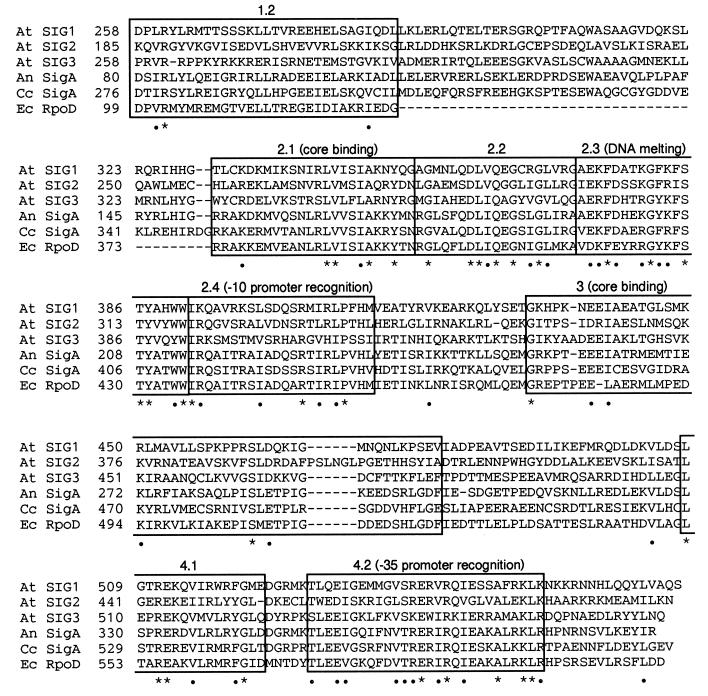
Figure 1
Figure 1
Alignment of conserved domains in the deduced amino acid sequences of A. thaliana SIG1 (At SIG1), SIG2 (At SIG2), and SIG3 (At SIG3) with those of SigA from Anabaena sp. PCC 7120 (An SigA), SigA from C. caldarium (Cc SigA), and σ70 factor encoded in rpoD from E. coli (Ec RpoD). Regions 1–4 in bacterial σ factors (5, 26) are boxed. Residues marked with an asterisk (∗) or a dot (•) are identical or similar, respectively, in all six sequences. The numbers between the product designations and the amino acid sequences are those of amino acid residues. There are 246 amino acids in a gap between subregion 1.2 and subregion 2.1 in E. coli RpoD.
Figure 2
Figure 2
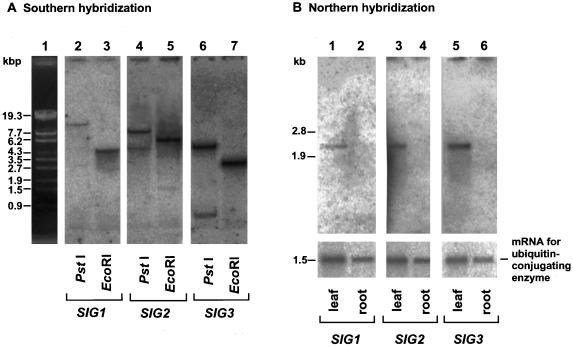
Southern and Northern blot analyses of SIG genes. (A) Southern hybridization with SIG gene probes of total cellular DNA (8 μg per lane) digested with PstI (lanes 2, 4, and 6) and EcoRI (lanes 3, 5, and 7). DNA in lanes 2 and 3, lanes 4 and 5, and lanes 6 and 7, was hybridized with 1.7-kb EcoRI fragment from SIG1 cDNA, 1.6-kb XbaI fragment from SIG2 cDNA, or 1.2-kb XhoI fragment from SIG3 cDNA, respectively. (B) Northern hybridization with SIG probes of total poly(A)+ RNA (0.5–1.0 μg per lane) from leaves (lanes 1, 3, and 5) and roots (lanes 2, 4, and 6). The cDNA for ubiquitin-conjugating enzyme, which is constitutively expressed (M.S., Y.N., and H.K., unpublished results), was used as a probe as an internal control for equivalence of amounts of RNA loaded into lanes. Each of the SIG genes gives rise to ≈2.3-kb mRNA.
Figure 3
Figure 3
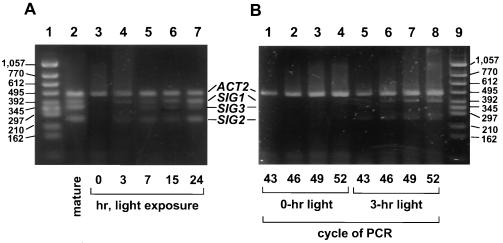
Time-sequential changes of transcripts for SIG genes in dark-adapted plants after exposure to light. (A) A. thaliana grown for 3 weeks was incubated in the dark for 3 days or maintained under the same light conditions for plants indicated as “mature.” Leaves of individual dark-adapted plants were harvested at 0, 3, 7, 15, and 24 hr after initiation of the exposure to light at 3,000 lux. RT-PCR products were subjected to electrophoresis after PCR cycles when intensities of signals for ACT2 were unsaturated and comparable among RNA fractions harvested at different illumination times. RT-PCR products (5 μl from 50 μl of reaction mixture) were electrophoresed in 3% agarose gel (Agarose H, NipponGene), stained with SYBR green I (FMC BioProducts), and observed by FluorImager SI (Molecular Dynamics). (B) RT-PCR products of 0- and 3-hr illumination after indicated PCR cycles were electrophoresed and stained with SYBR green I.
Figure 4
Figure 4
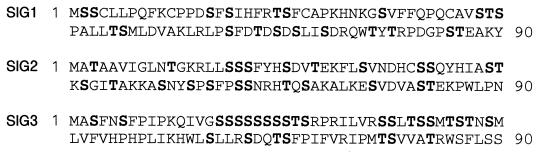
N-terminal sequences of SIG1, SIG2, and SIG3. The first 90 amino acids in the ORFs of SIG1 (SIG1), SIG2 (SIG2), and SIG3 (SIG3) cDNAs are represented. Ser and Thr residues are indicated in boldface.
Figure 5
Figure 5
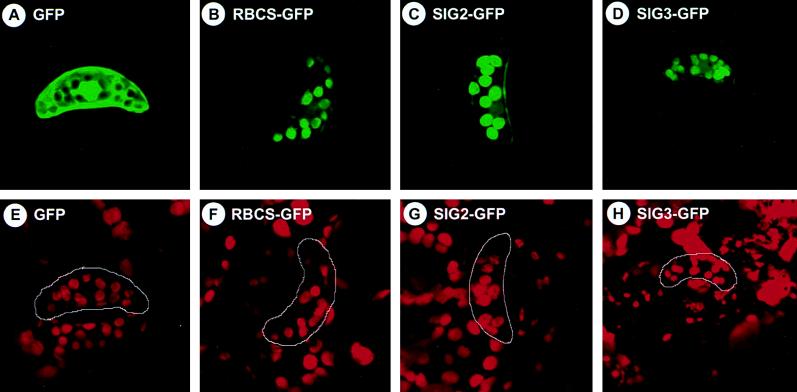
Localization of GFPs fused to N-terminal regions of SIG2 and SIG3. GFP fusion constructs with the N-terminal regions of SIG2 ORF (SIG2-GFP, C and G) and SIG3 ORF (SIG3-GFP, D and H), and the transit peptide of the small subunit of Rubisco (23) (RBCS-GFP, B and F), as well as GFP alone (23) (GFP, A and E), were introduced into tobacco leaves by particle bombardment. Guard cells were observed by using the MRC-1024 Confocal Imaging System (480×) with excitation at 488 nm and emission at 520 nm (A–D), as well as excitation at 647 nm and emission at 666 nm (E–H). The same objects are shown in each pair of upper and lower panels.

References

    1. Allison L A, Simon L D, Maliga P. EMBO J. 1996;15:2802–2809. - PMC - PubMed
    1. Kung S D, Lin C M. Nucleic Acids Res. 1985;13:7543–7549. - PMC - PubMed
    1. Igloi G L, Kel H. Crit Rev Plant Sci. 1992;10:525–558.
    1. Burgess R, Travers A, Dunn J, Bautz E. Nature (London) 1969;221:43–46. - PubMed
    1. Helmann J D, Chamberlin M J. Annu Rev Biochem. 1988;57:839–872. - PubMed

Publication types

Associated data