


Sphingoid base 1-phosphate phosphatase: a key regulator of sphingolipid metabolism and stress response
- PMID: 9419344
- PMCID: PMC18156
- DOI: 10.1073/pnas.95.1.150
Sphingoid base 1-phosphate phosphatase: a key regulator of sphingolipid metabolism and stress response
Abstract
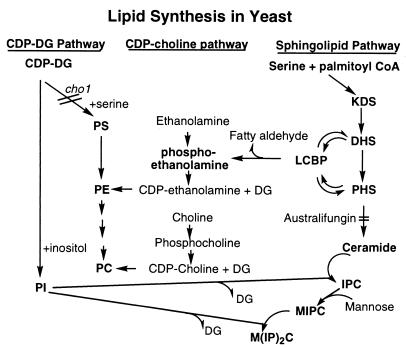
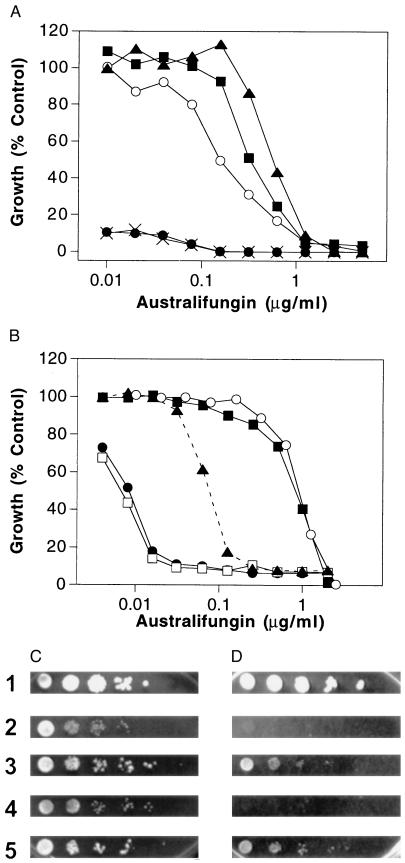
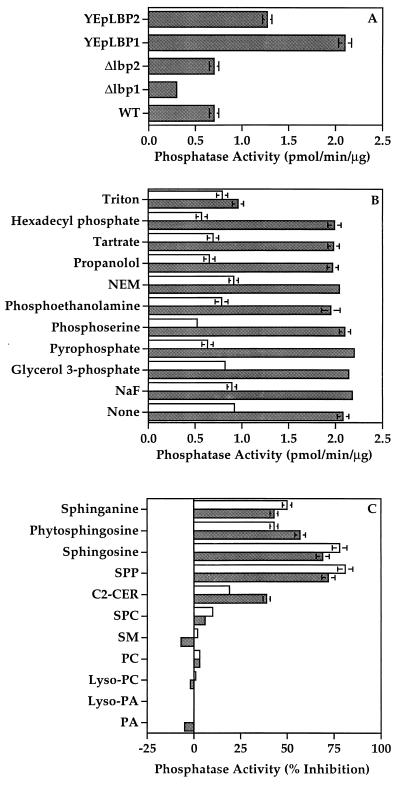
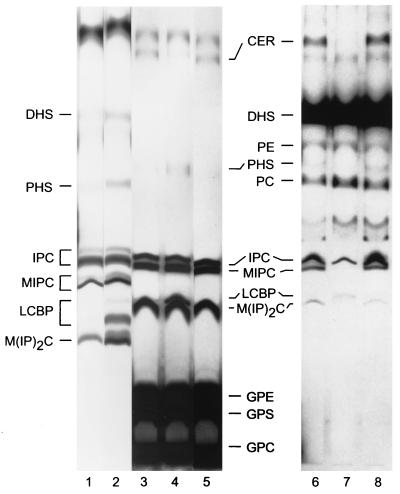
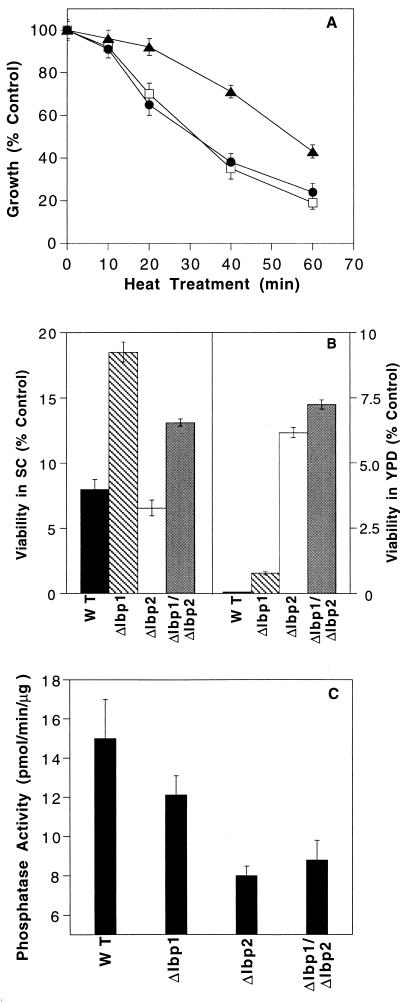
The sphingolipid metabolites ceramide and sphingosine-1-phosphate are second messengers with opposing roles in mammalian cell growth arrest and survival; their relative cellular level has been proposed to be a rheostat that determines the fate of cells. This report demonstrates that this rheostat is an evolutionarily conserved stress-regulatory mechanism that influences growth and survival of yeast. Although the role of sphingosine-1-phosphate in yeast was not previously examined, accumulation of ceramide has been shown to induce G1 arrest and cell death. We now have identified a gene in Saccharomyces cerevisiae, LBP1, that regulates the levels of phosphorylated sphingoid bases and ceramide. LBP1 was cloned from a yeast mutant that accumulated phosphorylated long-chain sphingoid bases and diverted sphingoid base intermediates from sphingolipid pathways to glycerophospholipid biosynthesis. LBP1 and its homolog, LBP2, encode very hydrophobic proteins that contain a novel-conserved sequence motif for lipid phosphatases, and both have long-chain sphingoid base phosphate phosphatase activity. In vitro characterization of Lbp1p shows that this phosphatase is Mg2+-independent with high specificity for phosphorylated long-chain bases, phytosphingosine and sphingosine. The deletion of LBP1 results in the accumulation of phosphorylated long-chain sphingoid bases and reduced ceramide levels. Moreover, deletion of LBP1 and LBP2 results in dramatically enhanced survival upon severe heat shock. Thus, these phosphatases play a previously unappreciated role in regulating ceramide and phosphorylated sphingoid base levels in yeast, and they modulate stress responses through sphingolipid metabolites in a manner that is reminiscent of their effects on mammalian cells.
Figures
References
-
- Hannun Y A. Science. 1996;274:1855–1859. - PubMed
-
- Verheij M, Bose R, Lin S H, Yao B, Jarvis W D, Grant S, Birrer M J, Szabo E, Zon L I, Kyriakis J M, Haimovitz-Friedman A, Fuks Z, Kolesnick R. Nature (London) 1996;380:75–79. - PubMed
-
- Santana P, Pena L A, Haimovitz-Friedman A, Martin S, Green D, McLoughlin M, Cordon-Cardo C, Schuchman E H, Fuks Z, Kolesnick R. Cell. 1996;86:189–199. - PubMed
-
- Adam-Klages S, Adam D, Wiegmann K, Struve S, Kolanus W, Schneider-Mergener J, Kronke M. Cell. 1996;86:937–947. - PubMed
-
- Merrill A H, Jr, Schmelz E-M, Dillehay D L, Spiegel S, Shayman J A, Schroeder J J, Riley R T, Wang E. Toxicol Appl Pharmacol. 1997;142:208–225. - PubMed
Publication types
MeSH terms
Substances
Associated data
- Actions
- Actions
Grants and funding
LinkOut - more resources
Full Text Sources
Other Literature Sources
Molecular Biology Databases
