


doi: 10.1128/JVI.72.1.882-885.1998.
Clearance of an influenza A virus by CD4+ T cells is inefficient in the absence of B cells
Affiliations
- PMID: 9420305
- PMCID: PMC109454
- DOI: 10.1128/JVI.72.1.882-885.1998
Item in Clipboard
Clearance of an influenza A virus by CD4+ T cells is inefficient in the absence of B cells
J Virol.
1998 Jan.
Abstract
The primary CD8+ T-cell response protected most B-cell-deficient muMT mice against intranasal infection with the HKx31 influenza A virus. Prior exposure did not prevent reinfection upon homologous challenge, and the recall CD8+ T-cell response cleared the virus from the lung within 7 days. Depleting the CD8+ T cells substantially reduced the capacity of these primed mice to deal with the infection, in spite of evidence for established CD4+ T-cell memory. Thus, the control of this relatively mild influenza virus by both primary and secondary CD4+ T-cell responses is relatively inefficient in the absence of B cells and CD8+ T cells.
Figures
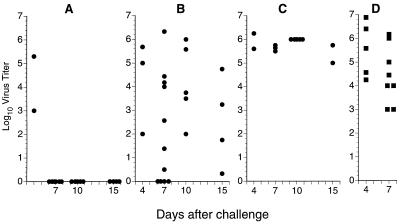
Virus clearance profiles following secondary i.n. challenge with 240 HAU of the HKx31 influenza A virus. The μMT mice were all infected i.n. with the HKx31 virus at 6 weeks of age and then challenged i.n. by the same regimen 60, 180, or 270 days later (see Table 2, experiments 2 to 4). There was no obvious difference between the efficacy of priming for the three groups. The lungs were removed after a further 4 or 7 days and homogenized, and virus titers were determined as log10 50% egg infective doses following endpoint titration in the allantoic cavity of embryonated hen’s eggs (23). The panels present the virus titration results for rat Ig-treated μMT mice (A), CD8-depleted μMT mice (B), and CD4 and CD8 doubly depleted μMT mice (C). As a positive control for virus infection, previously uninfected B6 mice were depleted of both CD4+ and CD8+ T cells (D). Each symbol represents one animal. Two of the four doubly depleted, primed μMT mice depicted in panel C that were to have been assayed at day 15 after infection died before they could be sampled.
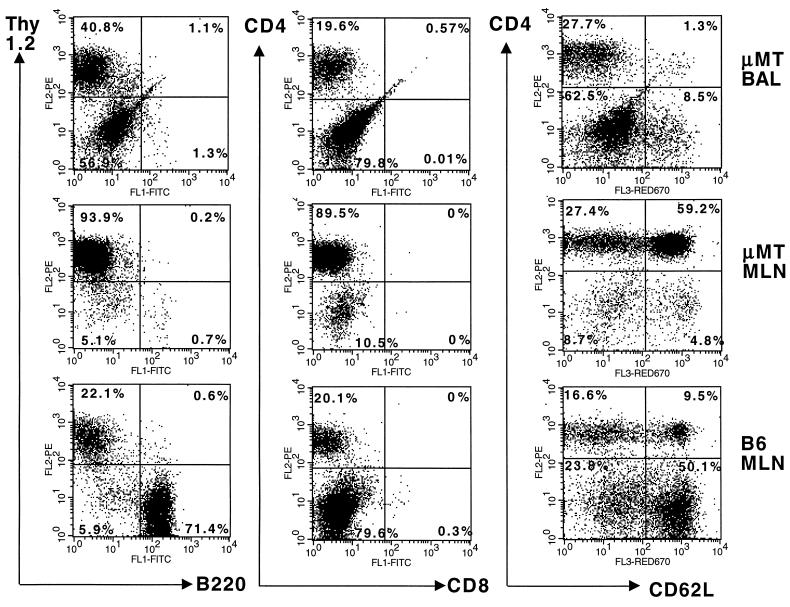
Flow cytometric analysis of CD8+ T-cell-depleted μMT and B6 mice at 7 days after i.n. challenge with the HKx31 influenza A virus. Mice that had recovered from an identical influenza virus infection 2 months previously were treated with the MAb 2.43 against CD8, given at 2- to 3-day intervals commencing 3 days prior to infection. Pooled BAL samples and single-cell MLN suspensions were obtained from three mice and stained with conjugated MAbs against Thy1.2 (PE–53-2.1) and B220 (FITC–RA3-6B2), CD4 (PE–RM-4-5) and CD8 (FITC–53-6.72), or CD4 and CD62L (biotin–MEL-14 and then streptavidin red 670) prior to two-color flow cytometric analysis in a FACScan. The percentages of stained lymphocytes in the respective quadrants are given. Estimates of virus-specific CD4+ T-cell numbers in the MLN samples from these mice are presented in Table 2 (experiment 4).
References
-
- Allan W, Tabi Z, Cleary A, Doherty P C. Cellular events in the lymph node and lung of mice with influenza. Consequences of depleting CD4+ T cells. J Immunol. 1990;144:3980–3986. - PubMed
-
- Askonas B A, Taylor P M, Esquivel F. Cytotoxic T cells in influenza infection. Ann N Y Acad Sci. 1988;532:230–237. - PubMed
Publication types
MeSH terms
Grants and funding
LinkOut - more resources
Full Text Sources
Research Materials
