. 1998 Jan;36(1):77-80.
doi: 10.1128/JCM.36.1.77-80.1998.

Clinical evaluation of a new PCR assay for detection of Coxiella burnetii in human serum samples

Affiliations

Clinical evaluation of a new PCR assay for detection of Coxiella burnetii in human serum samples

G Q Zhang et al. J Clin Microbiol. 1998 Jan.

Abstract

A nested PCR method was developed for the detection of Coxiella burnetii in human serum samples. Two pairs of oligonucleotide primers were designed to amplify a 438-bp fragment of the com1 gene encoding a 27-kDa outer membrane protein of C. burnetii. The primers amplified the predicted fragments of 21 various strains of C. burnetii but did not react with DNA samples from other microorganisms. The 438-bp amplification products could be digested with restriction enzymes SspI and SalI. The utility of the nested PCR was evaluated by testing human serum samples. The com1 gene fragment was amplified from 135 (87%) of 155 indirect immunofluorescence test (IF)-positive serum samples and from 11 (11%) of 100 IF-negative serum samples. The nested PCR with primers targeted to the com1 gene appeared to be a sensitive, specific, and useful method for the detection of C. burnetii in serum samples.


Figures
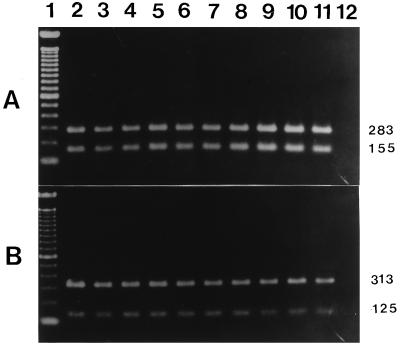
FIG. 1
FIG. 1
Analysis of the restriction endonuclease profile of the 438-bp amplification products of 10 reference strains of C. burnetii. (A) The amplification products were digested with SspI, electrophoresed on agarose gels, and stained with ethidium bromide. Lane 1, molecular size markers (100-bp DNA ladder); lanes 2 to 8, seven reference strains (Nine Mile VR 615, Priscilla, MAN, ME, GQ212, SQ217, and KoQ229, respectively), lanes 9 to 11, three Japanese isolates (307, 605, and TK-1, respectively); lane 12, negative control. (B) The amplification products were digested with SalI. The samples in lanes 2 to 12 are the same as those in panel A. The numbers on the right are in base pairs.
FIG. 2
FIG. 2
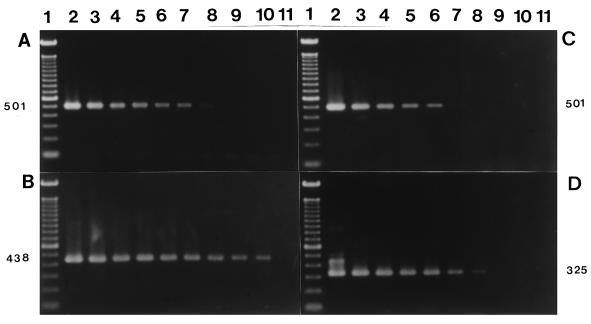
Sensitivity of the nested PCR with serial 10-fold dilutions of total DNA (from 500 ng to 0.5 fg) extracted from the Nine Mile VR 615 strain of C. burnetii. (A and B) Gel electrophoresis of first-round and second-round (B) PCR products amplified with primers OMP1-OMP2 and OMP3-OMP4. Lane 1, molecular size markers (100-bp DNA ladder); lanes 2 to 11, PCR products with serial 10-fold dilutions of total C. burnetii DNA (from 500 ng to 0.5 fg). (C and D) Gel electrophoresis of first-round (C) and second-round (D) PCR products amplified by primers Q3-Q5 and Q4-Q6. Lane 1, molecular size markers (100-bp DNA ladder); the DNA samples in lanes 2 to 11 are the same as those in panel A. The numbers on the sides are in base pairs.
FIG. 3
FIG. 3
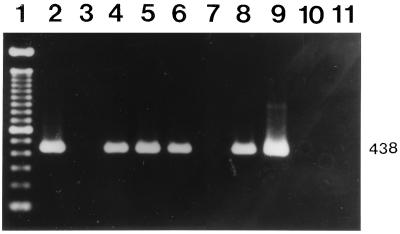
Detection of C. burnetii DNA in human sera by nested PCR with primers OMP1-OMP2 and OMP3-OMP4. An agarose gel electrophoretogram of amplified DNA after the nested PCR and ethidium bromide staining is shown. Lane 1, molecular size markers (100-bp DNA ladder); lanes 2 to 8, human serum samples (the serum samples in lanes 2, 4, 5, 6, and 8 were positive; the remaining samples were negative); lane 9, positive control (5 pg of purified C. burnetii DNA); lane 10, negative control serum; lane 11, reagent-negative control. The number on the right is in base pairs.

References

    1. Baca O G, Paretsky D. Q fever and Coxiella burnetii: a model for host-parasite interactions. Microbiol Rev. 1983;47:127–149. - PMC - PubMed
    1. Derrick E H. The course of infection with Coxiella burnetii. Med J Aust. 1973;1:1051–1057. - PubMed
    1. Dupuis G, Peter O, Peacock M, Burgdorfer W, Haller E. Immunoglobulin responses in acute Q fever. J Clin Microbiol. 1985;22:484–487. - PMC - PubMed
    1. Dupuis G, Peter O, Pedroni D, Petite J. Clinical aspects observed during an epidemic of 415 cases of Q fever. Schweiz Med Wochenschr J Suisse Med. 1985;115:814–818. - PubMed
    1. Field P R, Hunt J G, Murphy A M. Detection and persistence of specific IgM antibody to Coxiella burnetii by enzyme-linked immunosorbent assay: a comparison with immunofluorescence and complement fixation tests. J Infect Dis. 1983;148:477–487. - PubMed

Publication types

MeSH terms

LinkOut - more resources