


Antitoxin-in-membrane and antitoxin-in-well assays for detection of toxigenic Corynebacterium diphtheriae
- PMID: 9431948
- PMCID: PMC124835
- DOI: 10.1128/JCM.36.1.207-210.1998
Antitoxin-in-membrane and antitoxin-in-well assays for detection of toxigenic Corynebacterium diphtheriae
Abstract
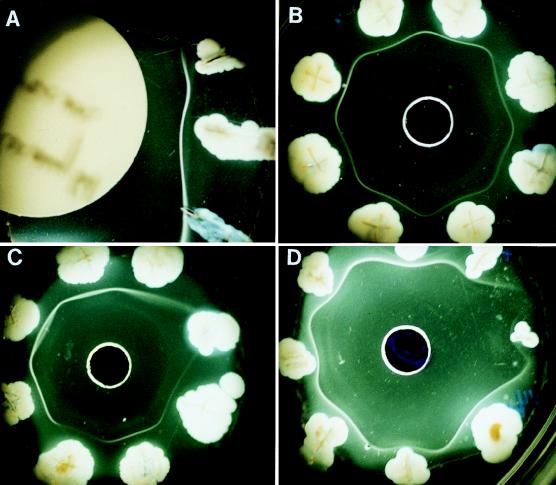
The Elek culture plate precipitin test is routinely used for the detection of exotoxin from toxigenic strains of Corynebacterium diphtheriae. Recently, the World Health Organization standardized this test to ensure accuracy, reliability, and reproducibility. In this study, we further modified the standard Elek test by using the antitoxin-in-membrane (AIM) and antitoxin-in-well (AIW) approaches. In the AIM tests, each strain was stabbed and streaked backwards and away from a point approximately 7 mm from the edge of a sterile cellulose acetate-cellulose nitrate filter membrane disk (pore size, 0.45 microm; diameter, 25 mm) containing 25 IU of diphtheria antitoxin. For AIW tests, a central well (diameter, 5 mm) containing 9 microl of antitoxin (4.5 IU) was surrounded by eight equidistant stab-streaks of each strain placed 10 mm from the well. In both methods, precipitin bands of identity typically were noted after 24- and 48-h incubations at 37 degrees C. Both toxigenic and weak toxigenic strains gave clear and reproducible results. Compared with the standard Elek test, the AIM and AIW tests each use 50% less medium and 75 and 87% less antitoxin, respectively. AIM has the potential to test up to 14 isolates and AIW has the potential to test up to 24 isolates on the same plate. Furthermore, clearer positives were noted with weak toxigenic strains. In a blinded test of 209 verified C. diphtheriae isolates, a 99.5% agreement with the standard Elek test was obtained overall. Both modifications conserve reagents and medium, permit the simultaneous testing of a larger number of strains, and may be particularly suitable for reference laboratories or hospitals involved in diphtheria epidemic settings.
Figures
References
-
- Centers for Disease Control and Prevention. Diphtheria epidemic—New Independent States of the Former Soviet Union, 1990–1994. Morbid Mortal Weekly Rep. 1995;44:177–181. - PubMed
-
- Efstratiou A, Maple P A C. WHO manual for the laboratory diagnosis of diphtheria. Reference no. ICP-EPI 038(C). Geneva, Switzerland: World Health Organization; 1994.
-
- Galazka A M, Robertson S E, Oblapenko G P. Resurgence of diphtheria. Eur J Epidemiol. 1995;11:1–11. - PubMed
Publication types
MeSH terms
Substances
LinkOut - more resources
Full Text Sources
